
All three of the topics of this Blog: Wine, Travel, and Food, are highly subjective. Something I rave about may be something where you had a bad experience or simply don’t like it. This blog is about Salmon and I have some strong opinions about this fish which will rapidly become apparent. Upfront I will state that the conclusions stated below are IMHO and you are very welcome to disagree and adding comments where you disagree might be of interest to others reading this blog.
Salmon Background
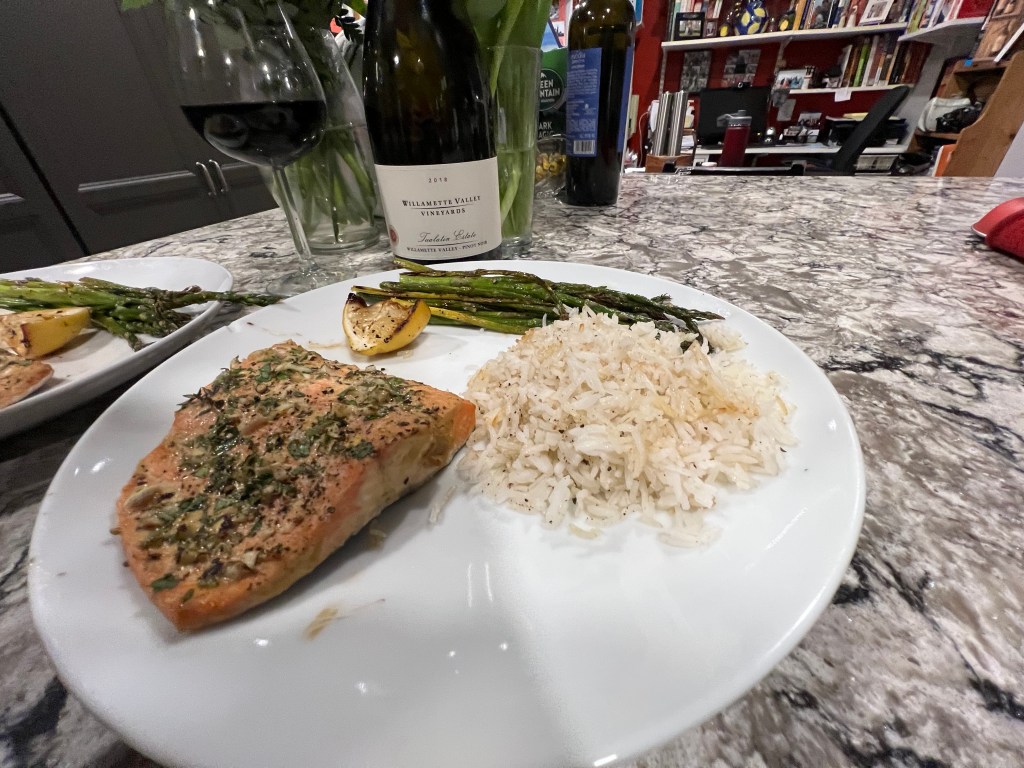
Salmon comes from many areas around the world, and I have found the taste varies widely. Here on the East Coast we see a lot of Atlantic Salmon, almost all of it farm raised. About the only good thing I can say about farm raised Atlantic Salmon is that the color is very similar to other fish that actually have some flavor. I have two dishes that I make with Atlantic Salmon and if those recipes are of interest let me know in a comment. At the cooking school Beth and I went to in France we did Salmon fish cakes where we used a food processor to break the cutlets down and added a lot of seasonings to them to make fish cakes that are pretty tasty. I also cure the farm raised Atlantic Salmon overnight and then hot smoke it on my Kamado grill and serve it with some different aioli’s. Cold smoked Salmon that you get in the store is raw Salmon that is hung in a smoke house at 80° where smoke is blown in to cure it. Hot smoked Salmon is cooked slowly at a very low temperature, I do mine at 180° which is as low as I can get my Kamado without the fire going out. The cure, the long slow smoke, and the aioli infuse taste in very inexpensive Salmon.
Scottish and Norwegian Salmon are generally pretty good if they are wild and not farm raised and much better if never frozen. I put Pacific Coast Salmon in that same category. My preference is strongly for Alaskan wild Salmon, either Sockeye or Coho which we can generally get on the East Coast and that is what I call out in the recipe below. We don’t see much Chinook or King Salmon unfortunately. You will get a different flavor if you do the identical recipe with Salmon from one of the other regions.
One of the interesting aspects about cooking Salmon is skin on or skin off. Cooking it with the skin on can add flavor but it can also generate a strong odor. I did this recipe completely outside on my Weber gas grill to avoid stinking up the house. I cooked it on a cedar plank to infuse flavor, so I did not need to us the Kamado grill for this and the ability to set up different cooking zones was much easier on the gas grill. Below is a link on Amazon if you want to get some cedar planks for grilling fish. I find I can use each plank at least two times, once on each side, and sometimes twice on each side if they are not scorched since they are in the indirect heat zone of the grill.
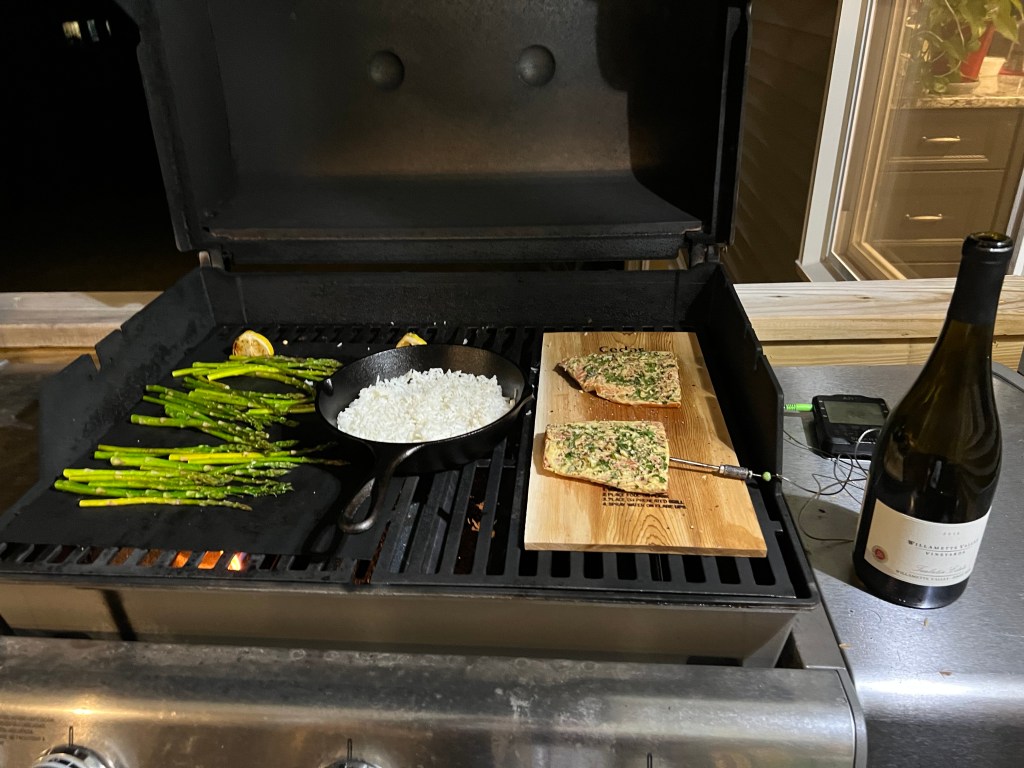
I had the burner on the left on high and there is where I grilled my asparagus on a grill mat to accompany the Salmon. I had the middle burner on medium and that is where I had my cast iron fry pan for the crispy rice. I use Bobby Flay’s crispy rice recipe and you can download recipe from the Internet that if you want to include it in your meal. I had the right burner completely off and that is where I had the Salmon on the plank. That portion of the grill was about 350 degrees, so the Salmon coked for about 12 minutes which let it get some nice flavor from the cedar plank. I also grilled a lemon. Squeezing grilled lemon juice on any dish adds much more flavor than squeezing juice from a lemon just out of the refrigerator.
One common theme you will see in my food posts is to cook by internal temperature, not by minutes per pound or minutes per inch of thickness. Those are just approximations, and you can easily end up with food over or under cooked. I used a temperature probe in the fish to tell me the internal temperature and another alongside on the grill to tell me the real cooking temp. That lets me keep the cover down on the cooking surface of the Weber grill for a much better cooking environment and I am monitoring it on my phone the entire time. I was able to pull the fish off right when it hit 125° internally. In the notes below is a link to an Amazon listing for the temp probe set that I use.
We generally think about white wine with fish, but Salmon is very good with roses and having a wine that is very similar in color to the fish is interesting. For this recipe I served a very nice Pinot Noir from the Willamette Valley Vineyards in Oregon, and it really complemented the flavor of the Salmon.
Salmon Recipe
Ingredients:
- Two 5 to 6 oz. sockeye or coho Salmon fillets. Pat dry with paper towel
- 1 TB Dijon mustard
- 1 TB minced garlic
- 1 TB fresh chopped parsley
- 1 TB fresh chopped thyme leaves
- Juice from ½ lemon, no seeds, divided
- 1 Tsp kosher salt, divided
- ½ Tsp fresh ground black pepper, divided
- 1/3 Lb. asparagus with woody ends trimmed off
- I TB olive oil
- ½ lemon cut in half for grilling
- Cedar plank for grilling fish
Instructions:
- Soak cedar plank in water for at least 30 minutes. I use a half sheet pan and put a small pot on top to fully submerge the plank and flip it after 15 minutes, so the part covered by the pot is fully immersed in water.
- Light your grill and configure it for indirect heat for the Salmon and direct heat for the asparagus. I use a grill mat for many of the vegetables that I do on the grill. See note below for those grill mats. If you are also doing the sticky rice on the grill, you want a medium level heat zone between the fish and the asparagus and I recommend a cast iron skillet for this. Let the indirect heat zone stabilize at 350°. The big thermometer that comes in the lid of most grills is well off the heating surface and not a good measure of what temperature the food is really cooking at and when setting up two or three cooking zones it will just have the average temp which does not help for this recipe. Having a second temperature probe on the grill surface in the indirect zone will give you the reading you need for the Salmon.
- Place the salmon skin side down on the cedar plank. Put the mustard in a small bowl and with a brush spread the mustard over the top and sides of both fillets. You don’t want to put the brush that has been in contact with raw fish back in the mustard jar so putting the mustard in a small bowl and using that to brush the Salmon is much better.
- Sprinkle the garlic, parsley, and thyme over the Salmon trying to get it evenly distributed.
- Squeeze juice of ¼ lemon over the two fillets. If you have a small lemon, use a half lemon so you get juice over each fillet, but you don’t want to wash the mustard that herbs off.
- Season the salmon with salt and pepper
- In a ¼ sheet pan spread the olive oil along the bottom and then add the juice for ¼ lemon (again or a half lemon if you don’t get much juice from the ¼ lemon) and the salt and pepper. Add the asparagus and roll them around in the pan to pick up the oil, lemon, salt, and pepper.
- Put the planked salmon in the indirect heat zoned of the grill and put the asparagus on the mat in the direct heat zone. Put the two ¼ lemon pieces on the mat to grill. Close the grill cover.
- The fish should cook in 10-12 minutes but this is just a guideline and the internal temp of the fillet is what you should use to know when to take them off the grill. You can open the grill twice to roll the asparagus so the it cooks on all sides but keeping the lid down preserves the right cooking temp for the fish. The asparagus can also come off early if they look fully cooked. Take the planked fish and the lemon wedges off when the internal term reads 125° and let it sit for 3 minutes and then serve. If you like your fish a little more done, pull it at 130° internal.
Notes:
- Cedar Grilling planks – https://www.amazon.com/Cedar-Grilling-Planks-12-Pack/dp/B009BFBNWO/ref=sr_1_3?crid=1LQE1E8IJ24FZ&keywords=cedar+planks+for+grilling+salmon&qid=1646152171&sprefix=cedar+%2Caps%2C118&sr=8-3
- Grill mat – https://www.amazon.com/RENOOK-Grill-6-100-Non-Stick-Reusable/dp/B074BT57HG/ref=sr_1_2_sspa?crid=23WZC6B1C8AWG&keywords=grill+mats+for+outdoor+grill&qid=1646152534&sprefix=grill+mat%2Caps%2C75&sr=8-2-spons&psc=1&smid=ACJQA1NIM9VX0&spLa=ZW5jcnlwdGVkUXVhbGlmaWVyPUEzMEdGWDdGOVhXQktPJmVuY3J5cHRlZElkPUEwMTM3OTEwSTQ0OUNVSEVYWTZCJmVuY3J5cHRlZEFkSWQ9QTA5NjA0ODEyU1k1NjhJWEo2OUlPJndpZGdldE5hbWU9c3BfYXRmJmFjdGlvbj1jbGlja1JlZGlyZWN0JmRvTm90TG9nQ2xpY2s9dHJ1ZQ== . Your vegetables and the lemon will get grill marks through the mat.
- Grill Thermometer – I like the one with 4 probes so I can track the internal temp of two steaks or two pork shoulders and also the temp on the cooking surface. Two probes are a little less expensive and will cover 90% of grilling. https://www.amazon.com/ThermoPro-Wireless-Bluetooth-Thermometer-Temperature/dp/B07Z7HDNC4/ref=sr_1_8?crid=K0S6540UKFVY&keywords=Thermopro+grill+thermometer+bluetooth&qid=1646153128&sprefix=thermopro+grill+thermometer+bluetooth%2Caps%2C45&sr=8-8
Comments and questions very much appreciated.
 Bill's Thoughts on Wine, Travel, and Food