
I have done several posts on doing a Reverse Sear as the best way to cook a steak in those posts I have mentioned that we really like to Reverse Sear a thick cut Dry Aged steak. What is a Dry Aged Steak? Why Dry Age a steak? Why does a Dry Aged steak cost so much more? Is Dry Aging something that requires an expensive professional environment or can it be done in a home kitchen?
I just dry aged a 5 bone ribeye roast and got six thick dry aged steaks from it and my cost was only $10.97/lb. In this post I will answer the first of the three questions above, and you can download a discussion with lots of pictures on how I created my own dry aged steaks at a great price.
What is a Dry Aged Steak?
Dry aging is a process that puts a large cut of protein in a controlled environment for a few weeks. This post will talk about beef as the protein, but dry aging can be used for many other proteins including fish. You cannot dry age a steak. You dry age a large cut of beef like a ribeye and then cut it into steaks.
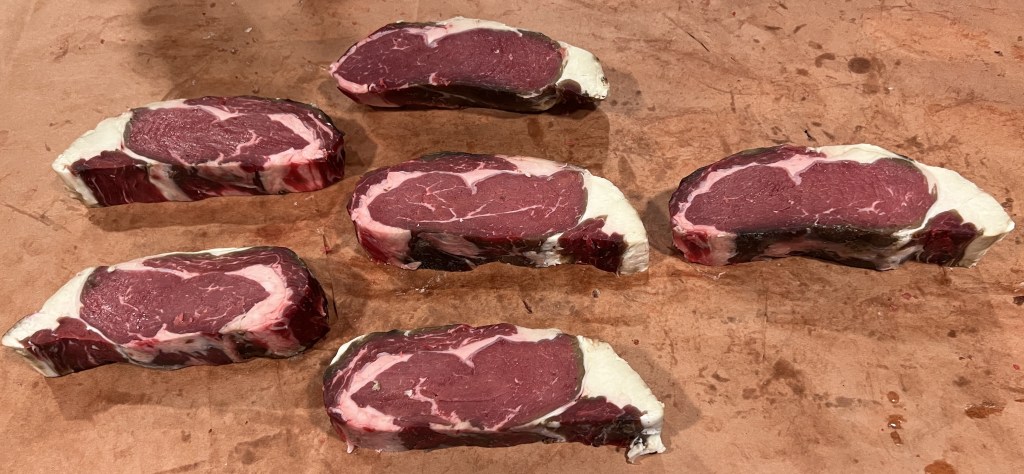
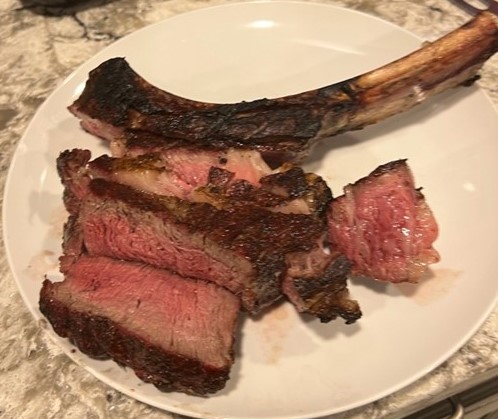
The dry aging process generally takes at least 3-5 weeks during which the roast will lose about 15-18% of its weight. At the end of that process, the roast has a developed a dry skin that needs to be trimmed off. I dry aged a 12 lb. boneless roast and when I had it trimmed and ready to cut into steaks, it was 7.2 lb. The controlled environment lets the aging happen without any mold developing on the roast. The first picture below is the roast showing its bright red color. The second picture is the 6 dry aged steaks I cut after dry aging that roast showing they now have a deeper red color. The last picture is a dry aged steak that I cooked with the Reverse Sear method and let sit for five minutes before cutting into thick slices showing hour bright red and juicy the steak is, in case you had any concerns about the color of the freshly cut steaks or concerns about some of the juices evaporating during the day aging process.
Steaks are not dry aged, large cuts of beef like a whole ribeye or porterhouse are dry aged and them trimmed and cut into steaks. To cook a dry aged steak so you get the best flavor, the steak should be cut to be at least 1 ½” thick.

Why Dry Age Beef?
The short answer is that it makes the steaks taste MUCH better! Many of the top steak houses have a dry aging room where they hang the large roasts for weeks before cutting them into steaks to serve to customers. Peter Lugers in New York City, often ranked the best steak house in the world, built their reputation on dry aging their steaks and cooking them to perfection. When you order they will ask how many people want the steak and they will cut a steak to the thickness for that many and serve one steak for the table.
The aging process causes the connective tissues in the large roast to break down, making it much more tender. Filet Mignon is the most tender cut of beef, but it has the least flavor of any cut of beef. Dry aging can make other cuts almost as tender, but the richer flavor that they have compared to Filet Mignon is enhanced even more by the dry aging process. Dry aging causes some of the juices to evaporate, concentrating their flavor. Cooked correctly, dry aged steaks are very moist and delicious, the evaporation does not cause them to dry out.
Why Do Dry Aged Steaks Cost So Much?
On a restaurant menu a dry aged steak commands a premium price over a regular steak, if they have both on their menu. Some of the larger Harris Teeter supermarkets have a refrigerator sized dry aging unit in their store and that is where we first got our dry aged steaks when we wanted to splurge. It is generally right next to the meat counter in the stores that have it, and the top of it is glass sided so you can see the roasts hanging in the unit. Each of them has a sign on it for when that roast was put in the unit, when it will be available to cut steaks from, and the last day that steaks can be cut from it. You can tell the person at the meat counter how think you want your steak cut. They are generally in the $25-30/lb. range which is significantly higher than the steaks from the same cut of beef that have not been dry aged.
The reason why is cost. First you have about a 30-40% weight loss between the evaporation and the trimming that needs to be done. Second that roast will be in the unit for 5-7 weeks before it is sold. If they just cut it into steaks when they got it, it would be sold in a couple of days. Sitting for that long has a cost and that is reflected in the price that they charge. They also have to consider the cost of the dry aging unit and the floor space it takes up in the store. People are willing to pay that price for a custom cut dry aged steak.
Can I Dry Age Steaks In My Home Kitchen?
Yes – But! The biggest issue is likely the amount of refrigerator space that is taken up for five weeks. The entire roast needs to sit on a rack in a pan in your refrigerator for that length of time with room around it for the steak to breathe. For many home kitchens that is a showstopper. We have a second full sized refrigerator in our basement and I was able to use half of one of the shelves for the five weeks to dry age a half ribeye. Using our primary refrigerator in our kitchen was not an option. The refrigerator needs to be a full sized frost-free refrigerator that has a compressor fan and has regular traffic so the door is opened and closed several times a day. Small beverage refrigerators or dorm room mini fridges will not properly dry age a roast.
There are several companies that sell dry aging kits or bags. For Christmas our son got me the UMAi Dry Aging Bags, which are highly rated, and they really worked well for me. They also have bags for making charcuterie or slow fermented dry sausage. Below is a link to a 10 minute video that will give you a good introduction of how to dry age a roast at home and what you will get when you do that. It also has some very good insights on how the steak will taste so much better from the day aging. I think you will find it very interesting. https://www.youtube.com/watch?v=pGMuWEhAWTc&list=PLU7RqiCq-smfgsCtmge3nuJBtAwkEQT-X&index=9
They are doing a full ribeye in this video. I bought about a half a ribeye and the link below will let you download a PDF file where I will walk you through the process I did with lots of pictures.
A high-level financial summary may encourage you to download that file. We buy our meet at Safeway which has the best meat in the town we live in, and they will custom cut it for us if we ask. Because it is just the two of us, I had then cut me a 5 rib roast that was 13.2 lb., about half of a full ribeye. The sticker price for that roast was $198.02. In the PDF I will tell you how I paid $79 for that roast. I had them trim and remove the bones but leave them in the package because the sale price was for a bone in ribeye roast. I could have done the dry aging with the bones attached and I do like a bone in steak. But working with the bones is a little more difficult in prepping for the dry aging. More importantly, being able to custom cut the thickness instead of cutting between each of the bones I got six steaks instead of only five really thick steaks. In the PDF I have a picture of five bones showing they have a lot of meat on them, enough for a full meal for two of us. In computing the cost for my steaks I did not deduct anything for those bones, so that meal will be free to us. Taking away the bones, my roast weighed 12 lb. After 35 days of day aging it weighed 10 lb. After trimming I had a 7.2 lb. roast that I cut into six steaks the thickness I wanted. Since I paid $79, that comes out to a cost of only $10.97/lb. and I have the meaty rib bones for free. The current supermarket sale price for a boneless ribeye steak is $16.99/lb., so I will be enjoying the much flavorful dry aged steaks for $6 less!
I cooked one of the steaks that evening and froze the other five. The steaks will be OK in your refrigerator for up to three days after cutting them. Any longer than that and they should be frozen. Because the evaporation has reduced and concentrated the juices in the meat, they will have less impact from being frozen than a regular steak. You can also dry aged previously frozen roasts.
If you want to try some dry aged steaks from Harris Teeter before trying to dry age a roast, that is what we did. If you dry age a roast and get some great steaks, or if you buy a nice dry ages steak, I strongly encourage you to Reverse Sear it for the best flavor. Below is a link to my blog post on Temper Your Steak and Then Reverse Sear It for a discussion with lots of pictures on how to do this. https://billwinetravelfood.com/2022/08/18/temper-your-steak-and-then-reverse-sear-it/
I hope you become as big a fan of dry aged steaks as Beth and I are and I hope you decide to dry age a roast yourself. Let me know what you think.
This has been two food blogs in a row! Please do not worry that I have given up wine. I have several wine blogs a a travel blog planned.
 Bill's Thoughts on Wine, Travel, and Food