
Unfortunately, the answer is – it depends. There is no simple answer. Some of the major factors are discussed below. I will finish up with the pretty simple approach I take to my hobbyist cellar of about 800 bottles.
Red vs White Wine
White wines and red wines age very differently. Very few white wines are crafted to get better as they age in the bottle, what is called age worthy. One of the two major exceptions will be discussed in the next section on what grapes were used. The other white wine exception is sparkling wines, where two factors can be in play. I will just say Champagne to refer to the French sparkling wines and Cava for sparkling wine from Spain and Prosecco for sparkling wine from Italy. The first of two factors for Champagne is that most Champagne is made of a blend from wines made in different years. Only in the infrequent years that are declared vintage years is there a date on the bottle, so there is no way to know how old the wine in a bottle that is not a vintage year really is. Cava and Prosecco are also most commonly made from a grapes from several years. If there is no date on the bottle then it was probably made from a blend of several years.
The second factor is what grapes were used. Champagne is made primarily from a fairly equal mix of Chardonnay, Pinot Noir, and Pinot Meunier. The last two are red grapes which age much better than white grapes and Pinot Noir is one of the most age worthy wines in the world. I am not a Champagne expert, but I have been told that rich people who love vintage champagnes age them for years to taste even better. Cava and Prosecco are also blends from several grapes and the grapes used can vary more than is the case with Champagne.
What about US sparkling wines? Again, no easy answer here, as the laws and wine making customs vary greatly from state to state, and some are still being called Champagne even though they are not made with the “méthode traditionnelle”. So it is even harder to figure out when sparkling wine that is made in the US is getting old.
Almost no still white wines are crafted to age in the bottle to improve their taste. They are made to be consumed soon after you purchase them. Some of them will start to get darker in color as they get older, and that is never a good sign. My basic rule of thumb, that I will expand on a little at the end of this post, is that white wines should be drunk within five years of when the grapes were harvested.
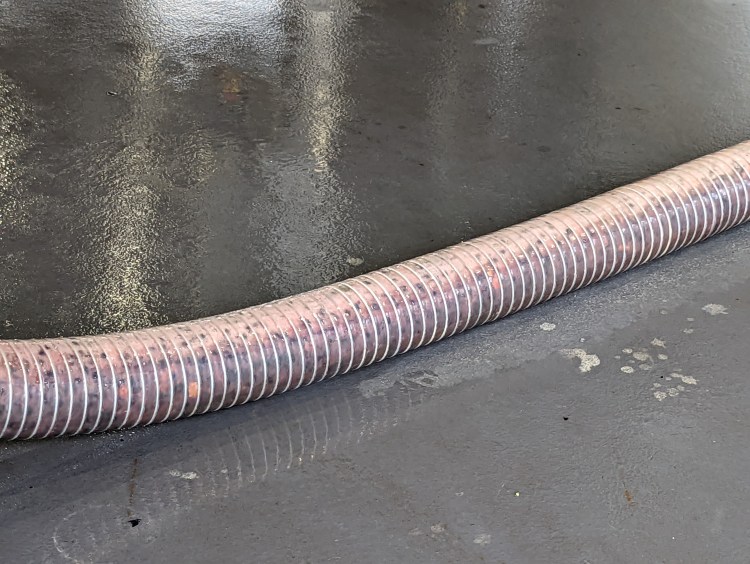
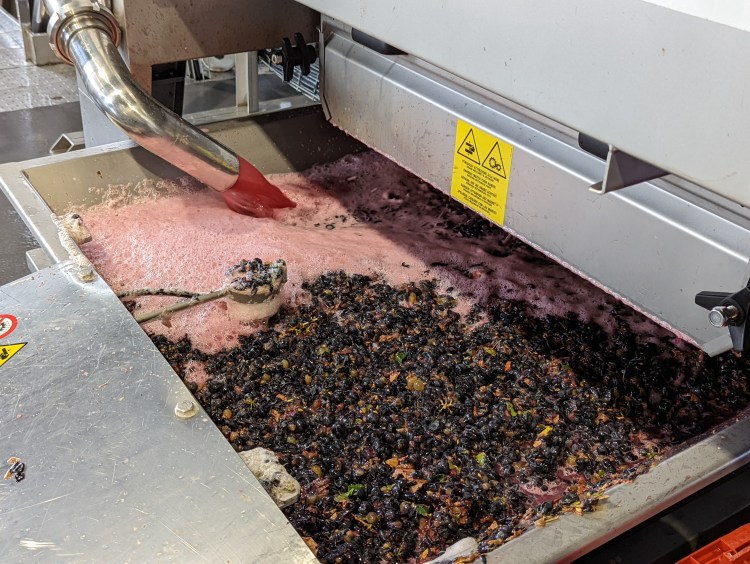
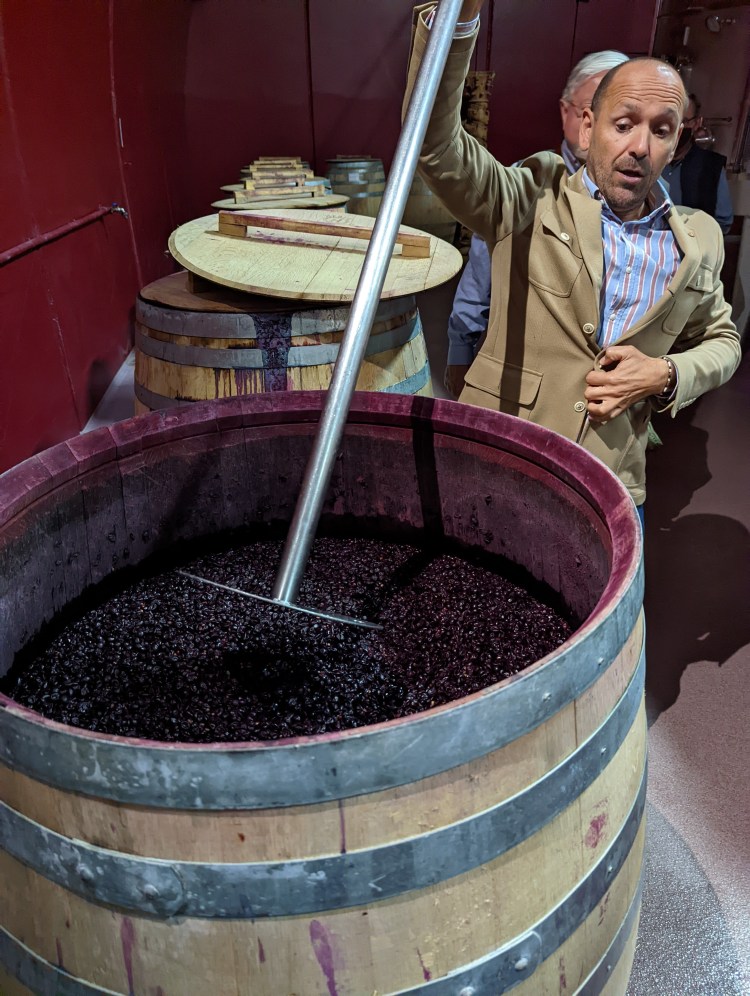
Many, but not all red wines are crafted to improve with age, and this discussion greatly simplifies the complex process of making good red wine. The reason why red wines are red is because when white wine is made the grapes are pressed to extract the juice which is then fermented. The juice from all grapes is clear. Remember from above that 2 of the 3 grapes used to make Champagne are two red grapes, but Champagne is a white wine, unless additional steps are taken to make it a rose. The wine becomes red when the grapes are crushed instead of being pressed, and the skins and juice of the crushed grapes all go into the fermentation process together. The pictures below show the grapes being fed into the crusher and then the crushed grapes and juice flowing down the pipe into a holding bin. The last picture is the mixture fermenting in a barrel. We got to taste the mixture which had been in the barrel for about a month.

All the color for red grapes is in the skins, as well as the tannins and many other elements that make red wine taste so different from white wine. This is called fermenting on the lees and the color and many of the flavor elements held in the skins get extracted and added to the as they sit together for weeks. As the wine ages in barrels and then in bottles, the oxygen that it interacts with oxidizes many of those elements which changes and improves their taste, most significantly the tannins. That happened faster in the barrels and much slower in the bottle because little oxygen is present there. All red wines get some improvement over time. How long they get better and when they start to get old is driven by the three things discussed below.
What Grape(s) Were Used
Some red grapes can be used to make wines that age very well. Cabernet Sauvignon and Pinot Noir are probably the flag bearers. Some grapes are seldom used to make age worthy wines. Grenache is one example and in Spain the red wines made with the Mencia grape are delicious, but are meant to be drunk within five years of the harvest.
Probably the biggest example of a white wine that can age well is Chardonnay, and this will tee up what I think is the most important factor of when does a wine start to lose flavor because of its age, how the wine is crafted. Chardonnay was first grown in the Burgundy region of France and is crafted similarly to how they make their Pinot Noir, to age for decades. The terroir in Oregon is very similar to that in Burgundy and many of the winemakers there studied and/or worked in Burgundy to learn their trade and they make very age worthy Chardonnay which does have some tannins and should be decanted before drinking.
But Oregon’s southern neighbor, California. makes the Chardonnay that people in the US are most familiar with. The terroir in the different wine regions in California, and the most common ways that wine is crafted there, produce wines that should be consumed within five years category. The grape is the same, but the wine that is made with that grape is very different
Was The Wine Crafted To Be Age Worth
Bordeaux crafts their red wines to age for decades and the very best of those wines don’t begin to show all of their great character and taste for 25 years, and hit their peak at about 40 years. Those wines are made primarily from blends of Cabernet Sauvignon, Merlot, and Cabernet Franc with either of the first two as the primary grape and the other two as junior partners. In California a wine can legally be called Cabernet Sauvignon as long as 75% of the grapes used were Cabernet Sauvignon. The other 25% can be any other grapes, but Merlot and Cab Franc are the most popular ones added. The general guidelines given by California winemakers for their Cab is that it hits is peak at about 5 years and should not go longer than 8-10 years. The grapes are pretty much the same in both regions, but the way the wines are crafted, and the goals for those wines, are totally different. California wine makers want you to be able to enjoy their wines soon after you buy them, not put them in the cellar for several decades. The same is true for two of the other most popular grapes grown in California – Chardonnay and Pinot Noir.
There is no right or wrong here, just different goals for their wines yielding different tastes that appeal more to some people than to others. Knowing what the goals were for the wines you put on your shelf can help you know when they may start to be getting old. Unless you are a Master Sommelier you won’t know that for thousands of different winemakers but going with the general practice for that region has worked pretty well for me.
How Was The Wine Stored
The wild card in how a wine ages is how you store it. If it is lying down in a room where it is not in direct sunlight and the temperature stays pretty consistent and not above 80° or below 50° for red wines, below 40° for white wines, that wine should age well. If it is standing upright and often in bright sunlight it will not age well. Wines with a screw top or artificial cork do not have a problem with standing upright. Temperatures higher than 80° or lower than the numbers above are not good at all for wines.

What Is My Secret Method?
No secret, just a simple rule of thumb. In late December or early January every year I go through my wine collection. Any white wines, other than Chardonnays from France and Oregon (the only Chardonnay I have in my cellar), that are five years old or older get pulled into a box. For red wines there are a few rules:
- Grenache and Mencia wines older than 5 years
- California red wines older than 10 years
- Most Italian wines older than 10 years
- Red wines from Burgundy, Rioja, Ribera del Duero, and Portugal older than 20 years
I try to make sure that the wine in those boxes are consumed within a couple of months.

I will end with two stories from the process I just went through 2 weeks ago. I ended up with 23 white wines and 11 red wines that got pulled to be consumed soon, a few of them we have already had.
- I found two white wines that I had missed in past reviews somehow. One was 8 years old and getting more golden in color than white. When we drank it, it was OK, but definitely showed its age. The other was a Spanish Rueda (Verdejo grape) that was 7 years old. It was delicious with no signs of age.
- I was very surprised to find a bottle of Trader Joe’s Reserve Zinfandel from 2008. I was pretty sure it would be undrinkable. Zinfandel, especially the Old Vine Zins in plentiful supply right now, easily age 10 years, but I had my doubts on 17 years. My experience with Trader Joe’s Reserve wines has also been very good, but they are very good wines at a great price, not great wines. I pulled the cork the next day and poured a small taste. I was very surprised that it tasted really good, so I served it with dinner that night. Because of its age I did not decant it as that generally adds age to the wine. That turned out to be a mistake because the bottle had LOTS of sediment. When we poured our second glass and we had to pull out a fine screen strainer and pour that wine into a different glass to get rid of the sediment and enjoy the last of that wine.
The conclusion from this is that my process is not foolproof and I could be drinking some wines that still have a few years to age and improve. But I have very few wines that have really shown their age when I poured them using this approach. But just because a wine is way outside the target age parameter does not mean it should be thrown out. Wine is bad and undrinkable when it has a cork failure. When it gets old it just has lost some of its flavor. Maybe enough that you want to open another bottle in its place or maybe just enough that you wished you had opened it earlier. Maybe it will taste much better than you ever thought it would.
When has your wine gotten too old? It depends.
 Bill's Thoughts on Wine, Travel, and Food
Another good post. I use the Cellar Tracker app to keep track of my 600 bottle cellar. It has a feature that tells you what wines need to be consumed currently. You can use their built in age range recommendations for customize it to your preference. FYI, in your red wine rules above you left out Bordeaux…what rules do you apply for these wines and are they different for left vs right bank? Thanks
LikeLike
Great information about Cellar Tracker. I don’t have any Bordeaux over 20 years old at this time.
LikeLiked by 1 person
I do not see any reason to have different age targets for Left Bank wines than I have for Right Bank wines.
LikeLiked by 1 person
Follow up to using cellar tracker. If you have multiple bottles of a vintage it will space them out over its particular drinking window so you don’t end up with several at the end of its life. Also I use AI to help me determine the aging potential of a particular wine/vintage which I then use to customize cellar tracker. I also ask AI to summarize a wine/vintage when I open it to refresh my memory. Here is an example of a recent one I searched:
https://grok.com/share/bGVnYWN5LWNvcHk_8d98b8cb-5d34-4768-a704-f23b0d437570
LikeLike
Really interesting technology usage. If you would be willing to do a write up on it, I would be happy to post it introducing you as a guest contributor.
LikeLike