
This is not a simple recipe, but it was very delicious. Peking Duck is a classic Chinese dish with delicious crispy skin served in thin pancakes with Hoisin sauce. I’ve heard that some purists only put the wonderful skin inside the pancake and use the duck meat for other dishes but every time I have had it in a Chinese restaurant we got both meat and skin and that is the way we ate this dish.
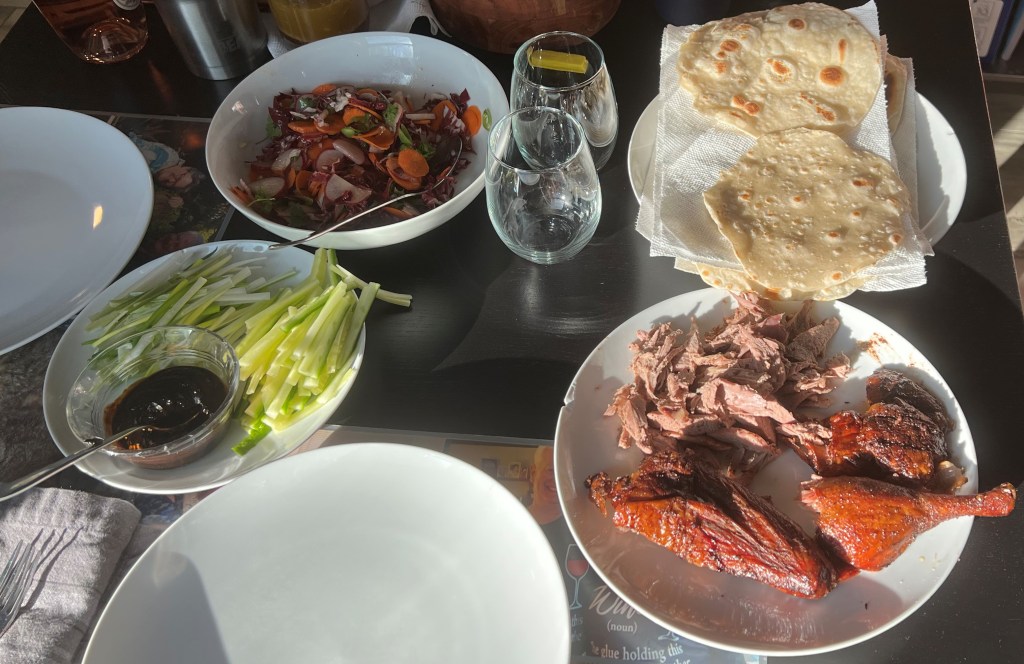
You do not need any special kind of duck to make this dish. The ingredients and timing are for a 5 lb. bird and that is a pretty standard size for a duck. Ours had been frozen and we defrosted it and used the recipe below. The picture shows the shredded meat, along with the wing and leg for anyone who just wanted duck meat, the pancakes, the cucumber and scallion garnishes along with the Hoisin Sauce, and the delicious salad that Beth made to round out the plate. This recipe is for a Kamado Joe grill but can be easily adapted to other smoking grills like a Big Green Egg. In the paragraphs below I have some discussion and pictures and the full recipes for the duck and the pancakes are at the bottom of this post.
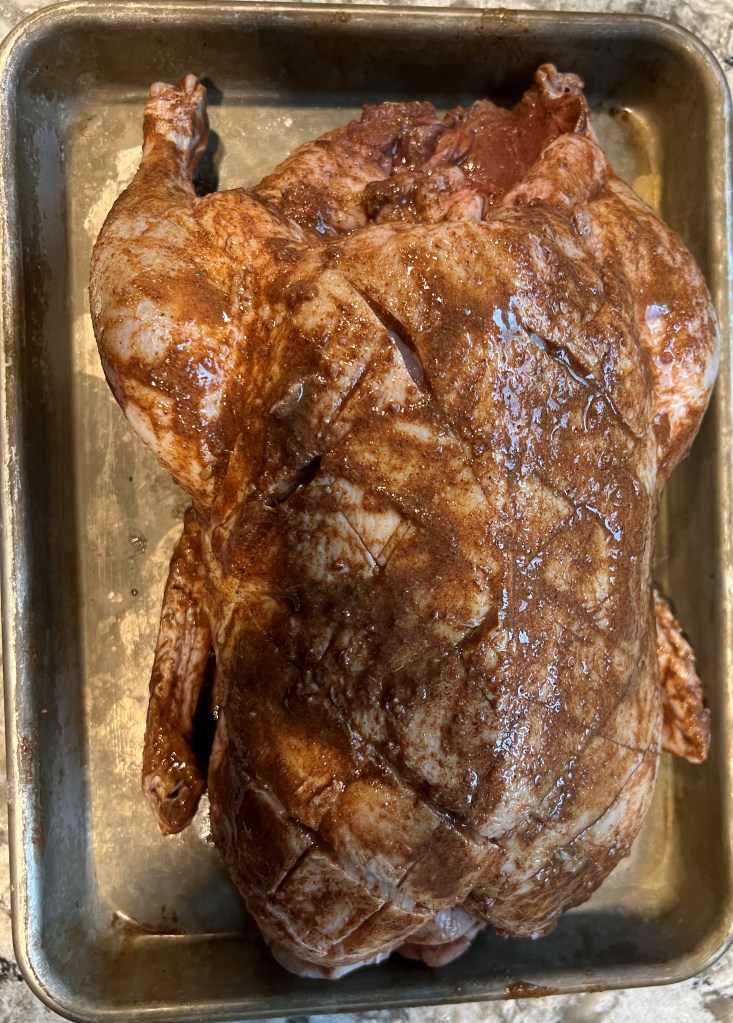
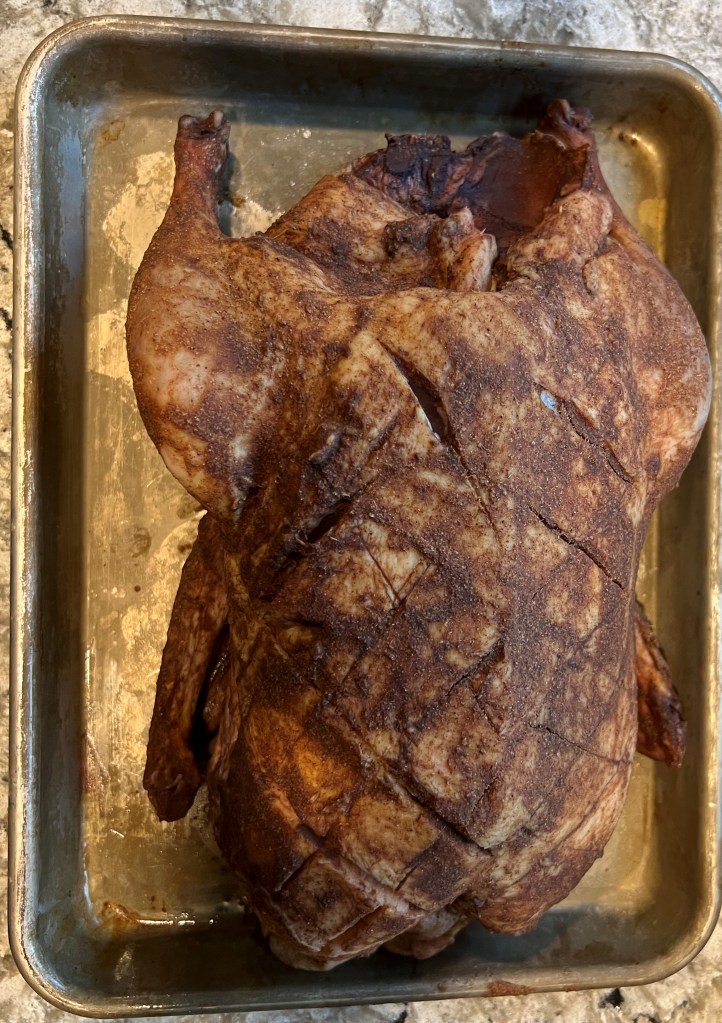
The approach is to create a paste that you rub all over the skin of the duck and let it sit uncovered in your refrigerator for 48 hours before cooking. The picture on the left is when I first put the rub on and the picture on the right is when I took it out of the refrigerator two days later. You then smoke it for 60 minutes per pound or 5 hours for a 5 lb. bird at 250°. It should be at 180° internal temperature at the end of the smoking, and I used my multi probe ThermoPro to have one probe monitoring the internal temp on the bird and one measuring the temp at the grill level where the bird is so I can keep that at 250°. You then take the bird out and quickly bring the grill temp up to 400° for 15 minutes to crisp up the skin.
One key thing to remember when cooking any duck, and this is even more true if you want to take on roasting a Goose (really delicious). Both birds have a layer of subcutaneous fat surrounding their bodies so they can handle cold temperatures. If you just roast them that fat will render inside the skin under the heat and you will be boiling the meat in fat the entire time, and the result is very unappealing. As you can see in the three pictures, I cross hatched the duck skin on both breast side and underside, going just through the skin but not deep enough to go through the fat and into the duck meat. If I had gone that deep the juices of the duck meat would have run out and the meat would have been dry. By just cutting the skin down to but not through the fat layer, the rendered fat runs out into a drip pan as the bird cooks. During the smoking process I had the bird breast side down for half the time and then using my poultry forks, I turned it breast side up for the remaining cooking time. This lets both sides drip their rendered fat into the drip pan. When I turned it, I tilted it up so that any rendered fat that had accumulated in the cavity ran into the drip pan. I did the same thing when I pulled the duck off at the end of the smoking period.
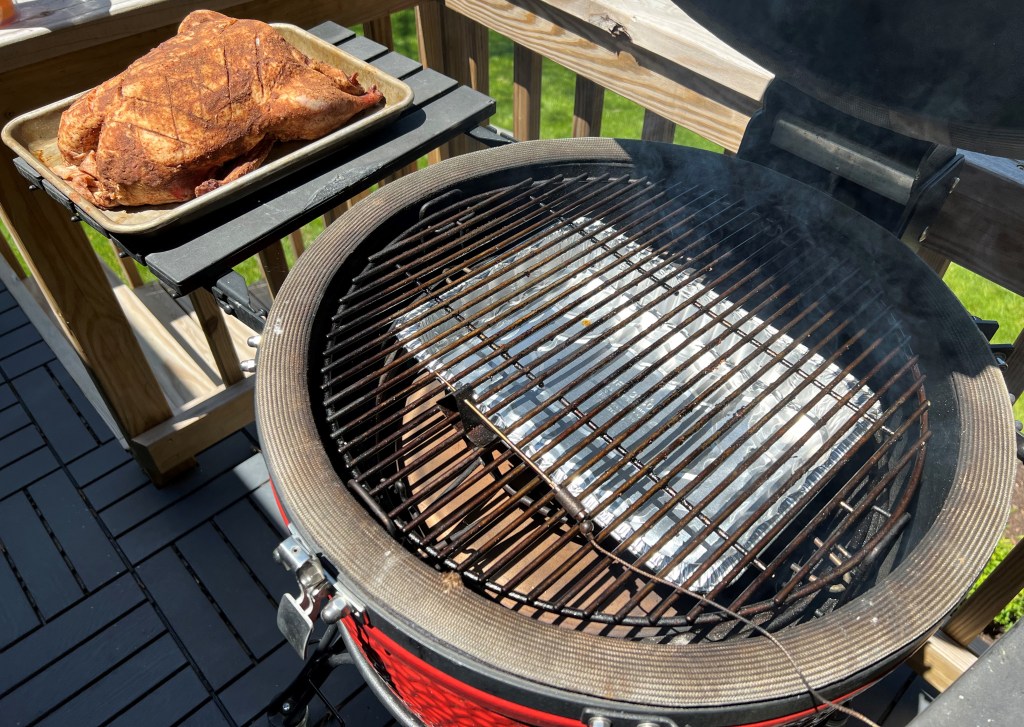
Because I was doing this on the grill, I wanted the bird on the grill grates, so it was surrounded by the heat, but I did not want the rendered fat dripping down onto the heat deflectors, so as the above picture shows, I had the accessory rack in the lower position and a throw away aluminum pan on it under the bird to capture all the rendered fat. I had the heat deflectors in the low position, so it was indirect heat but sufficient circulation for the smoke from the apple wood I used to add a little smoke flavor to the duck.
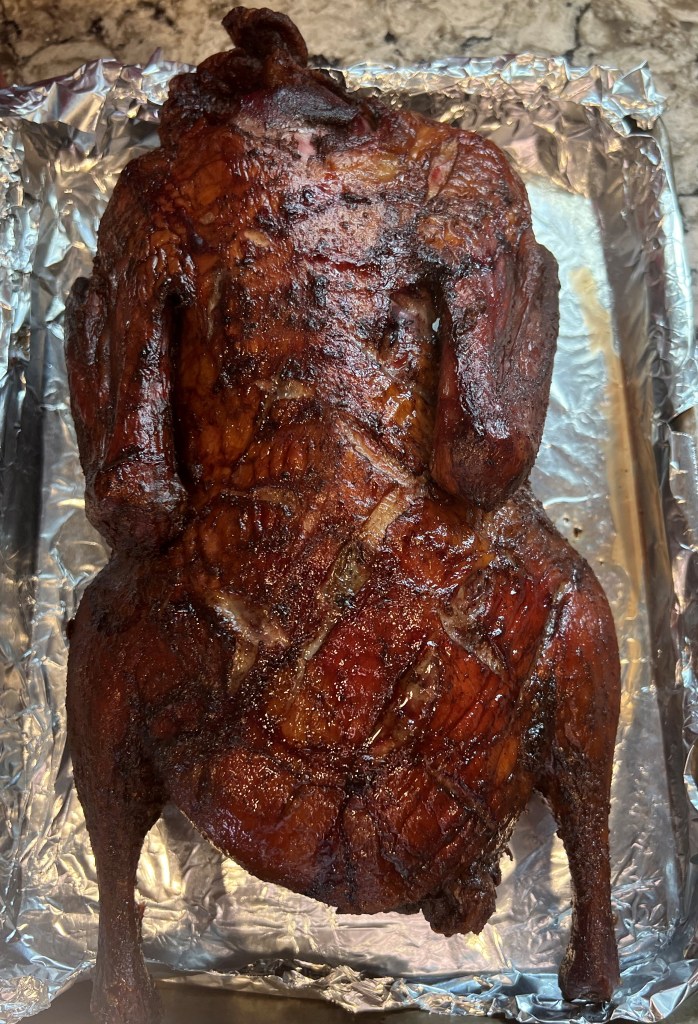
You do not want to have a strong smoke flavor for this dish, so a fruit wood is best and either apple or cherry is very good with duck. The picture shows the duck as it came off the grill into the kitchen to carve. The skin is dark and really crispy from this cooking process. Because shredded meet is what this calls for, I used by knife to remove strips of the crispy skin and put them on the platter and then used a fork and my fingers to shred the meat. The bird was hot so I used a carving fork and my knife to get large pieces and then once they were off the bone they quickly cooled down enough hand shred.
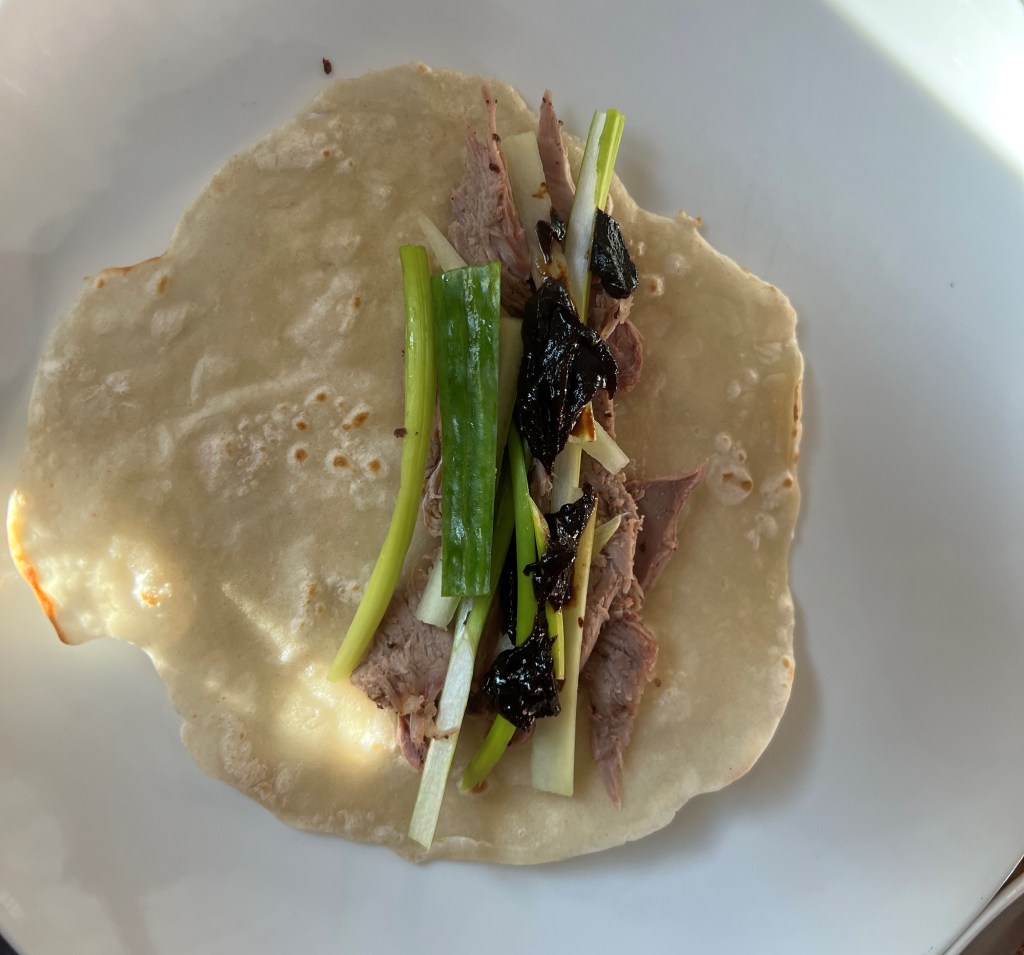
To eat Peking Duck you take one of the thin Chinese pancakes and put some Hoisin Sauce on it. You then put some of shredded meat and then some of the crispy skin on top of the sauce. The last step is to add some thin strips of scallion and cucumber (with the wet center of the cucumber removed) and fold it up and eat it. The pancakes are a key ingredient, and you can order frozen pancakes on line, but I chose to make them and that recipe is also below. It was not difficult but a little time consuming. I started when I flipped the duck breast side up and thought I would have plenty of time while it finished the cooking process, but I actually did the last pancakes when the duck was in the final 15 minutes under higher heat to crisp up the skin. Next time I plan to make the pancakes right after I put the rub on the duck and put it in the oven for 2 days. I will then freeze the pancakes and simply reheat them as discussed in the recipe below, so I don’t have that distraction when I am cooking the duck.

One of the very interesting things about this recipe is that you divide up the dough into 16 balls the same size. I used our scale to make sure they were all pretty close to the same weight. You then take two of the balls and flatted them with your hand and put one on top of the other and roll them out to about 7” in diameter. You cook the two pancakes together in the frypan and then after all the pancakes are cooked you separate the 8 double pancakes into 16 single pancakes. It was as strange to do it as it sounds but it worked, and we really liked the pancakes.
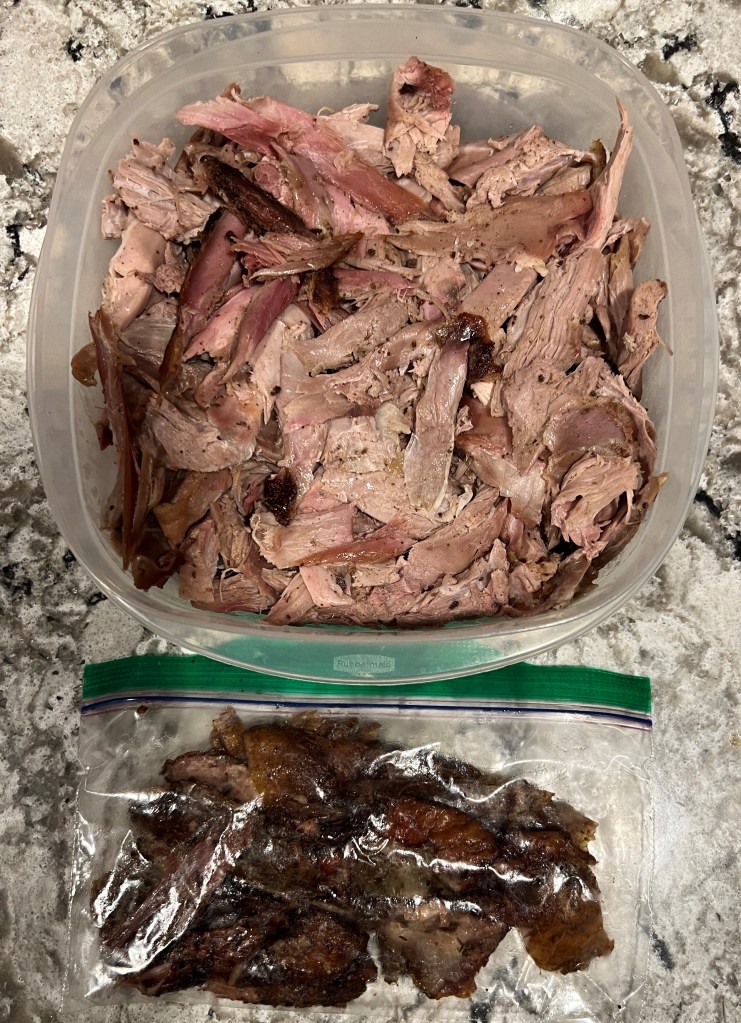
One very strong tradition of Chinese cooking to use every part of an animal because peasants were poor and needed to get everything possible out of any animal they were cooking. If I had just done roast duck, we would have made a duck stock with the carcass and put the remaining shredded meat into a soup made with that stock. In this case we wanted to have a second meal of Peking Duck, so after dinner I stripped every shred of meat off the bones and ended up with a nice container of meat for that second meal along with a bag of the crispy skin.
As mentioned above, Beth made a very nice Chinese salad and if there is interest in that I will ask her for the recipe and post that. We had the Coppola Sofia Rose with this meal, and it was the perfect accompaniment.
RECIPE: Smoked Duck Peking Style – adopted from barbeque-smoker-recipes.com
Ingredients:
- One duck
- 1 tablespoon cider vinegar
- 4 teaspoons salt
- 2 Tsp star anise or 2 Star Anise ground in a mortar and pestle
- 2 teaspoons soy sauce
- 2 teaspoons Chinese 5 spice
- 2 teaspoons sesame paste (tahini)
- 1 teaspoon sesame oil
- 1 teaspoon powdered ginger
- 1 teaspoon sugar
For the “garnish”
- Chinese pancakes – recipe below
- 1 cucumber
- 6 spring onions (scallions)
- Hoisin sauce
Method:
Grind up the star anise in a pestle and mortar if you don’t have already ground star anise. Add to a bowl with the salt and the other ingredients and mix well until a rich paste is formed.
Remove the duck from any packaging and using a dish towel, thoroughly dry the duck. Raw poultry should never be washed in your sink because anywhere the water splashes you can have contamination. All poultry should be completely dry before you start to work with it. Immediately put that dish towel used to dry the duck into a place where it will go into your next hot water wash for your laundry and not be used for anything until then. Take your duck and with a sharp knife score the skin surface on both sides taking care to not to cut too deeply into the fat. Rub the paste all over the bird and set aside uncovered for 48 hours in the refrigerator.
Remember that you are working with raw poultry. Wash your hands frequently and very thoroughly after you put the duck with the rub into the refrigerator. Clean all your utensils and the cooking area very thoroughly to remove any traces of the duck. Chlorine wipes are a very good idea when cleaning up areas where you have had raw poultry.
Set your Kamado up for indirect cooking with the heat deflector stone in low position. Put the Accessory Rack in position below the grill grates and put a disposable drip pan large enough to capture all of the drippings from the bird on that rack. Stabilize your cooking temp to 250° and add your wood chunks for smoking. Light citrus woods like Apple or Cherry are recommended. Put the bird it breast side down to get the fat rendered out and halfway through the cooking reverse it to breast side up, tilting the bird so that any juices in the cavity run into the drip pan. Cook the duck low and slow 60 minutes per pound, 5 hours for a typical 5 lb. bird. The bird should have an internal temp of 180° at this point. That concludes the first stage of the cooking process, and you’ll now have a beautifully succulent bird.
The paste is salty so you can scrape off any that’s remaining before starting the second cooking stage.
Crank up your kamado to 400°F and put the duck back on the grill for 15 minutes to crisp up the skin. The bird is fully cooked when it hits 180° internal so you only need a short time to get the skin really crispy.
Note:- This is still using the indirect cooking set up.
Garnish – can be done anytime during the cooking cycle.
- Top and tail the spring onions and slice length-ways to produce strips about 6” long.
- Peel the cucumber, cut into thirds, and then cut each third length-ways into quarters. You can now easily cut out the watery center. Now cut what’s left of the cucumber lengthwise to produce thin cuboid lengths.
- Spoon out some hoisin sauce into a saucer or bowl
- Warm your pancakes if they are not made fresh while the bird is cooking
Now it’s time to take your bird out of the oven for the final assembly of smoked duck Peking style. Take two forks or bear paws and shred the duck meat. Coat a pancake on one side with hoisin sauce, add some shredded scallions and cucumber in a line along the center together with some shredded duck. Roll up the pancake and take a bite. It will be delicious.
RECIPE: Peking Duck Pancakes – from Redhousespice.com
An essential element of the classic Peking duck meal, Peking duck pancakes are known as Chun Bing meaning spring pancakes as they’re a traditional food for celebrating the beginning of Spring. Sometimes they might be referred to as Mandarin pancakes.
Made with wheat flour and water, Peking duck pancakes are cooked either in a steamer or a pan. Compared to the popular tortilla, they are much thinner and have a smoother appearance. Apart from Peking duck, many other Chinese dishes, such as Moo Shu Pork, Bean Sprout Stir-fry, etc., can be enjoyed inside these pancakes.
Ingredients:
- 360 g all-purpose flour
- 230 g hot water (just boiled)
- cooking oil for brushing the pancakes
Method:
Peking duck pancakes are soft, moist and very thin. To achieve the right texture, you need to get the dough right.
- All-purpose flour (aka plain flour) containing 10-12% of protein works very well for this recipe.
- It’s important to use hot water (soon after being boiled) to mix with the dough. This way the dough is partially “cooked” thus taking less time to cook through in the pan. Also, hot water dough produces a supple and tender texture (It’s also used for making steamed dumplings). You can also heat the water in your microwave but you want it just below boiling point to get the partial cooking.
- To make 16 pancakes, you’ll need 360g flour and 230g hot water. The finished dough should be soft but not sticky.
Put the flour in the bowl of your stand mixer with the dough hook. Add the water and let it run until the dough comes together in a rough mass. Turn off and let set for 10 minutes for the dough to hydrate. Turn the mixer back on for about 4 minutes to knead into a smooth dough. Take out of the bowl and check that it does not need any hand kneading to be nice and smooth. Transfer to a bowl, coat it with a little oil, and leave to rest for 30 minutes covered with a lid.
Afterwards, divide the dough into 4 equal size pieces and each of them into 4 small pieces and shape them into round balls. Try your best to divide them as equally as possible. This will make the next step neat and smooth. Using a kitchen scale to check the weight as you cut the dough into four pieces two times is a good way to make sure each of your pancakes will be the same size.
Once the dough pieces are ready, it takes two simple steps to turn them into Peking duck pancakes: flatten with a rolling pin until very thin, then briefly cook in a pan without any oil.
To make rolling easier and speed up the process, apply the “double pancake” method and follow a good workflow. Here are the procedures and tips:
- Brush a layer of oil on the top of a dough piece, then place another piece on top. Repeat to stack up every two pieces. Roll out the first double-layer dough into a very thin circle (about 7 inches). See picture above.
- Heat up a frying pan over medium heat. Transfer one of the rolled pancakes into the pan. Cover with a lid. As soon as air pockets appear, flip over to cook the other side. The pancakes should have a few light brown spots as shown in the pictures above. Be attentive and adjust the heat if needed. When the pan is too hot, the pancakes will burn easily. If it’s not hot enough, it will take longer to cook and the pancakes will be drier. It should take about 2 minutes to cook both sides. Repeat with each set of double layer pancakes. When finished separate each into single pancakes so you have a total of 16 pancakes.
HOW TO STORE AND REHEAT:
You may store leftover Peking duck pancakes in air-tight bags in the fridge for up to 3 days or in the freezer for 1 month or so. They can be reheated in two ways.
- In a steamer: Steam for 3 minutes if chilled or 6 minutes if frozen.
- In an oven: Defrost first if frozen. Sprinkle a little water between each pancake. Then wrap them in aluminum foil. Put into a preheated oven at 350°F. Heat for about 6 minutes.
Let me know what you think of these two recipes. We hope you enjoy them as much as we did.
 Bill's Thoughts on Wine, Travel, and Food
Duck is one of my favorite meats, that looks delicious. I printed out that recipe. I know my dad has always said how he loves Peking duck, I donât know Iâve ever had it prepared that way.
Iâm going to give it a go, hopefully in the next few weeks. Iâll coincide preparation with having my parents over for dinner.
Great write up!
Best Regards,
[Graphical user interface, text Description automatically generated]
[cid:image002.png@01D83391.8D5A75E0]
[cid:image003.png@01D83300.6AF41FB0][cid:image004.png@01D83300.6AF41FB0]
LikeLike
Tell your Dad hi for me.
LikeLike
Who woulda thunk you could actually do this at home. Your bird looks beautiful. Bill. Thanks for posting.
LikeLike
Thank you. I am doing some more adventurous cooking now that I am retired and have more time. Sorry you will not be joining us tonight for the Pinot Noir
Tasting.
LikeLike