If You Like Sauvignon Blanc Wine, You May Love The White Wines From Bordeaux

Bordeaux is justifiably known for making some of the very best red wines in the world.  And while the red wines from some of the most famous vineyards in Bordeaux range from several hundred dollars a bottle to a couple thousand dollars a bottle, there are very good Bordeaux red wines in the $12-30 range.  But the very enjoyable white wines from that region are what often gets lost in all the attention given to the red wines of Bordeaux.  Yes, the famous vineyards getting lots of money for each bottle of their red wine also make white wines, those wines are again hundreds of dollars a bottle.  But I have found some really enjoyable Bordeaux white wines that sell for $13-30 and I have ten of them that I am recommending in this blog.

What does this have to do with Sauvignon Blanc?  Most Bordeaux white wines are a blend of two grapes. Sauvignon Blanc and Sémillon.  Sometimes a few other grapes are also added in small quantities, but those two grapes are the primary ones in Bordeaux Blanc, which is what the French call the white wines from the Bordeaux region.  That blend adds some additional flavors and character to the Sauvignon Blanc that I really enjoy.  This post is an update to the blog post I did 2 years ago on Bordeaux Blanc wines and introduces three wines that were not on that list from two years ago. 

My wife and I have been long time members of the ABC club when it came to white wine – Anything But Chardonnay.  This was driven by the available chardonnays that were primarily from California and featured a big oaky flavor.  We are not fans of lots of oak taste in wines.  Many people love that taste and I have nothing bad to say about it. We just don’t enjoy very oaky wines.  We have found some very enjoyable unoaked Chardonnay, mostly from the Burgundy region of France and from Oregon but that is a planned future blog post.  Getting back to Sauvignon Blanc, that was our white wine of choice for years.  When we got introduced to some Bordeaux Blanc wines, they had all the things we liked about Sauvignon Blanc, and more. 

Sémillon is a golden-skinned grape that is native to the Bordeaux region of France and has been widely grown in Australia. South Africa, and Chile for over 100 years.  It is used to make both dry and sweet white wines. Its thin skin makes it susceptible to the botrytis fungus that is the key to some of the most expensive white wines in the world, the decadent sweet wine from Sauternes.   But when the vines are grown not to be exposed to that fungus, that grape makes a very nice dry white wine.  Sémillon is known for its high levels of aroma compounds which offer a delightful play of fragrant citrus fruits mingled with undertones of dried grass and subtle minerality. On the palate Sémillon typically shows refreshingly moderate acidity and a full-bodied texture that can be delightfully silky. It leans toward the fuller side of the body spectrum.  I have found only a few dry white wines that are 100% Sémillon, and frankly none of them greatly appealed to me.   But, when partnered with Sauvignon Blanc, I found wines that I really enjoyed.  One of the wines in my list is 91% Sauvignon Blanc.  But half of the wines have Sémillon as the primary grape, one of them with 70% Sémillon. 

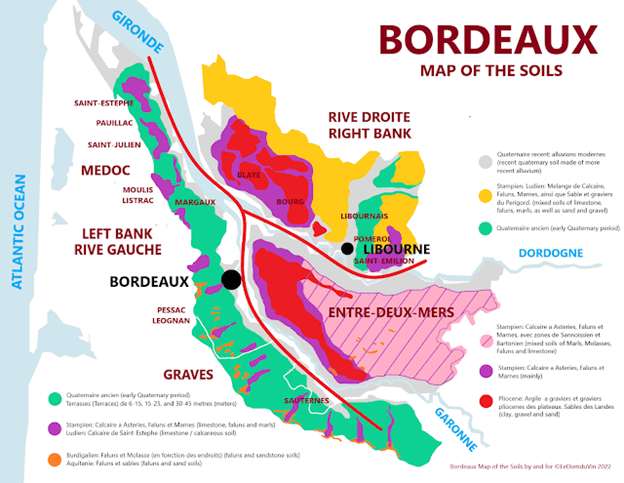
The heart of the white wine region in Bordeaux is the Graves region which the map above shows is south of the Medoc region of Bordeaux and on the left bank of the Gironde River.  At the very bottom of the map you will see Sauternes, home of the great sweet wine.  Just under the Bordeaux marker for the city of Bordeaux, you will see the Pessac Leognan region which is the AOC in Graves where some of the best white wines are made and I have three wines on the list from this AOC.  Some reasonably priced Bordeaux Blanc wines are made in the Medoc region on the Left Bank and in the some of the Right Bank vineyards.  There is a strong belief that the name for the Sémillon grape came from the town of St. Emilion, where some of the best Right Bank red wines are made.  The big pink area in the middle with the name Entre-Deux-Mers is worthy of note because it is developing a very good set of white wine estates and, because it falls in between the two famous regions of Bordeaux, the Left Bank and the Right Bank, its wines are lower priced, but still nice table wines.   The name translates to Between the Two Waters as it sits between the more famous Gironde River and the Dordogne River. 

Below are 10 Bordeaux Blanc wines that I recommend that you try listed in the order of my preference.  The bpttom wines on the list are in my cellar and highly recommended, the ones at the top of the list are just a little more my favorites.  The information for each of the wines comes from different web sources.  Where possible, I use the aromas and tastes that come from the website of the estate for that wine.  I also have what I usually see as the price for these wines, but they can differ based on different locations and vintages. 

The AOC designation is the specific geographic region that produces this wine.  For more information on Bordeaux AOCs, you can download a write up on  Bordeaux Geography and Geographic Classifications using the link below.  The heart of the white wine region in Bordeaux is the Graves region which the map below shows is south of the Medoc region of Bordeaux and on the left bank of the Garonne River. 

After this brief discussion of each of these wines, I have a short paragraph on where to get them. 

Lions de Suduiraut Blanc Sec – Bordeaux Blanc AOC.  This wine is my favorite Bordeaux Blanc.   It has a unique personality thanks to a singular blending style made of Sémillon and Sauvignon Blanc, depending on the vintage.  Smooth, subtle, fresh and mineral, with a creative profile, Lions de Suduiraut is modern and pleasant to taste young.  Suduiraut makes some of the best wines in Graves, including one of the top Sauternes.    In 2024 the blend was Sémillon 56%, Sauvignon Blanc 29%, Sauvignon Gris 15%.  $20.

Clos Floridene – Graves AOC, 55% Sémillon, 44% Sauvignon Blanc and 1% Muscadelle.  On the first day of our great trip to Bordeaux we had a cruise up the Gironde River, and this was one of the wines we were introduced to, and it immediately became a favorite.    Denis Dubourdieu was the white wine master of Bordeaux for years, consulting with all the top vineyards on their white wines until he died in 2016.  This wine comes from what was his personal vineyard in Graves.   Bright and lively in the glass, tangy and sharp but so well balanced with intensity yet softness, getting the liveliness and energy but also complexity of flavor – lemon, pineapple, apricot and peach – sharp, almost sour, so tangy and zesty in the glass just shining brightly.  $30.

Domaine De La Solitude – Pessac- Leognan AOC.  The wine stays near the top of my list even though it is very hard to find.  The great white wine from this estate at a very attractive price sells out quickly and a very large fan base in France limits the amount exported.    The typical bends are around 65% Sauvignon Blanc and 35% Semillon.  The palate is juicy, creamy, and fresh, with sweet, yellow citrus from start to finish. Aged for 9 months in French oak barrels on fine lees, these white wines are bottled before the following summer.  Its freshness, structure, elegance, and beautiful length on the palate give it a true aging capability. A few years in the cellar reveals an aromatic and gustatory complexity that offers numerous food and wine pairing possibilities.  $29.  Note – there is an estate in the Rhone Valley with the same name.  I have not had their wines but if you want to try this wine, be sure it say it is from Pessac Leognan. 

Chateau Hart-Vigneau – Pessac Leognan AOC.  The typical blend is 80% Sauvignon Blanc, and 20% Sémillon. Tropical fruit and lime flavors come through along with good acidity and a crisp aftertaste.  It has a brilliant pale yellow breezy bouquet of citrus gooseberries and a hint of Creme Brule. On the palate the Sauvignon Blanc and Sémillon notes race along glistening with an edge of brisk lemon pith as the wine provides a mouthwatering finish of white flower tarragon and graceful minerality.  $28.

Clos Des Lunes ‘Lune d’Argent – Grand Vin Blanc Sec, Bordeaux AOC, The typical blend here is Sémillon 70% and Sauvignon Blanc 30%.  The palate is dry with passion fruit and pear notes underpinned by a distinct salinity. The wine is medium to full bodied and has good depth. Acidity gives fair freshness.  A rounded, clean, pungent, fresh finish.  $20.

Les Legends Bordeaux – Bordeaux Blanc AOC.  The Legende wines come from the Domaines Barons de Rothschild, which is part of the Lafite Rothschild family of wines.  The Legende wines are the low-cost introduction to the wines from this most famous wine producer and they have a product range that includes each of the five major appellations in Bordeaux: Bordeaux Rouge, Bordeaux Blanc, Medoc, Saint-Emilion and Pauillac, These wines have an approachable style, inspired by every day drinkability and enjoyment. This blend combines tropical fruit notes such as pineapple and passion fruit with delicate mineral notes. Aged on lees, it has a nice roundness balanced by a fresh and crisp finish.  This wine has Sauvignon Blanc as the major partner, generally about 85%.   The 15% Semillon gives the wine its volume and an incredible sensation in the mouth, while increasing its longevity.  $20.

Chateau La Garde – Pessac- Leognan.  The blend for the 2023 vintage was Sauvignon Blanc 91% and Sémillon 9%, the highest percentage of Sauvignon Blanc for the wines in this list.  A fresh, chiseled wine with a distinctive mineral character, supported by great length.  The fresh array of citrus-packed lemon and grapefruit aromas on the complex nose are immediately inviting, accompanied by a typical note of Sauvignon on limestone. Semillon adds the perfect finishing touch to the blend, bringing generosity and balance.  $30.

Chateau Marjosse Blanc – Bordeaux AOC, This is the second lowest cost wine on the list and a great buy.  It offers fresh and floral with notes of white nectarines, crushed stones and hints of chamomile and citrus leaves. Medium-bodied, clean and textural. It’s crisp and tangy but shows delicacy and poise, flavorful and delicious.  The typical blend is Sauvignon Blanc 44%, Sémillon 32%, Sauvignon Gris 20%, Muscadelle 4%. Starting very recently, each kind of grape was harvested and vinified separately in order to have even greater control over the final blend, using only the finest lots. Grapes were harvested at night or during the early morning to take advantage of the cooler temperatures, control oxidation and preserve maximum freshness and complexity of aromas.  $15.

Chateau Granville Lacoste – Graves AOC.  Crisp, fresh, and refreshing with notes of citrus, cut grass, and subtle tropical fruits.  Sémillon 60%, Sauvignon Blanc 35%, Muscadelle 5%.    Their vines are five decades old and therefore have access to deep water reserves.  a rich, full, aromatic mid-palate to complement the clean finish of this wine.  $22.

Chateau Martinon – Entre-Deux-Mers AOC.  This wine introduced us to the very good white wines from this AOC that are real bargains.  A typical blend features ripe Sémillon that gives this wine a smooth character. Creamed-apple flavors are prominent, shot through with tangy gooseberry and grapefruit flavors.  $13.

Below is a link that lets you download a list of these wines which are listed by price, lowest to highest.

For those of you in the DC area, all these wines are usually carried by Calvert Woodley, but are not always in stock.  I just placed my end of year restocking order and was disappointed that the Clos Floridene was out of stock.  Total Wine lists over 100 Bordeaux Blanc wines but only Clos Floridene and Clos Des Lunes from my list.  Most of their Bordeaux Blanc wines I was not familiar with and only about 30 of them were under $30.  With Total Wine, the wines on the shelf will vary from store to store.  I strongly encourage you to use their web site to check on the store closest to you and see what they have in stock.  The easiest way to get any of these wines is probably to order them online from a licensed retailer that will ship to you location.  I do this often and have never had a problem.  Below is a link to my blog post Where Do I Find The Wines That Are Being Recommended?

https://billwinetravelfood.com/2023/07/29/where-do-i-find-the-wines-that-are-being-recommended/

I hope you find some white wines from Bordeaux that will be come your favorites and provide an interesting alternative to your Sauvignon Blanc favorites. 

One final thought about Sauvignon Blanc wines.  When God created the Earth, he lovingly sculpted one small section in France to be perfect for Sauvignon Blanc grapes.  That section is called Sancerre.  If you want to know just how good Sauvignon Blanc single varietal wines can be, try one from Sancerre. 

Decanting Wine – Why, When, and How

Decanting wines can significantly improve their taste.  If you are not currently decanting any wines this post will help you understand why decanting can have a very positive impact on the wines you are drinking and what wines benefit the most from decanting.  I will share some suggestions on how long you should decant it before you plan to drink the wine.  I will walk you through the process I use when I decant wines.  And I will talk about different kinds and shapes of decanters with suggestions on where to get them if you want to start enjoying your wines decanted.

If you don’t think decanting is something that you want to get involved with, I encourage you to try a simple experiment.  Open a bottle of red wine like a Cabernet Sauvignon.  It can be an inexpensive bottle, but you will see more results if you go at least as step up from the mass-produced wines like Cupcake or Dark Horse to something in the $20 range.  Pour a glass of the wine and put the cork firmly back in the bottle and let both sit for at least an hour.  Take the cork out and pour a second glass of the wine and compare the tastes.  I will be very surprised if you don’t find the wine that was in the glass for an hour more enjoyable than the second glass that was just poured from the bottle. 

Why Decant Wine

There is a popular misconception that only very old red wines should be decanted to separate the wine from the sediment that has accumulated in the bottle.  That is a good reason to decant old wines, but the better reason is that many wines will taste much better when they are decanted.  I decant virtually every bottle of red wine that we drink.

The reason for this is the same as why many wines taste better when they have aged for years in the bottle.  The reason is oxidation.  Rapid oxidation is wood burning.  Sow oxidation is rust forming on metal.  In both cases the oxygen in the air is reacting with the wood or the metal and that reaction changes the wood or the metal.  With wine, the very small amount of air that is trapped inside the cork, or inside the screw top, reacts with the wine and changes it.  Because there is so little air, the change happens very slowly.  With wine the oxygen is reacting to some of the elements in the wine and one of the byproducts of that reaction is sludge forming in the bottle, like the flakes of rust on metal or the ashes left when the wood is fully burned.

One of the elements that reacts to oxygen is the tannins in the wine.  Tannins are most prevalent in red wines but in the next section I will talk about decanting some white wines. 

If you take a sip of red wine and swirl some under the inside of your upper lip, you are likely to get a burning sensation, either a little or a lot.  The nerve endings there are very sensitive to tannin.  When red wine is first made the tannins are strong and rough in taste.  As the wine matures over the years the tannins can get softer, and more gentle.  You will hear reviews of wine talk about tannins being nicely rounded after the wine has matured.  While the mature tannins may be one of the most noticeable changes in the taste, the oxidation that happens as the wine ages in the bottle also helps it develop more depth and character.

Decanting causes many of the same reactions to happen in a few hours instead of 5-25 years.  Let me be perfectly clear.  A good wine that is properly aged for 10+ years will taste better than that same wine decanted shortly after bottling.  But if we don’t want to wait 10 years to drink that wine, decanting it will cause that wine to taste much better than if you pull the cork from the bottle, pour it into a glass, and start to drink it.

The reason is that the decanting process causes much more of the wine to be exposed to much more air then when it is kept in the bottle corked. So the reactions happen much faster than they do in the bottle.  Pouring the wine into the decanter exposes all of it to air.  More so if the wine flows down the sides of the decanter as it is poured.  When the wine sits in the decanter it has a much larger surface area exposed to the air than just the tiny amount in the small neck of the bottle.  And there is much more oxygen available to the wine than just the little amount inside the cork.

So, the answer to why decant wines is that it rapidly speeds up the process of wine aging and developing more character and nicer tannins than if you just pull the cork and pour the wine.

What Wines Should Be Decanted?

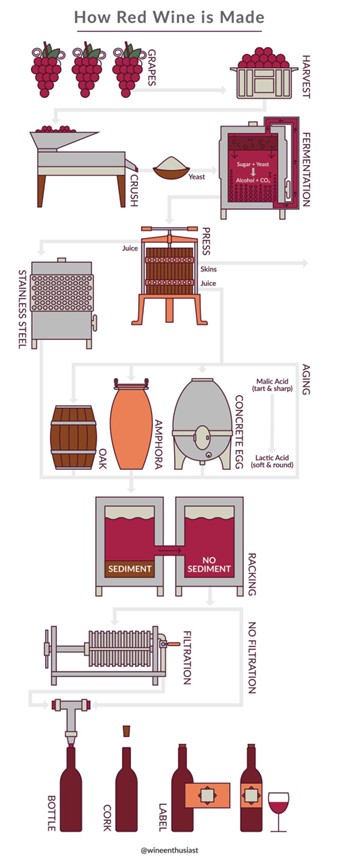
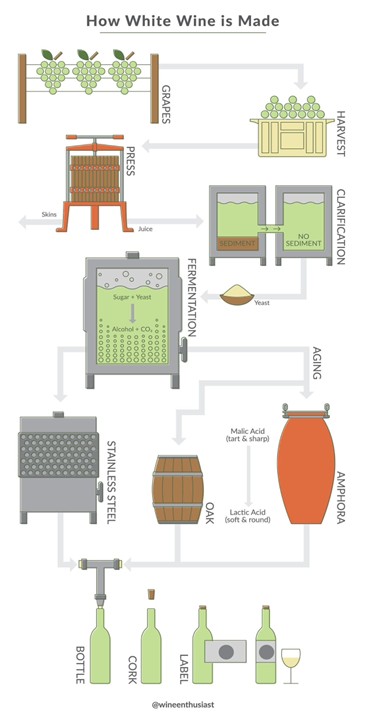
I decant virtually every red wine that I open. But I decant only one white wine from certain regions.  The two flowcharts below from Wine Enthusiast show the different processes for making red wine and making white wine and this will help me explain why decanting is much more common with red wines than with white wines. 

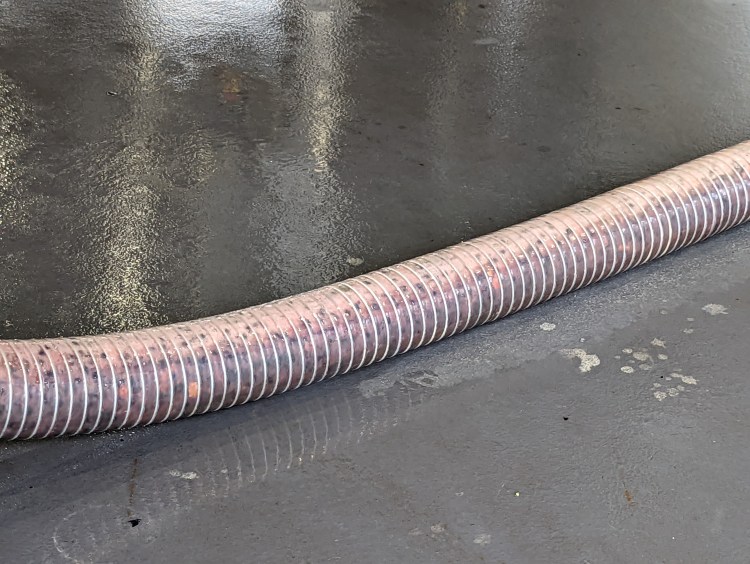
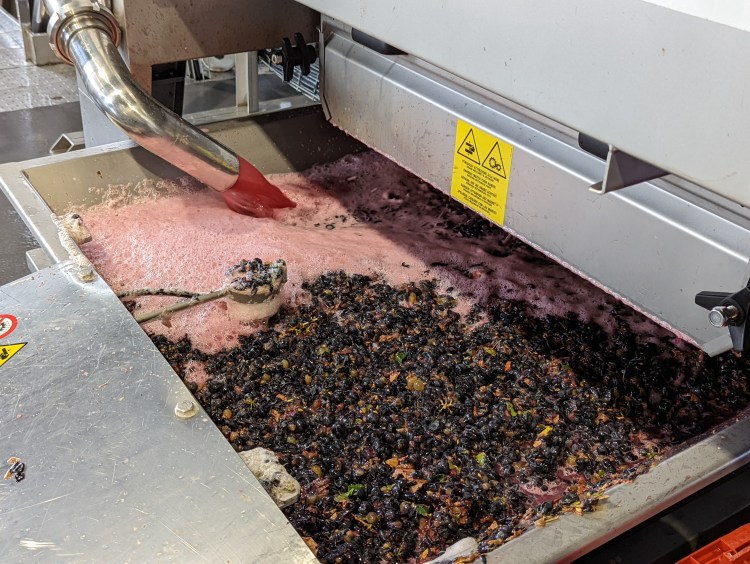
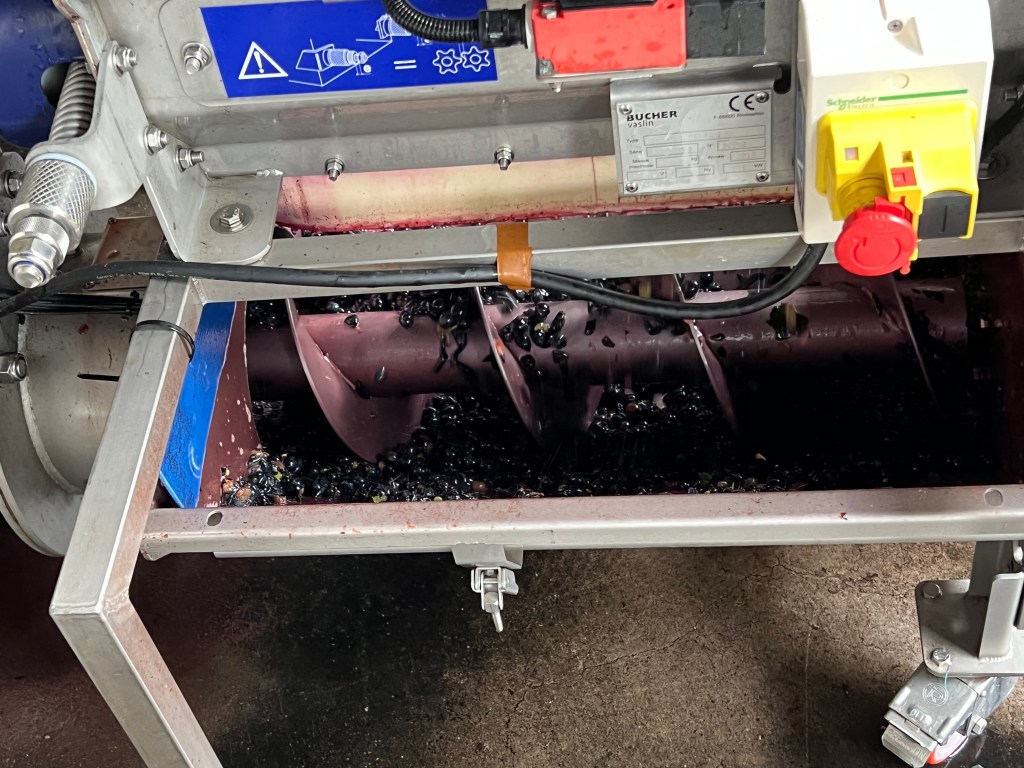
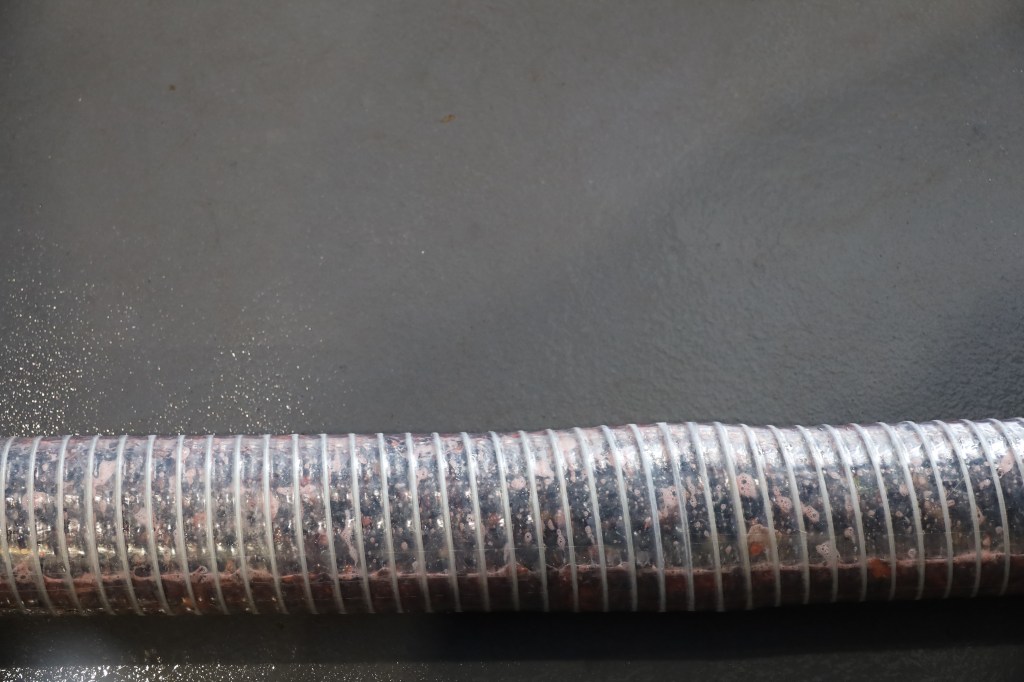
Almost all red wines, except those made in the bulk wine process, are crushed to get some of the juices from the grapes, but the crushed grapes are then put into the fermenting barrels along with the juice that came from the crushing process.  This is done because the skin of the grape contains much more flavors than just the juice that comes when the grape is pressed.   All the color in the wine comes from the skin of the grape.  If you press a red grape the juice will come out clear and very good white wines are made using the juice from red grapes.  Just one example is the legendary French champagne where generally 2/3 of the juice used to make Champagne comes from two red grapes.   The two pictures below show first a grape crusher and second the large hose that is taking the crushed grapes and any juice that came out from the crushing and pumping that mixture into a fermentation tank.

Most white wine is made from just the juices pressed out of the grapes with no chance to pull all of the goodness that is in the skins of the grapes, that wine will not age well.  My rule of thumb is that white wines need to be drunk no later than 5 years after the date on the bottle.  They just get darker in color and stronger in taste as they get older.  The two noteworthy exceptions to this is French Champagne  and Chardonnay that is specifically made to be age worthy, both of which can age for years.

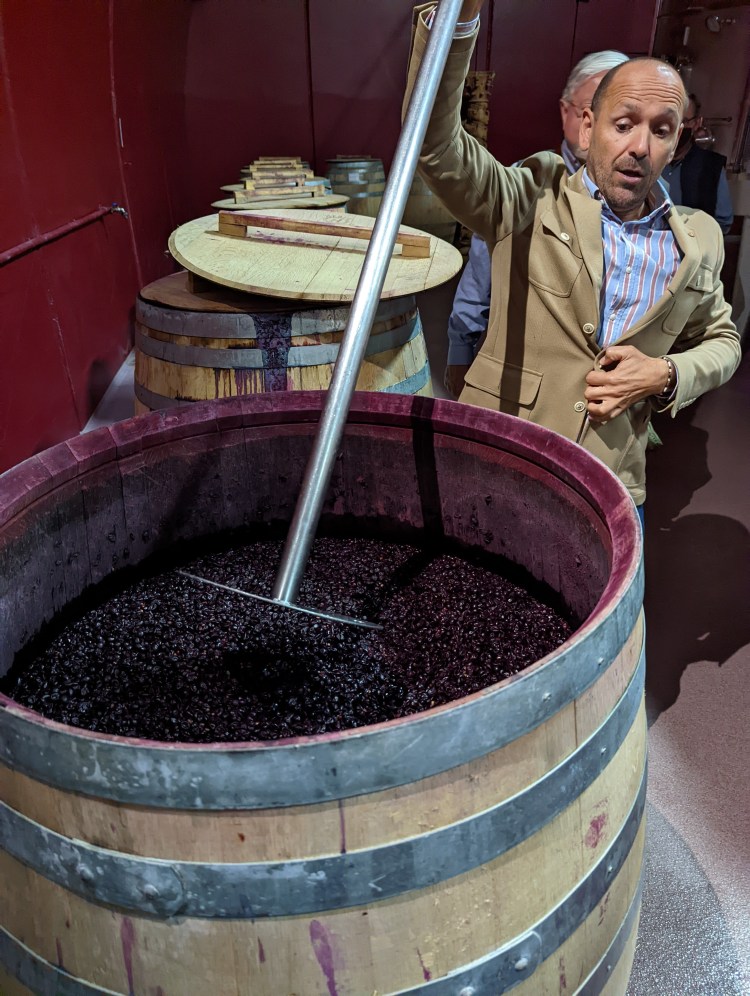
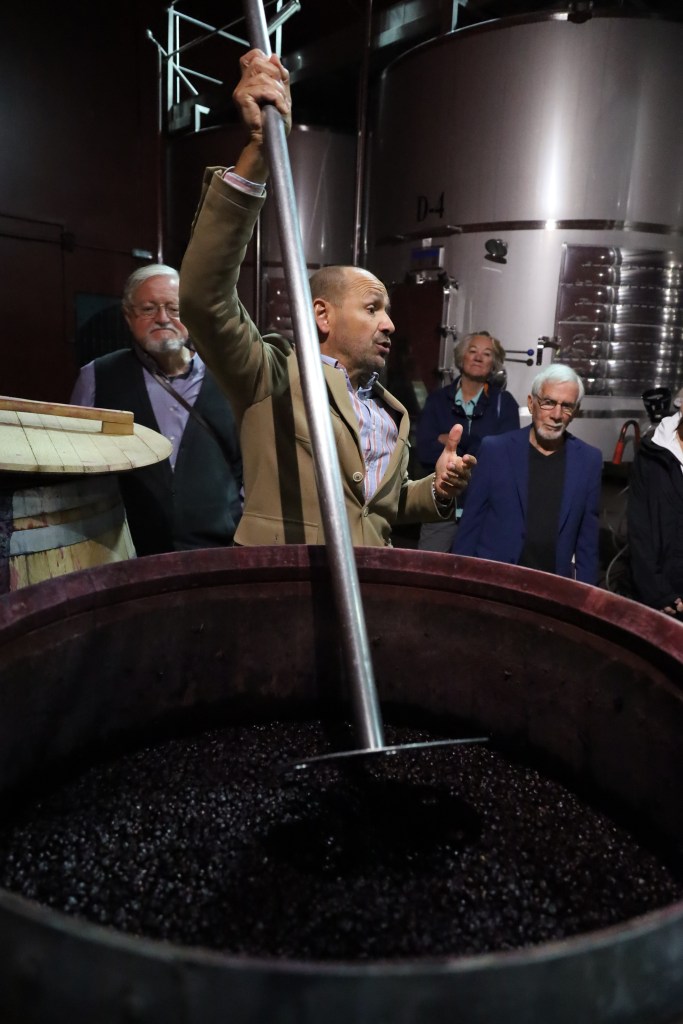
The crushed red grapes sit together with the juices in the fermenting barrel generally for at least several weeks, what is called the juice sitting on the lees.  This lets the juice extract the color and flavors from the skin of the grapes.  As the fermentation process happens the yeast give off CO2.  That gas gets trapped in the crushed grapes and causes them to rise to the top of the barrel and form a mat of crushed grapes floating on top of the juices.  The intent is to have the skins and the juice together in close contact, so it is necessary to break up that mat and mix the two together whenever that mat forms on the top of the fermenting barrel.  There are several ways this can happen.  Punching down the crushed grapes with some kind of tool is the most common and the picture below shows that being demonstrated.  Pumping the juice from under the crushed grapes to be on top of it so gravity breaks up the mat is another way this this can be done.  How often and how it is done is part of the winemaker’s individual process and contributes to wine from adjoining estates having very different flavors, based on the way the wine was made.

Some white wines are crushed and then go through the same process of sitting on the lees as described above.  The skin of white grapes will not impact the color of the wine like red grapes do, but they do add tannins and other flavors to the wine.  I think the best example of this is White Burgundy.  This is made from just Chardonnay grapes but having the juice sitting on the lees adds complexity to those wines that lets the top producers in Burgundy get hundreds of dollars a bottle for Chardonnay wine.  Those wines can age for decades in a cellar, and they benefit from decanting, especially when drunk younger.   California Chardonnay is not made to be age worthy and should be drunk within five years of the vintage date and not decanted.  However, most winemakers in neighboring Oregon closely follow the Old World or Burgundy style of wine making for both their Pinot Noir red wine and their Chardonnay.  If you are paying over $40 for an Oregon Chardonnay, list price from the winemaker, not restaurant price which has at least doubled the list price, you are getting an age worthy Chardonnay that will benefit from 5-10+ years in the cellar and should be decanted like red wine.

You may see some articles talk about double decanting.  What that means is that the wine is poured from the decanter back into the wine bottle using a funnel.  Some people do this because they like people to be able to see the label on the bottle when they are pouring the wine.  The initial pouring from the bottle into the decanter provides the a great deal of exposure to oxygen so a second pour back into the bottle is a second major oxygen rush.  If I want to double decant I would leave the wine in the decanter for an hour at most before doing the double decant back into the bottle.  If I have not been able to decant the wine and I am opening it very close to the time it will be served, double decanting will give a similar impact to 3-4 hours in the decanter.  I think the couple of hours sitting in the decanter is gentler and I prefer that to double decanting whenever possible. 

When Should I Decant The Wine?

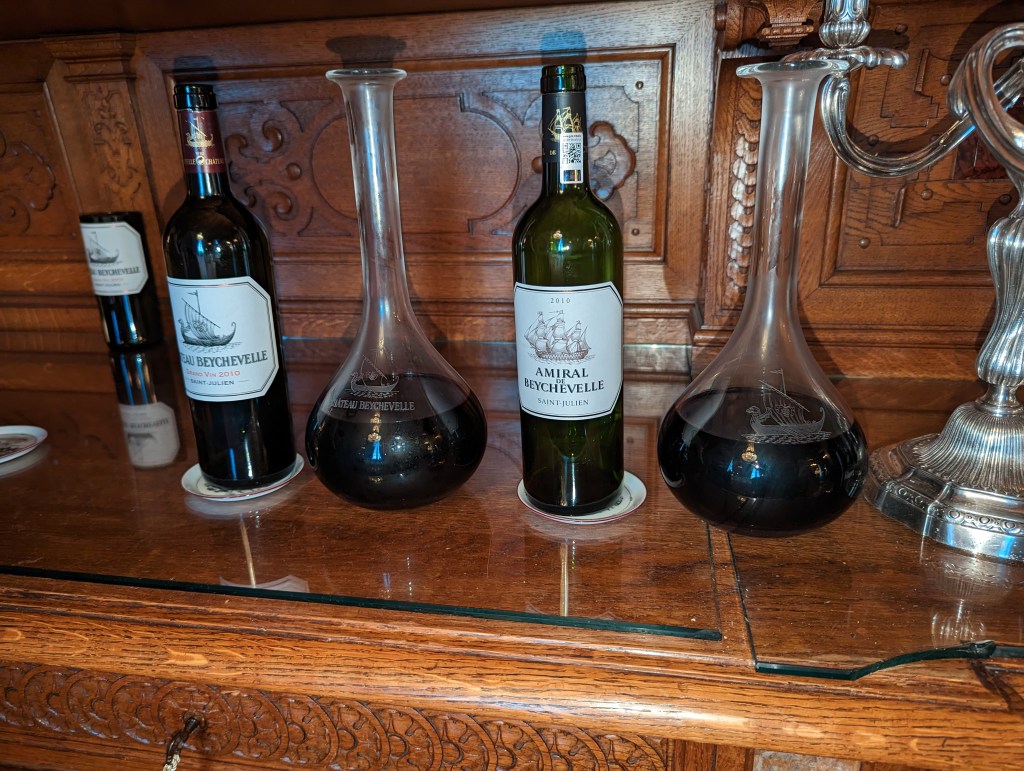
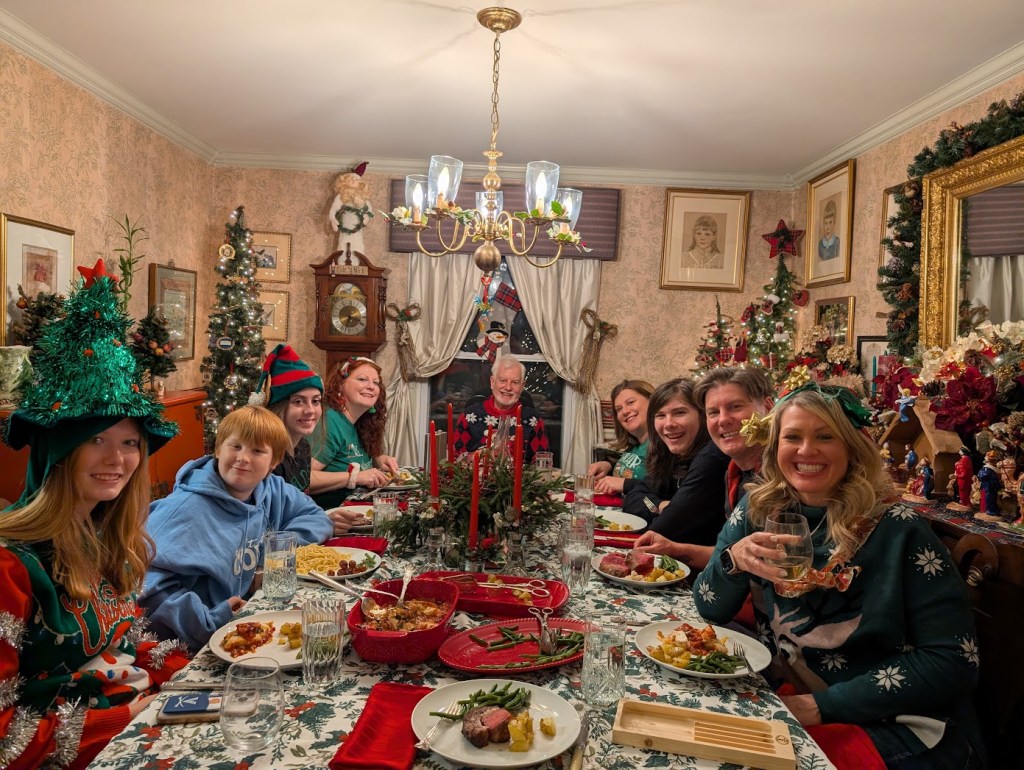
The picture above is from a wine tasting dinner that my wife and I attended at Chateau Beychevelle in Bordeaux two years ago.  The six wines we were served included two from 2010, and one each from 2005, 2000, 1996, and 1986. All of the wines they served us with that dinner had been decanted, not just the older vintages.  I asked when they had decanted those wines and our host said right after lunch that day!  If I am planning a red wine to accompany dinner, whenever possible I now go down to my cellar after lunch and select the wine and decant it.   I usually serve it between 6:30 and 7:30 PM.  I do this for $9 table wines and for $75 Pinot Noir.  It is easier for me to do this now that I am retired and am home most days.  If I have lunch away from home, then I do the decanting as soon as possible after I get home. 

Decanting adds a great deal to the taste of the wine, but serving wine at the wrong temperature can hide many of those delicious flavors and complexities.  One of the recurring themes in my blog posts about wine is that we in America drink our red wine too warm and our white wine much too cold.  When wine is decanted, especially if it is sitting on the counter in the decanter for hours, it will be at room temperature.  For the reasons explained below, red wine almost always shows it best flavors at 60-63°F.  I have a small wine fridge that lets me stand up some bottles, so I have a place to put a full decanter of wine.  I keep that little wine fridge set at 55° and take the decanter out and leave it on the table for 30-45 minutes before pouring the wine to get up to at least 60°.  If you have heard my rant about wine temperature before you can skip down to the next section about types of decanters and sources for them.

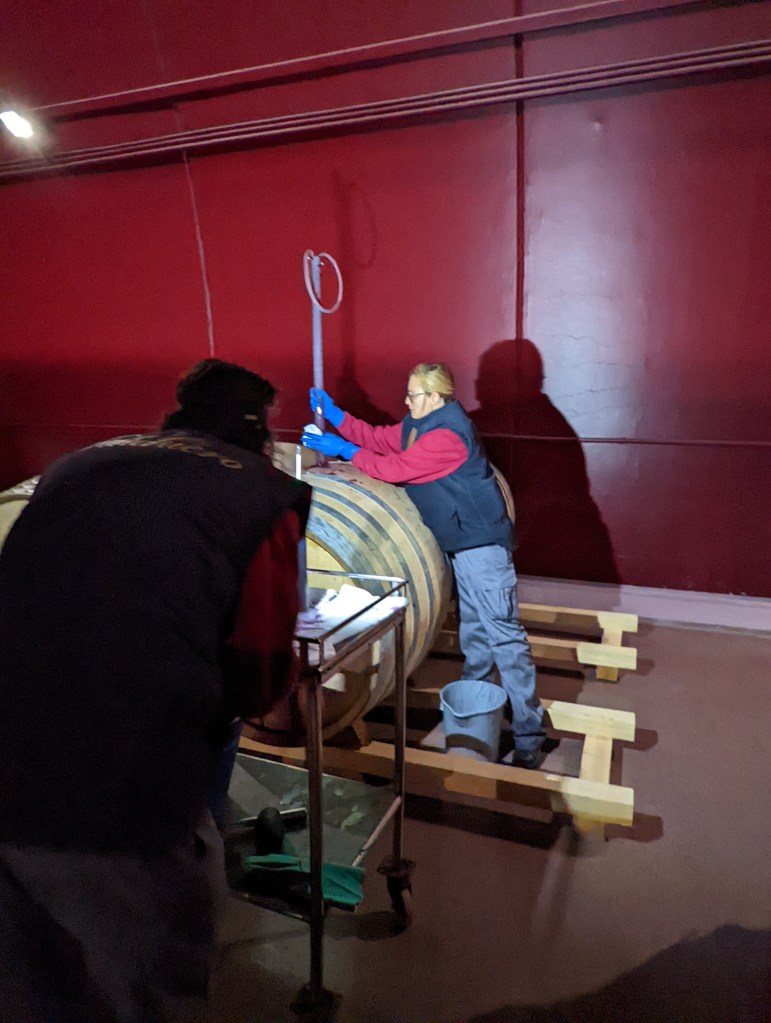
Most good red wine is made in cellars which are kept at 15°C or about 59°F.  After the fermentation the wine is aged in different vessels, most often stainless steel tanks or oak barrels, and kept in a cellar kept at that temperature.  The winemaker then blends the wine from different tanks or barrels into the finished product. The wine he or she is tasting to do that blending is at the cellar temperature.  See the winemaker wearing a vest as she tastes the different barrels for blending in the picture below.

Even if it is a single varietal wine like Pinot Noir or Cabernet Sauvignon, the wine is typically a blend of different plots of that grape to get the specific flavor the winemaker is looking for.  If the winemaker is tasting wines at 60° to find the right blend, he or she is creating a wine that will taste the best when consumed at that same temperature.  If you go to the winery web site and they have a data sheet on the wine, sometimes that will have a suggested serving temperature for that wine.  60° is not cold wine.  It is cool to the taste. 

Most white wine is made to be consumed at 50-55°F.  Wine served right out of a refrigerator that is at 40° will hide much of its flavor.  If I had that wine in my wine fridge, it would be a little too warm at 55°. I put the open bottle standing up in my kitchen fridge for about 30 minutes to bring it down to 50°.  If it was in my kitchen fridge for some reason, I take it our 40-50 minutes before serving to warm up to at least 50°. 

Another simple experiment is to try two glasses of wine at the different temperatures. One would be at the temperature I am suggesting and one if you just open the bottle and taste it. To do an experiment with the red wine, pour a glass and put that glass in the refrigerator for 30 minutes. Take it out and pour a second glass from the bottle that has been sitting on the counter. For a white wine experiment put a bottle in your refrigerator overnight. Take the bottle out, open it, and pour a glass and leave it sitting on the counter. Put the bottle back in the fridge for 45 minutes. Take it out and pour a second glass. In both experiments the wine in one glass will taste different from the wine in the other glass. I think you will find that the wines at the temperatures I am suggesting have more flavors.

In a restaurant I have no control over what temperature they bring the wine to me.  But I ask them to leave the white wine bottle on the table and not put it in an ice bucket.  When I order a bottle of red wine in a restaurant I always ask if they can decant it.  About 80% of the restaurants are happy to do that.  Sometimes the waitperson has a totally blank look and has no idea of what I am asking.  I then ask them to ask their manager if they are able to decant the wind that I just ordered.  Even if it just sits in the decanter for 15 minutes until the food is served, that will make the wine taste better.  It also delivers a message to the staff the I am knowledgeable about food and wine. 

How Should I Decant The Wine?

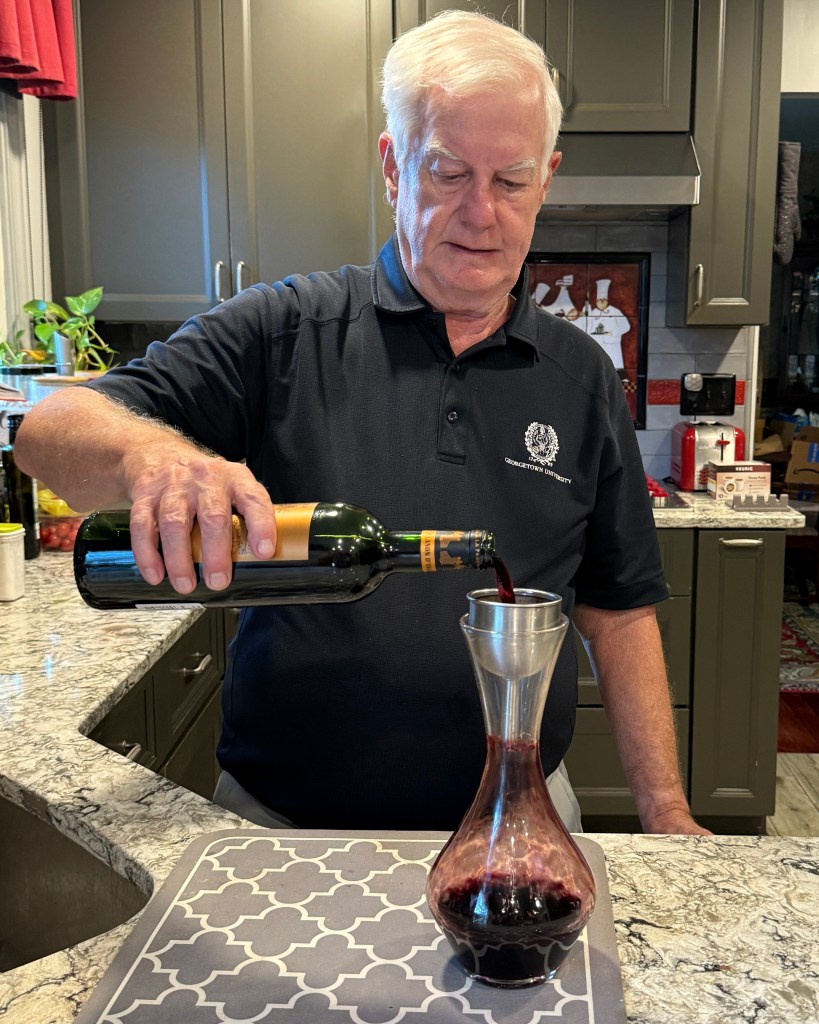
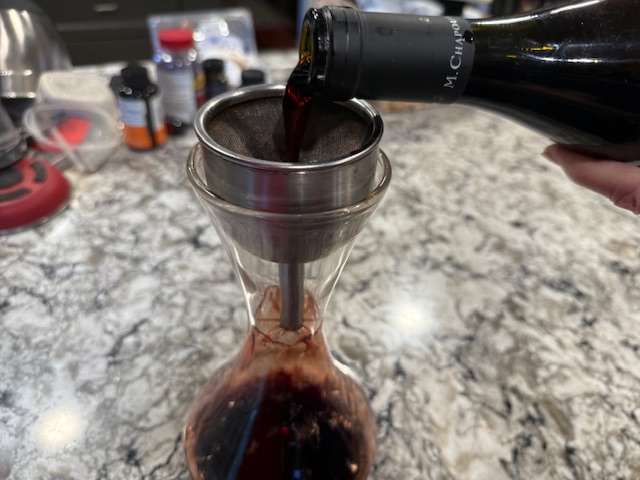
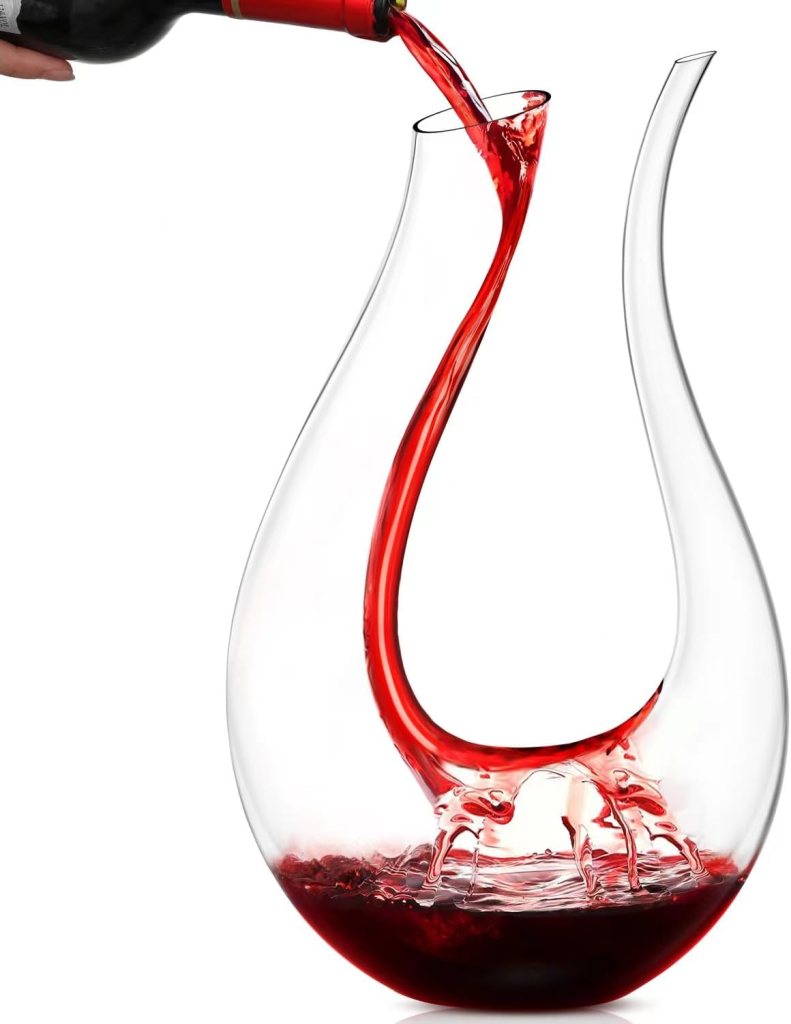
Here are several pictures to help the discussion of how to decant wines.  I use an aerator that has a cup that I slowly pour the wine into, and the bottom of the stem that is inside the decanter has eight small openings.  As you can see in the picture below, this causes the wine to go in multiple small streams down the side of the decanter.  This is letting much more wine have much more exposure to the oxygen in the air so the initial process of pouring the wine into the decanter has even more impact.

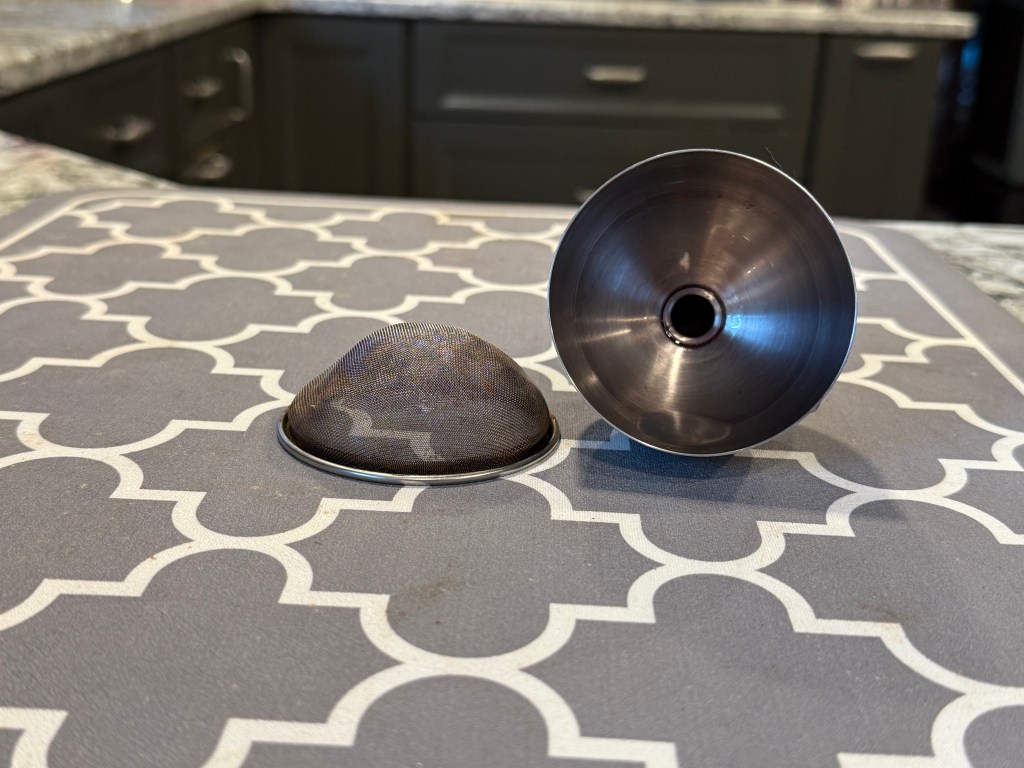
A small wire basket sits inside the cup to catch any sediment in the wine and any bits of cork that came off when the cork was pulled.  The second picture shows the two pieces which were bought as a package on Amazon.  It is listed as 3in1 Steel Funnel with Strainer (Wine Shower + Aerator + Filter) and the link for it is below.  It is listed as Amazon’s Choice with a rating of 4.5 stars and over 900 reviews.  Amazon has hundreds of wine aerators listed so feel free to pick the one that most appeals to you.

https://www.amazon.com/dp/B06Y1Y9WTB?ref_=ppx_hzsearch_conn_dt_b_fed_asin_title_1&th=1

NOTE: This blog is a retirement hobby and not intended in any way to make money.  When I list a product, like the one above, it is only to make it easy for you to evaluate it.  I get no incentive or recognition for any product that I recommend. 

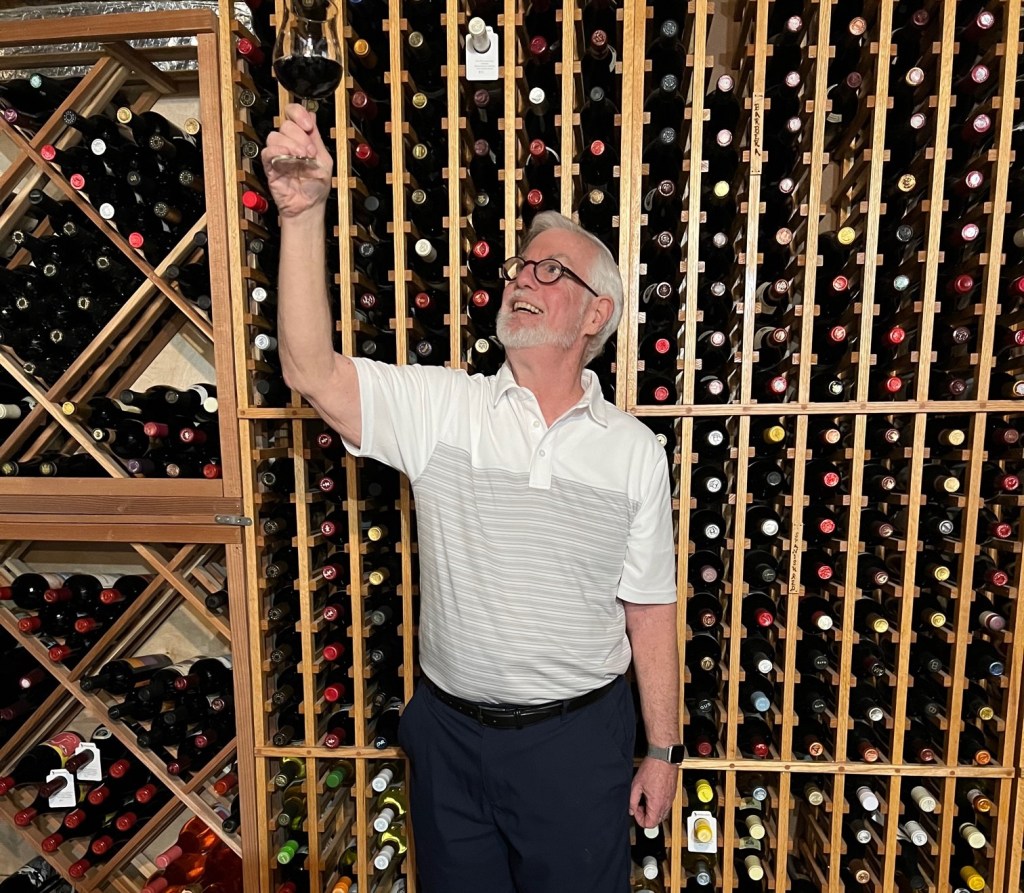
The picture at the very beginning of this blog shows me decanting a bottle of wine.  The more that you can make a smooth, even pour that does not overflow the cup or lets it empty out, the better.  But it is not any issue if you get interrupted for some reason and have to stop the decanting and then continue it a few minutes later. 

There are also mini wine Aerators that you plug into the neck of the wine bottle.  They use different means to swirl the wine around before it gets into your glass.  Any aeration is better than pulling the cork and pouring a red wine into a glass, but these mini aerators have nowhere near the same positive impact as decanting the wine.   I am not a big fan of these mini aerators. 

What Decanter(s) Should I Buy & Where Can I Buy Them?

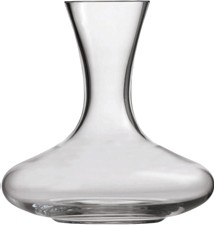
If your Grandmother has some decanters in a cabinet which look like this picture, please do not accept them as a gift so you have a free decanter.  The very large base does give even more wine exposure to the air but these decanters have a huge base that takes up an enormous amount of space on the table.  They also take a great deal of practice to pour the wine into a glass without a flood of wine going all over the place.  I don’t want to pour nice wine on the table just to practice.

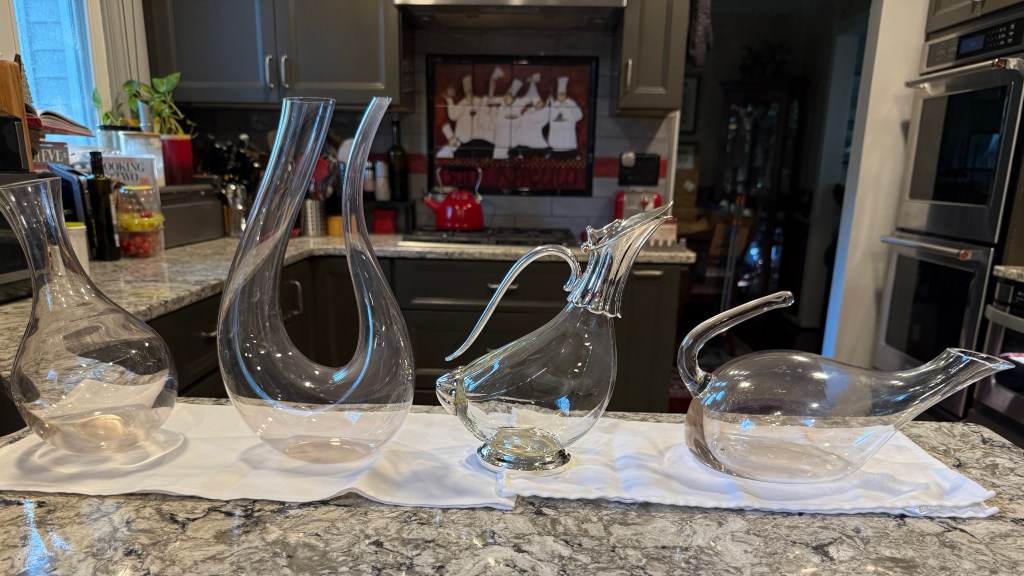
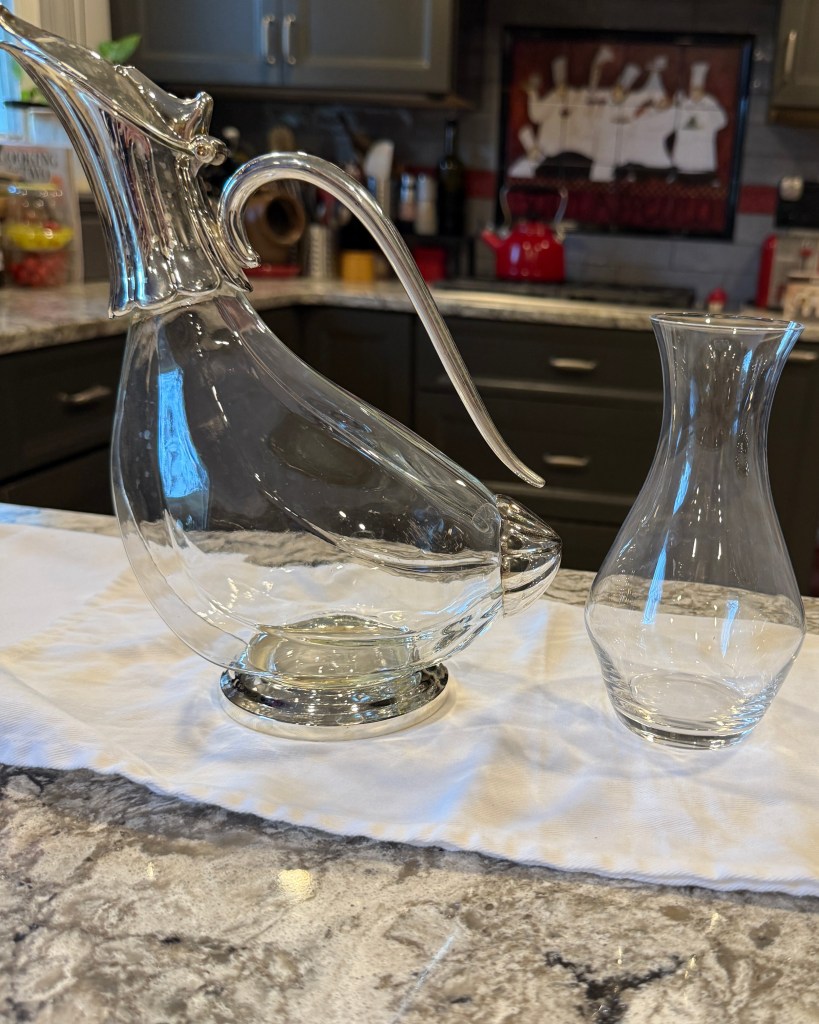
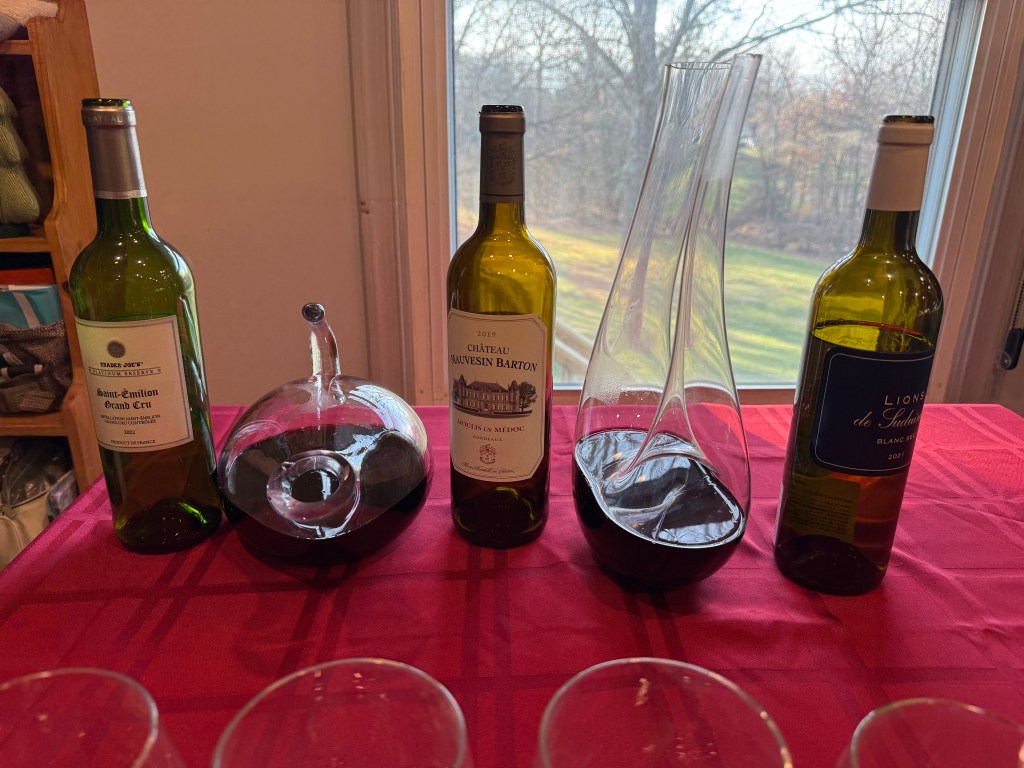
Below is a picture of the four decanters that I really like and use when I have a party with multiple wines available for tasting.    I will talk briefly about each of them individually.  Amazon has an excellent selection of decanters and generally their prices are pretty good.  The website for Wine Spectator also has a good selection of decanters.  Just for fun, check out all the decanters that Reidel has at Riedel.com.  Four pages of decanters, some of them very attractive and some of them look like a puzzle of where does the wine come out.  Some of them are $650 each but three of them are just $55: Veloce, Performance, and Merlot.  The decanter used in the pictures of me decanting the wine is the Riedel Merlot decanter, but we got it at Bed, Bath, & Beyond for much less.  I think most if not all of their stores may be gone by now but their website is still operational and that decanter is there at a price of $36.73.  Amazon has that same decanter for $50 and if you get free shipping as an Amazon Prime member, the net price could be pretty close to Bed, Bath & Beyond.  Lots of availability to get a good general purpose decanter to get started with at a reasonable price  and see how you like it.

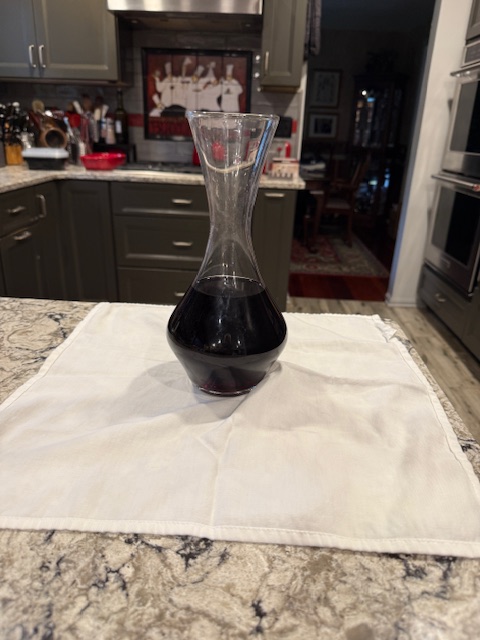
the picture below is our everyday decanter. As noted above, it is the Reidel Merlot decanter purchased from Bed, Bath, and Beyond. I don’t drink California Merlot but the Riedel Cabernet Sauvignon decanter looks very similar and is 2X the price. I am pretty confident that my palette could not tell the difference if the same wine was decanted into the Merlot decanter and the Cab decanter, so I am fine with the much lower cost one. I use it for every different kind of red wine that we drink (which are many) and are very happy with the results each time. When I am doing the dishes I first rinse it with soapy water first, shaking the decanter to get overall coverage, and then a rinse with clean water to get all the soap out. I have a little gadget on the counter with four spikes standing up in the air. I put the decanter upside down over one of the spikes to dry. I can put any of our water bottles over the other spikes. Every few weeks I take a long handled brush and use it to scrub the sides and bottom of the decanter. About every three months I put into the dishwasher with the dinner dishes for a thorough cleaning. Riedel lists it as dishwasher safe. Because the other decanters listed below are used much less often, they just need the two stage rinse after each usage.

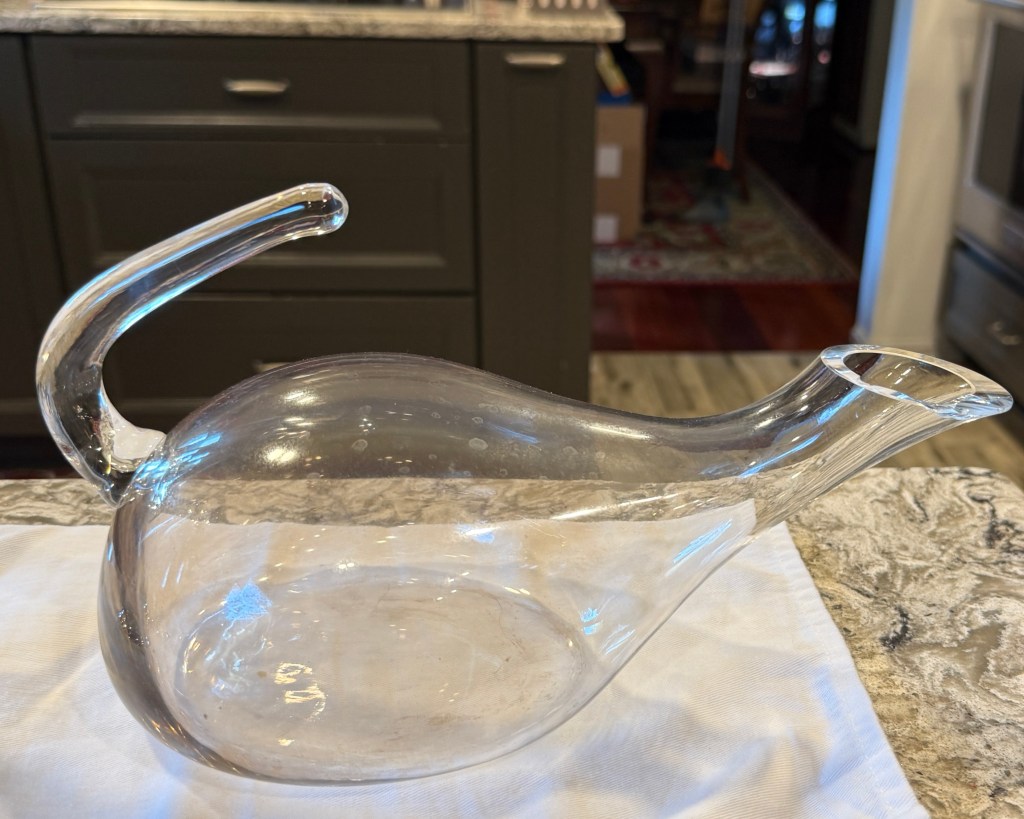
We saw the decanter below at a wine tasting and fell in love with it.  If you checked out all the Riedel decanters as suggested below, you saw that having them bend in all different directions is very popular now.  The wine is poured into the decanter through the larger opening and I can put by aerator into that opening with no problem.  The wine is poured into the glass through the narrow opening.  If you just experiment with pouring some water into a wine glass when you first get it, you will find it is easy to use and control the pour.  Amazon has this decanter for only $37!  It really impresses guests who are not very into decanting.  Having a decanter for each wine when you are serving several makes it easy to taste and compare different wines. 

For my most expensive wine this is the decanter that I use.  It has had Lafite Rothschild in it twice.  It provides the most surface area for the wine to interact with the oxygen in the air, and it is a very attractive decanter.  I don’t remember where we got this decanter so I can’t suggest where to look for it or anything about its price. 

For a long time the classic decanter is fine restaurants was the Duck Decanter.  We have one that is also for special occasions.  But because we do not want to polish the Sterling Silver that this decanter has, we keep it sealed up so the sliver does not tarnish.  It is a great style of decanter to give the wine lots of surface area to breathe and is very attractive. 

I also have a mini decanter as shown in this next picture.  If my wife or I are dining alone and want a glass of wine with our dinner, we can pour it into this mini decanter and put a stopper in the rest of the bottle for another day.

I hope you have found this blog post on decanting interesting and informative.  I’d love to hear if you decide to make decanting part of our standard routine to serve and enjoy wine.

A Different Approach to Tacos

We have always enjoyed tacos.  Beef tacos, pork tacos, fish tacos – we love them all.  when making them at home for years we bought one of the boxes of preformed corn taco shells at the supermarket and just loaded them up with the protein and all the fixings.  At Beth’s suggestion we recently tried a different approach – and we really liked the results.

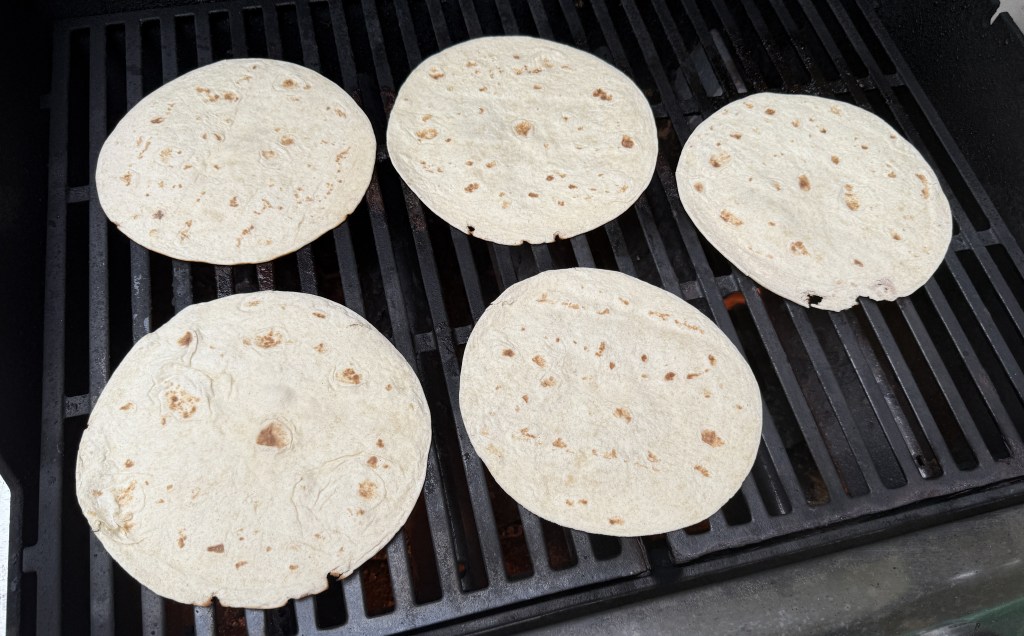
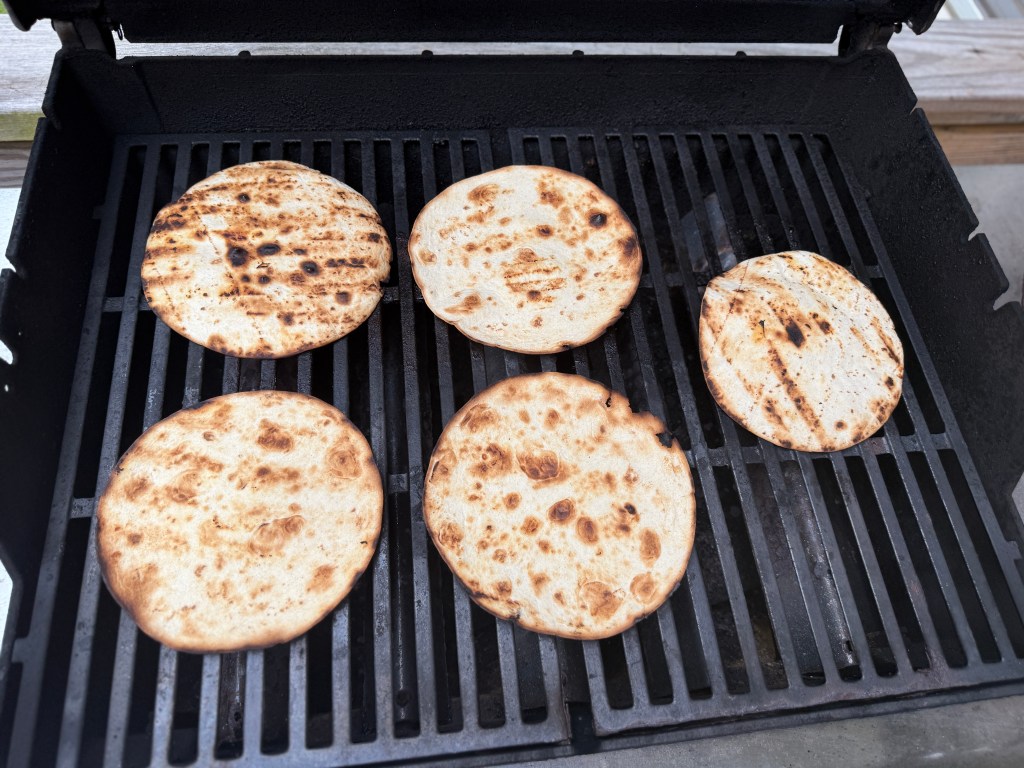
We bought a package of flour tortillas and quickly toasted both sides on the gas grill.  The three pictures below show: the package of tortillas, a set of them just put on the grill, and then after they were flipped to toast on the second side.  You can see a little color on the tortillas in that last picture. 

On my grill I do this at high heat, generally after I have grilled the protein that will be in the tacos, and it is resting for a few minutes.  I do them on one side for about 30 seconds and on the flip side for about 20 seconds.  This gets them crisp with a nice texture.  One time I did about 40 seconds on each side, and they ended up just being a large cracker with no ability to fold them around the taco fillings.  Don’t do that!  Maybe try one tortilla on your grill the first time so see how much time you want for each side.  The goal is just a little bit of color and foldable, but a little crispy. 
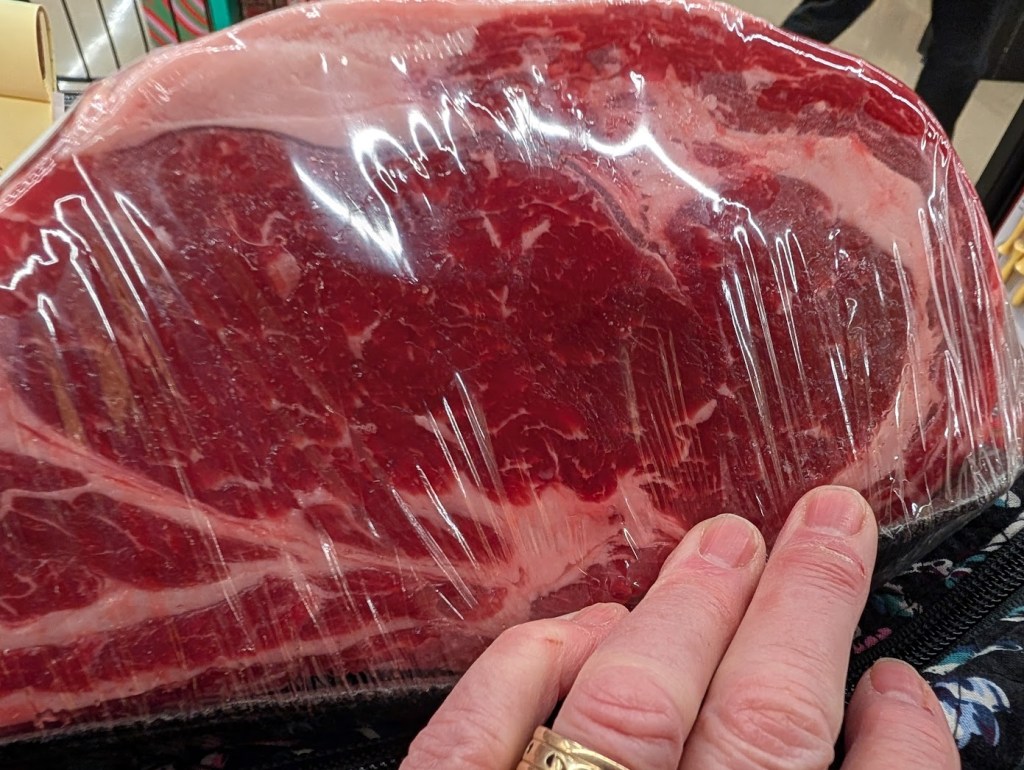
Our most used protein for tacos is skirt steak which has been marinated at least for a few hours and then grilled on high heat for 2 minutes on each side.  It then rests for 5 minutes to let the juices be absorbed by the meat.  I use one of those minutes to quickly toast the tortillas.  More time if I need enough tortillas that it takes more than one batch based on how many tortillas I need.  My grill is fairly large and I can do six of the flour tortillas at a time.  I slice the skirt steak on the diagonal into thin slices, against the grain of the meat.  Skirt steak has long ridges that run down the meat which indicate the grain.  Slicing against the grain means slicing across the long ridges.  Slicing it with the grain would have you slice it in parallel to those ridges, and those slices will be much less tender than those sliced against the grain.   

The thin slices of skirt steak are tender and easy to eat and very flavorful.  But some grilled fish would be great as well.  Even if you are using ground beef that you cook in a fry pan, you can still fire up your grill and quickly toast the tortillas.  We have only tried this with flour tortillas.  I see no reason why it would not work with flat corn tortillas, but I cannot suggest what the timing would be for those.  You might have to experiment with one or two to find the right time for each side.  If you have success and enjoy having toasted corn tortillas, please post a comment so others will know how long it will take to toast the corn tortillas.  I think we are locked into using flour tortillas. 

I hope you give this a try and provide your feedback. 

How much do you have to pay to get a nice bottle of wine to drink? 

Well, if your table wines are Classified Growth Bordeaux wines, then your definition of a “nice” wine, and your budget, is very different from mine.  My definition of nice is a wine that complements my everyday dinner and I enjoy drinking it every time I open a bottle.  Finding those wines at really attractive price points has been a long time quest, and this blog will share 13 of the best finds.    And they range in price from $8 all the way up to $15. 
The challenge will be finding some of these wines.  Three of them come only from Trader Joe’s, but none of them are “2 Buck Chuck”.  The Trader Joe’s where I live in Maryland cannot sell wine, so I drive 30 minutes into Virginia to get these three wines, and I am very happy to make that trip to have these three wines in my cellar.  Two others have only a few places in this country that are selling them now.  For each of the wines I have some suggestions on where to find it and at the end of the blog I have a link to my earlier blog post on suggestions for finding wines that are not on the shelf at your local liquor store. 
If you have been following some of my blogs on wine then you know that I think Americans drink their white wines way to cold and their red wines too warm.  The link below shares some ideas on how to get your wines to show their full tastes and aromas. 

Below is a short write up on each wine with a picture of the bottle to help you see if your local store has that wine.  I also have a list that you can download at the end to take to the store with you.  The first five of them are white wines and the last eight of them are red wines.   All of them are dry wines, but for one of them there are options for three different degrees of sweetness. 

White Wines

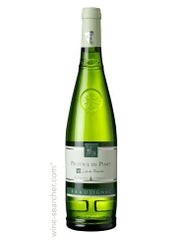
Picpoul de Pinet:  This is lovely dry white wine with medium body from the very southern shores of France down on the Med.  Its full name is Les Costières de Pomerols “Hugues Beaulieu” Picpoul de Pinet but everybody just calls it by the last three words in that name, and often just Picpoul for short.  It comes in a tall thin green bottle and for a while years ago it was the house white wine at the Inn at Little Washington, one of the top 10 restaurants in the world.   The price has gone up from when we first started enjoying this wine over 30 years ago, it is now all the way up to $10 a bottle.  It is one of several seafood wines that we enjoy, and it is a great wine to serve before dinner or at a cocktail party.

Where to get this wine: It has enough of a following that a reasonably good wine store might have it on the shelf.   Total Wine has it in many stores for $11.    Wine-searcher.com has a large number of resellers for this wine who ship to most states.  Their prices range from $10-13.  Wine.com has it on their site for $17.    In Maryland the Montgomery County Liquor stores have this wine for $12.                            

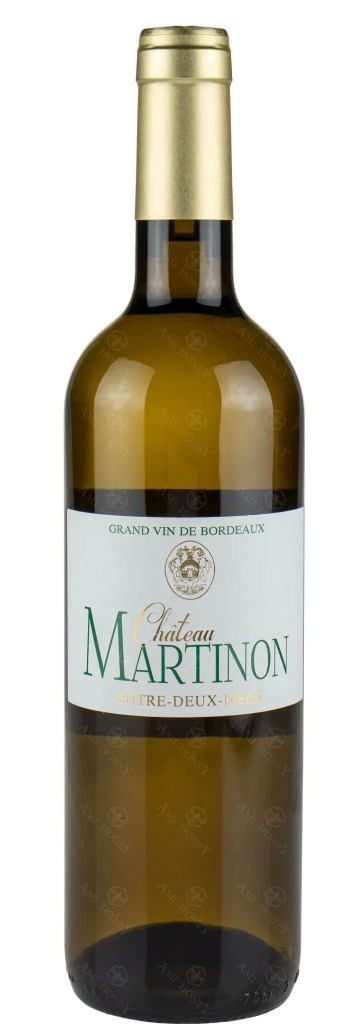
Château Martinon – Bordeaux Entre-Deux-Mers – This lovely white wine is from the Bordeaux region of France.  While known most for its very famous red wines, there are very good white wines made in Bordeaux.  Some of them sell for hundreds of dollars a bottle, gut this one is just $11.   The Entre-Deux-Mers on the label translates to between the two waters and defines the region between the two famous Bordeaux locations, the Left Bank and the Right Bank.   If you want a simple introduction to the different regions of Bordeaux, the link below might be of interest. 

Most white Bordeaux wines are a blend of Sauvignon Blanc and Semillon grapes.  This one is 60% Semillon, 25% Sauvignon Blanc, 13% Sauvignon Gris, and 2% Muscadelle.  James Suckling describes it as “This is showing aromas of chopped herbs, gooseberries and acacia flowers. It’s bright and floral with a medium body and a crunchy, clean finish.”  I think it pairs well with any poultry dish and with pork for those who prefer white over red wines.  

Where to get this wine: It is unfortunately not widely available.  I was introduced to it by my favorite wine store in DC, Calvert Woodley.  Total Wine does not appear to carry this wine.  On the Wine-searcher.com website mentioned in the download at the end of this post you will see two reputable retailers that carry this wine and ship to most states.    Wine.com does not carry this wine.  In Maryland the Montgomery County Liquor stores do not carry this wine.

Javier Sanz Nanclares Rueda – This is a GREAT white wine from Spain.  My favorite Spanish white wine comes from the Rueda region on the Duero River, east of the famous Rioja region.  Rueda wines are made with the Verdejo grape, and we’ve been enjoying them for about 25 years now.  Javier Sanz is an excellent winemaker and, when we visited Spain 5 years ago, we had a tasting lunch there and got to meet Javier.    He makes 10 different white wines, one of them a Sauvignon Blanc.  We have been enjoying his Rueda and his Malacorta Rueda since that trip.  Both are in the $20 range and highly recommended.   We only recently tried his entry level wine, the Nanclares Rueda and at $11 we think it is a Best Buy.  The Rueda wines have good character and can stand up to very flavorful dishes like seafood Paella or spicy poultry.  It is also my sipping white wine in the fall and winter months.

Where to get this wine: The problem with this wine is that it is VERY hard to find.  Even the online retailers that I use are not yet carrying it.  Calvert Woodley has it for those in the DC area.  The other two Javier Sanz wines I mention above are more readily available and, if you are not yet a Rueda fan, try both of them and see if you enjoy them.  If yes, keep your eye out for the Nanclares as it earns shelf space.  Total Wine does not appear to carry any Javier Sanz wines.  Wine-Searcher.com has retailers for a number of the Javier Sanz wines but not the Nonclares yet.  Wine.com does not have any Javier Sanz wines currently in stock.  In Maryland the Montgomery County Liquor stores do not carry any Javier Sanz wine.

Chateau Ste. Michelle Riesling – Riesling is generally thought of as a German wine, but the largest producer of Riesling wine in the world is Chateau Ste. Michelle in the State of Washington.  They have a number of different Rieslings at different price points and different taste profiles.  But their entry level Riesling comes in three versions, all of them about $10 at most retailers.  It is much more expensive if you order from the company website as they try to protect retailer margins, so buy it locally.  The Dry Riesling is my favorite, and it has a lemony palate with crisp acidity.  The bottle that just says Reisling has just a little sweetness and if I have company that enjoys a sweet wine, this is one we can both enjoy.  The bottle that says Sweet Riesling is what most people think of as a Riesling. I keep some in the cellar for parties where I know some of the people prefer sweet wines so I can have that for them along with a dry white for those who do not like sweet wines.   I enjoy the Riesling as a change of pace white wine.  In a restaurant with a limited wine list, it is a safe bet.  Just make sure the label is what you are looking for: Dry Riesling, Riesling, or Sweet Riesling. 

Where to get this wine: Very widely available, including at supermarkets that carry wine.   Total Wine has the three Rieslings in stock in many of the stores for $9.  Wine-searcher.com has a large number of resellers with prices around $9 and some of them may be local to you.  Wine.com carries many Chateau Ste. Michelle wines but not these three inexpensive Rieslings.  In Maryland the Montgomery County Liquor stores carry the Ch St Mich Dry Riesling  and Riesling for $16 but do not carry the Sweet Riesling.

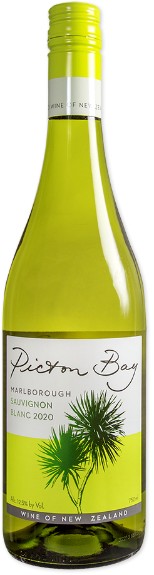
Picton Bay Sauvignon Blanc – This is my wife’s go to wine.  It comes from New Zealand, and we get it at Trader Joe’s for $8.  It is made by a family-owned-and-operated winery in the northeast corner of the South Island.  A handful of online retailers have for around $13 if your Trader Joe’s does not sell wine, or if you just can’t bring yourself to buy wine at a Trader Joe’s.  It is very nice Sauvignon Blanc for that price with the characteristic hint of grapefruit on the tongue.   Trader Joe’s describes it as “fresh and vibrant with clean grassiness, concentrated fruit and a crisp, lingering finish. It kind of reminds us of a Granny Smith apple: green, crisp and tart, with flavor that makes your mouth water just thinking about it. In that way, we describe it as approachable. Bright and light, Picton Bay Sauvignon Blanc is the perfect apéritif. It really gets the appetite going.”  We fully agree with that description.

Where to get this wine: Almost always on the shelf at the Trader Joe’s that can sell wine.  Total Wine and Wine.com do not carry Picton Bay.  Check the download at the end of this post on using wine-searcher.com to have wines shipped legally to you at good prices.  Wine-searcher.com has four resellers that will ship this wine to many states.  In Maryland the Montgomery County Liquor stores do not carry this wine.

Red Wines

Domaine Coudoulet – Pinot Noir Pays d’Oc – Although the finicky Pinot Noir grape tends to prefer cooler-climate areas like Burgundy, Oregon, and New Zealand’s Central Otago, this wine comes from a family winery in Minervois, located in warm South of France. It opens with a captivating bouquet of red berries and black raspberries. On the palate, it bursts with the joy of young Pinot Noir, with flavors of macerated cherry and dark plum infused with wild violets, all supported by a sensual finish of polished tannins. Most of my Pinot Noir wines are aging to develop the character and complexity that make Pinot Noir unique.  And they command the price that good young Pinot Noir from Burgundy and Oregon deserve.  Although this $11 wine has the structure to age for an additional year or two, it’s just too delicious to wait on and well worth that price.  Enjoy it now with classic red Burgundy accompaniments such as confit de canard, roast duck in cherry sauce, leg of lamb, and veggie dishes.

Where to get this wine: Calvert Woodley in DC has the best price on this.  The Wine House in San Francisco is a good online retailer who will ship to most states and has it for $15.  You can find them on wine-searcher.com.  Total Wine and Wine.com do not carry this wine.  In Maryland the Montgomery County Liquor stores do not carry this wine.

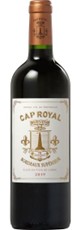
Cap Royal – Bordeaux Supérieur – Made by Château Pichon Baron, a top quality 2nd growth estate in the Pauillac region of Bordeaux, Cap Royal is a classic oak aged 70% Cabernet Sauvignon and 30% Merlot blend from the Médoc region on the Left Bank  It is classified as a Bordeaux Superior, that sells for around $14.  If you are not familiar with the different classifications in Bordeaux, the document available in the link above about the Chateau Martinon white wine will be of interest.  Cap Royal has a beautiful intense red color with purple reflections. The nose exhibits aromas of blackberry and blueberry jam with spicy and toasted notes. On the palate, the richness of the wine is evident through a creaminess enhanced by vanilla notes brought by the aging in oak barrels. A powerful, rich and fresh ‘everyday’ Bordeaux.  The 2022 vintage is on the shelves now and drinkable if decanted for a few hours.  Letting it sit for a few years or buying the 2020 or 2019 vintages will give you an even better wine.

Where to get this wine: Total Wine and wine.com do not carry Cap Royal.  Wine-Searcher.com has about 10 retailers that ship to most states.  I have used Saratoga Wine Exchange several times and have been very happy with them.  It is on the shelf at Calvert Woodley. In Maryland the Montgomery County Liquor stores do not carry this wine.

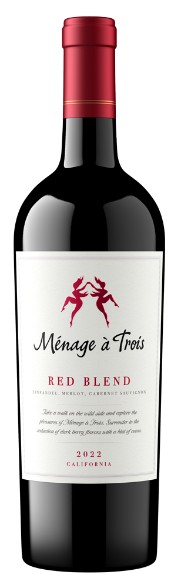
Ménage à Trios Red Blend   – There are a number of California bulk wine producers such as Dark Horse, Barefoot,  and Cupcake.  I think Menage a Trois makes the best wine of all of these bulk producers.  The name comes from choosing to blend three different grapes with Zinfandel being one grape that most of the other bulk producers don’t use.  California makes some excellent Zinfandel and that probably should be a future blog.  Menage a Trois makes at least 14 different red wines, and I enjoy most of them.  We started with Red Blend and that is what we like the best, especially the $8 price tag.  Here is what the Menage a Trois website says about Red Blend: “Our original Red Blend exposes the fresh, ripe, jamlike fruit that is the calling card of California wine. Notes of blackberry and raspberry jam are accompanied by a generous mouth feel with rich flavors and firm tannins.  Ménage à Trois Red brings together three varietals: Zinfandel, Merlot and Cabernet Sauvignon. To add complexity and retain character, each variety was fermented separately, then blended prior to bottling. Zinfandel is a saucy tease that brings blackberry and raspberry jam to the mix. Merlot, with its generous mouthfeel and red fruits, fits perfectly in the middle. The rich flavors and firm tannins of Cabernet Sauvignon make it the ideal candidate for the final layer of the trio.”

Where to get this wine: Widely available at liquor stores and supermarkets that sell wine.  Total Wine has it in most stores for $8.  Wine-searcher.com has over 1,900 resellers for this wine in the US, some of them may be local to you.  Wine.com does not carry this wine.  In Maryland all of the Montgomery County Liquor stores carry this wine for $13.

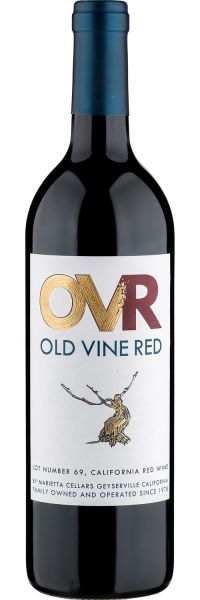
Marietta – Old Vine Red – Back in the early 80’s my father gave us a bottle of a wine he tasted while on a business trip to California and really enjoyed.  None of us had heard of a vineyard called Marietta.  The Old Vine Red became an immediate family favorite.    With the big OVR at the top of the label, Old Vine Red is a proprietary red wine made to replicate the field blends of many of the old vineyards in Sonoma and Mendocino counties. There are different lot numbers designating the release, but I just buy which ever one is on the shelf.   Predominantly comprised of Zinfandel, different lots will blend in some different amounts of Syrah, Petit Syrah, Carignan, Grenache, and Barbera.  It combines pure fruit, a supple mouth feel and a rich, solid structure.   Prices generally range from $13-15.

Where to get this wine: Many good wine ships will have this on the shelf.  Most Total Wine stores will have this on the shelf.  Wine-Searcher.com has about 70 retailers that ship to most states.  Wine.com sells it for $15.  In Maryland the Montgomery County Liquor stores do not carry this wine.

Oxte The Silence Red Blend – This is the second Trader Joe’s wine on this list of recommended wines.  It is probably the best $6 wine I have ever had and worth the effort to get to a Trader Joe’s that is allowed to sell wine.  It comes from Spain, and it adds some Cabernet Sauvignon to the classic GSM blend (Grenache, Syrah, & Mourvedre) that made the Rhone red wines famous.  It is very nicely balanced with a full body.  I enjoy this wine with most beef dishes and spicy dishes.  I had it recently tried it with the spicy Merguez sausage that I made, and it held its own.

Where to get this wine: It appears that Trader Joe’s has the exclusive rights to this wine in the US.  With the other two wines on this list that are only available at Trader Joes, I have no issue driving 30 minutes to a Trader Joe’s that sells wine.  Don’t be afraid to try a $6 wine.  In Maryland the Montgomery County Liquor stores do not carry this wine.

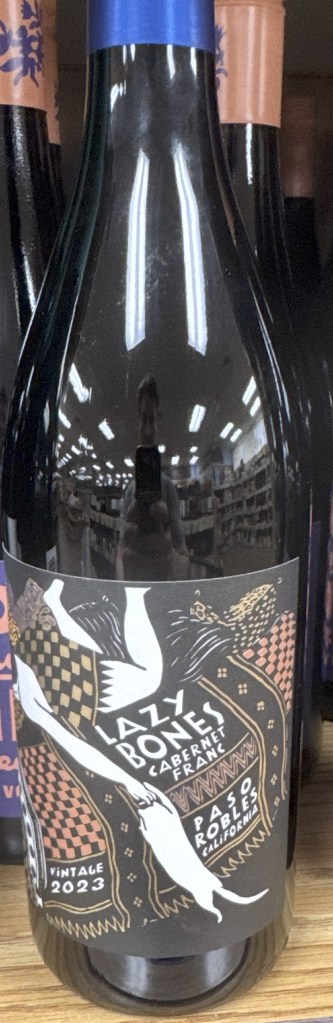
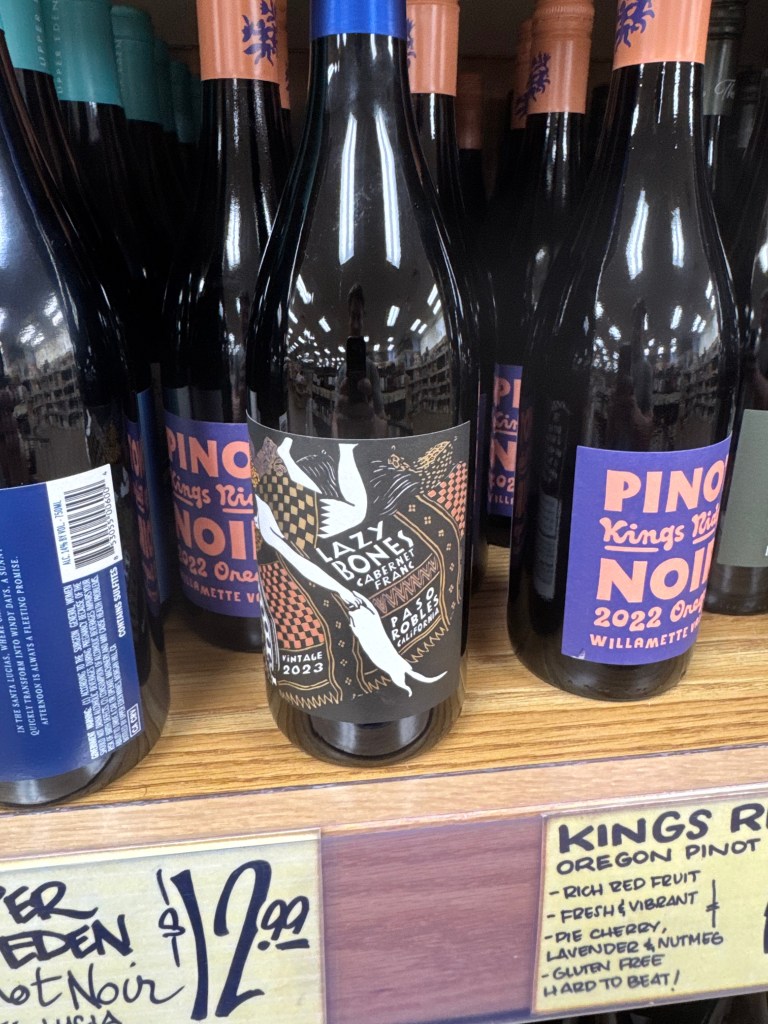
Lazy Bones Cabernet Franc – Here is a link to a post that I recently did celebrating the return of this wine at Trader Joe’s. https://billwinetravelfood.com/2025/05/14/the-best-buy-for-cab-franc-is-finally-back/. I won’t repeat the details that were in that blog, only that this is the best $8 wine I have ever had.   There was enough pent-up demand that it appears that many of the stores sold out quickly.  I am hoping that additional shipments will arrive soon, and it will not be another 3 year hiatus until we see it again. 

Where to get this wine: It appears that Trader Joe’s has the exclusive rights to this wine in the US.  With the other two wines on this list that are only available at Trader Joe’s, I have no issue driving 30 minutes to a Trader Joe’s that sells wine.  In Maryland the Montgomery County Liquor stores do not carry this wine.

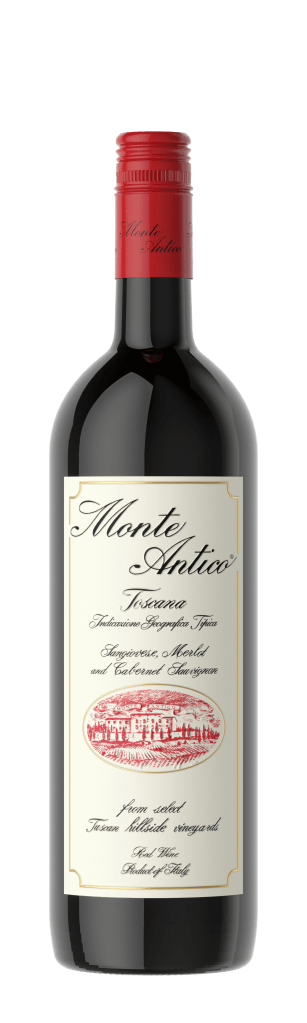
Monte Antico Tuscana – This is our Go To wine with Italian food.  It is a Rosso, or blend, from Tuscany that generally sells for $11-12.   Monte Antico, which means “ancient mountain”, was crafted as a tribute to Tuscany.  The wine makers have styled the quintessential Tuscan grape Sangiovese, highlighting all it has to offer and complementing it with just enough Merlot and Cabernet Sauvignon to bring it all together. The blend is 85% Sangiovese, 10% Merlot, and 5% Cabernet Sauvignon.  James Suckling says “This is one of the best value Italian red wines on the market. Medium to full body with dried cherry, milk chocolate and light chili aromas and flavors. Long and delicious. Caressing mouthfeel. Bright acidity.”   I find this wine really opens up and shows all its great flavors when decanted for at least two hours before serving and served around 60° F.

Where to get this wine: Widely available.  Most Total Wine stores will have it on the shelf.    Wine-searcher.com has over 70 resellers that carry this wine.  Wine.com is out of stock on this wine. In Maryland the Montgomery County Liquor stores all show that they have limited availability of this wine. 

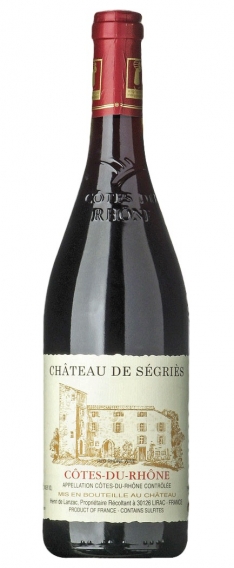
Château de Ségriès Côtes du Rhône – I am ending this set of recommendations with probably the best wine on this list.  It has long been one of our favorites and was $8 when we first fell in love with it.  Between inflation and growth in popularity, it can now generally be found for $15 and is a great wine at that price.  It comes from the Cote du Rhone in France, the third of the great wine making regions of France along with Bordeaux and Burgundy.  It is made in the southern region of the Rhone valley where their blended red wines have garnered worldwide acclaim and demand.   The most common blend is Grenache, Syrah, and Mourvedre which created the popular GSM acronym.  If you want a nice red wine with your meal at a restaurant, and get the attention of a knowledgeable wait staff, ask them if they have a nice GSM they would recommend with your meal. Segries has their variation of this blend with 50% Grenache, 30% Syrah, 10% Cinsault, and 10% Carignan.  The Grenache starts you off with a great full mouthful of taste.  The Carignan and Cinsault then add some depth and complexity while you are enjoying it in your mouth.  Then the Syrah kicks in with the really long finish that makes me love Rhone wines.  A couple hours of decanting will round out the tannins and let the Syrah show its great character.   This is an excellent choice with any red meat dishes and can stand up to any sauces that accompany the entree.

Where to get this wine: Pretty good availability.  Most Total Wine stores will have it on the shelf.  Wine-searcher.com has a handful of resellers who carry this wine.  Wine.com does not carry this wine.  In Maryland the Montgomery County Liquor stores do not carry this wine.

You can download a list of these wines with the prices I generally see for them using the link below if you want to take that list to the store with you.  Or print out this blog so you have pictures of the bottles to help you find them on the shelf. 

In addition to the notes on where to get each of these wines, you might find my earlier blog post  Where Do I Find The Wines That Are Being Recommended? of interest and you can find it with this link.   https://billwinetravelfood.com/2023/07/29/where-do-i-find-the-wines-that-are-being-recommended/

I hope you enjoy some of these wines as much as Beth and I do.  I welcome your feedback. 

The BEST BUY for Cab Franc Is Finally Back!

For years one of the top selling wines at Trader Joe’s was not their “2 Buck Chuck”. It was a Cabernet Franc from the Central Coast Region of California called Lazy Bones. The bottle was distinctive with a naked woman sprawled across the label.

If you are not familiar with Cab Franc, it, along with Sauvignon Blanc, are the two parents of the most popular red wine grape, Cabernet Sauvignon. Cab Franc and Merlot are the two wines most often blended together with Cabernet Sauvignon for the great Bordeaux wines. It is growing in popularity as a varietal wine, i.e. made from just one grape variety. I am planning a blog post on Cab Franc that will dive deeper into the wines made using this grape.

In my red wine recommendations Lazy Bones always got the highest recommendation as a terrific wine for under $8.00. But for over two years there has been no Lazy Bones on the shelves at Trader Joe’s. When asked, the staff would look it up on the computer where the answer was always “We are waiting for the next shipment”. I finally drank the last bottle of it I had in my cellar a couple of months ago and was resigned never to see it again.

This wine is finally back on the shelf at Trader Joe’s, bot ONLY the ones that are allowed to sell alcoholic beverages. I live in Montgomery County, MD which has the worst liquor licensing in the country, so none of our Trader Joe’s are allowed to sell wines. I have to drive 30 minutes to Virginia to get to a Trader Joe’s that sells wine. The label is slightly different, as shown in the picture above which is courtesy of my son Jon, with a drape now across the lounging lady on the label.

I strongly encourage you to find the closest Trader Joe’s store that sells wine and give this a try. The price varies between $7.88 to $8.99 depending on where you live, and I will put this wine up against any wine at double that price. But when my son Jon saw it at their store in Arlington, VA, he immediately got me a case. The odds makers in Los Vegas are very sure that if you try a bottle you will make it priority to get back to Trader Joe’s for a case of this wine.

It has had a very strong following with Trader Joe’s customers. As mentioned above, it was consistently one of their top selling wines. There is a very good chance that the first shipments will sell out quickly to people like me restocking their cellar. If you don’t see it one the shelf, ask at the Wine Counter if they have any available. If not, they can tell you when their next shipment is expected to arrive. Many of the stores will take your contact information and put whatever number of bottles that you want aside behind that counter and call you that it is waiting for you to pick it up.

Trader Joe’s has a number of other very good wines at good prices. Below are links to my earlier posts on recommendations of wine bargains.

Bill’s 10 Red House Wines Under $15 – https://billwinetravelfood.com/2022/02/14/wine-bills-red-house-wines-under-15/

10 Favorite White Wines for Under $15 – https://billwinetravelfood.com/2022/03/13/wine-ten-favorite-white-wines-under-15/

14 Recommended Rose wines for under $20 – https://billwinetravelfood.com/2023/06/02/rose-wine-my-14-favorites/

It is great to see this wine back at Trader Joe’s. I only hope that it will be consistently on their shelves for years to come.

Virginia Wine Tasting Weekend

Beth and I did a wine tasting weekend in Loudoun County VA this weekend and this post will share notes on the four vineyards we visited.  I will start with some general comments and then talk about each of the wineries facilities, tasting options, food options, and my appraisal of their wines. 

General Comments

Loudoun County in Virginia, north and west of Dulles Airport,  has the highest per capita income of any county in this country.  It has also developed a very strong wine industry.  The Loudoun County Wine Trail Guide has entries for 52 wineries grouped into six geographic clusters.  The terroir is similar to Western Europe and the primary grapes grown there are:

  • Red Grapes: Cabernet Franc, Merlot, Cabernet Sauvignon, Petit Verdot, Nebbiolo, Norton, and Tennat
  • White Grapes: Viognier, Chardonnay, Sauvignon Blanc, Petit Mansang, and Alberino

Many of the wineries have been around long enough to have mature vines that are producing very good quality grapes.  Some of the vineyards are also purchasing grapes from other regions around the country for some of their wines.  One of the vineyards we visited has no vineyards and purchases all of their grapes.  For several reasons I will mention when I talk about them, this was the visit we enjoyed the least. 

We arrived at the first vineyard each day within a few minutes of their opening at 11:00 AM and there were a few cars in the parking lot and no crowds.  We started both visits with one of their wine flights for tasting.  We chose one that had both red and white wines and had at least some of their higher end wines.  By getting there early we had a dedicated person to walk us through each of the wines with no interruptions.  When our questions and comments indicated that we knew a little about wines, they got into more details for us and each added a couple of tastes of wines that were not part of the standard flight.  We have found at wine tastings in many countries that having an intelligent conversation about the wines often leads to getting more wines, and better wines, than their standard offering.  From the tasting we each selected a glass of wine that we wanted to have with lunch, ordered food, and moved to a table to enjoy the lunch.  That was about Noon and both places then had much larger crowds by then so people were not getting the personalized attention we had gotten by arriving when they opened  and we were very glad we had gotten there early.    

If there was one consistent negative to the experience it was that the prices on the wines ranged from a little overpriced to very overpriced.  We enjoyed all the wines that we tasted but were not tempted to buy most of them, because of the price.  There are two reasons that generally drive the higher prices.  First is if the vineyard has any retailers putting their wines on the shelf, they have to protect those resellers and have a pretty high list price so the retailer can make some money and still make money if they put any of them on sale.  The second reason is if they have only a few or no retailers putting their wines on the shelf, the income they generate to stay in operation comes from people buying wines when they visit.  For people who are wine novices, a higher price can appear to be an indication that these wines are of premium quality.  If they like the wines in their tasting, the only chance to have them again is to buy that wine while they are there. 

The other consistent element is encouraging people to join their wine club which is a commitment to a certain number of wines per year.  The entry level club membership is generally three wines in each of four shipments a year or six wines in two shipments, both giving you a case of their wines each year.  Higher level memberships for two or three cases per year have higher discounts and other fringe benefits like free tastings and invitation to members only facilities and events.  The vineyard we liked the least was approaching obnoxious in their sales pitch to join their club.  We did join one of the clubs and that was the one who only mentioned the club at the start of the tasting and that was it. 

We stayed at the Spring Hill Suites in Ashburn because Marriott had given us a free night but we had to use it by May 15th. The hotel was convenient to the wineries we chose.

Wine tastings and driving do not go together well.  For Saturday we did a wine tasting and then had a glass of wine with our pizza from 11:00 to 1:00.  We sipped some water and relaxed until 1:30 and then drove 30 minutes to the second winery where we had a scheduled tasting at 2:00 that came with bread, cheese, and charcuterie.  We again relaxed for about an hour and drove back to our hotel where we read and rested for a couple of hours.  We then drove ten minutes to a winery with a full restaurant for dinner.  On Sunday we again did a flight tasting and then had lunch with a glass of wine that we enjoyed from the tasting.  They told us we could stay as long as we liked so we had a second glass of wine and dessert and then relaxed and took some pictures of their beautiful facility for an hour before driving home.  We were there for four hours, and they were fine with that.  We had planned to visit a second winery on the way home but agreed we had enough wine to drink and would save that other winery for a future visit.  It is certainly possible to visit three wineries in a day, and even more if you are doing ones close together.  But you are not safe to drive when you have that much to drink.  Please be considerate of the other people in your car and the pedestrians and other cars on the road and limit the amount you drink. 

Four Wineries We Visited

Below is our review of the four wineries that we visited, listed in chronological order, not starting with the one we liked the most. 

Stone Tower Winery – 19925 Hogsback Mountain Road, Leesburg. 

This was a one hour drive from our house on a Saturday morning and we got there a few minutes after 11:00 and could park close to the Harvest Barn Tasting Room.  They have a second tasting room for club members.  The Harvest Barn has two large bars that you can stand at to get guided tastings of different flight offerings.  You can also order glasses or bottles of wine and take them to tables that they have inside and outside. 

We chose a flight of six wines to taste and had two of their sparkling wines, a Rose, a Sauvignon Blanc, their Pinot Noir, and their Cabernet Franc.  They also poured us their Wind Boar Pursuit, a Bordeaux style blend, and their Port made from the Norton grape, neither of which were on the list of wines that we paid for.  The only wine we did not care for was the Pinot Noir which was a light picnic style Pinot Noir similar to some Napa valley Pinot Noir.  We are huge fans of the Old World style of Pinot Noir as very age worthy and having wonderful complexity.  Some people love the light Pinot Noir but that is not what we enjoy.  All of the other wines I would happily drink if someone was pouring them.  But the two sparkling wines and the Sauvignon Blanc were about double what I would be willing to pay for them – in the $40-50 range.  The red wines were $48-$60.  We liked the Cab Franc the best and it was $52.  I can get very good Cab Fanc for under $35.  I had a glass of the Cab Franc with my lunch and Beth had the Wild Boar Pursuit.   

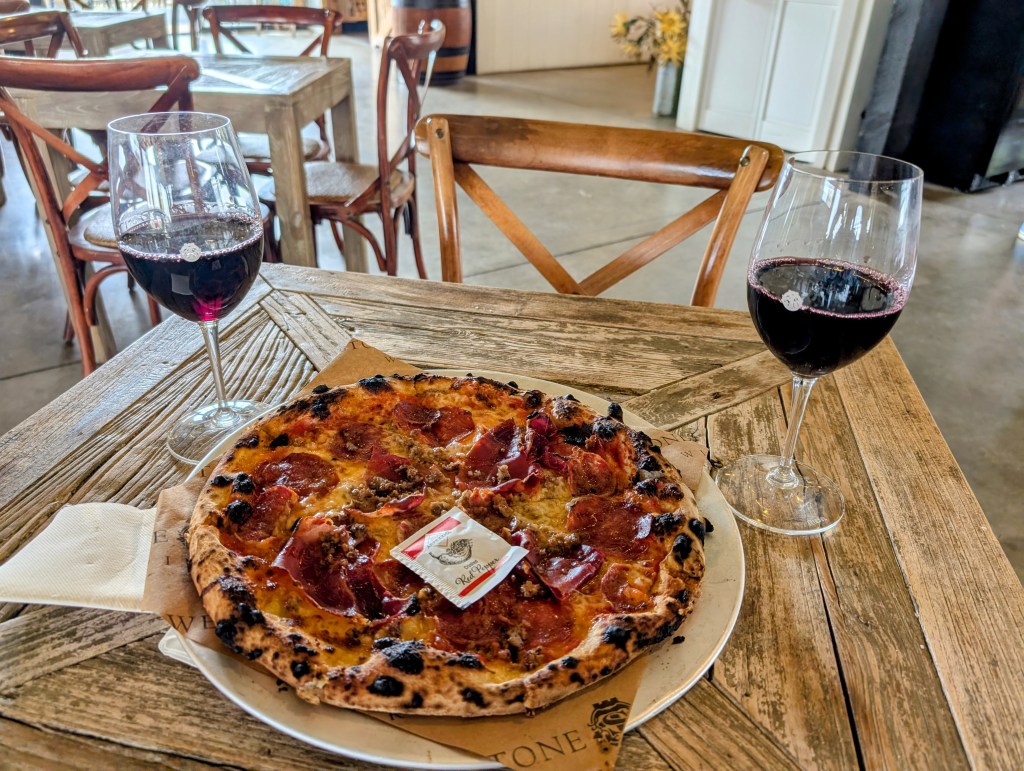
They have a separate kitchen across an outdoor sitting area and the person who led our tasting recommended the pizza and adding their Hot Honey which added $3 to the price.  It was delicious!   They also had a water cooler with cups, so we did not have to pay for water, unlike some wineries which only sell bottled water.  We thoroughly enjoyed our lunch.  By the time we sat down with our pizza it was Noon, and the place was packed.  We were very glad we got there right when it opened. We lingered over the pizza and caught up on email to absorb some of the wine before driving to our second winery.

Of the four vineyards that we visited, this one ended up being ranked third.  We enjoyed the food and the wine and recommend giving it a try.  It finished behind two others only because of the high prices on their wines.

Boxwood Estate Winery – 2042 Burland LN, Middleburg

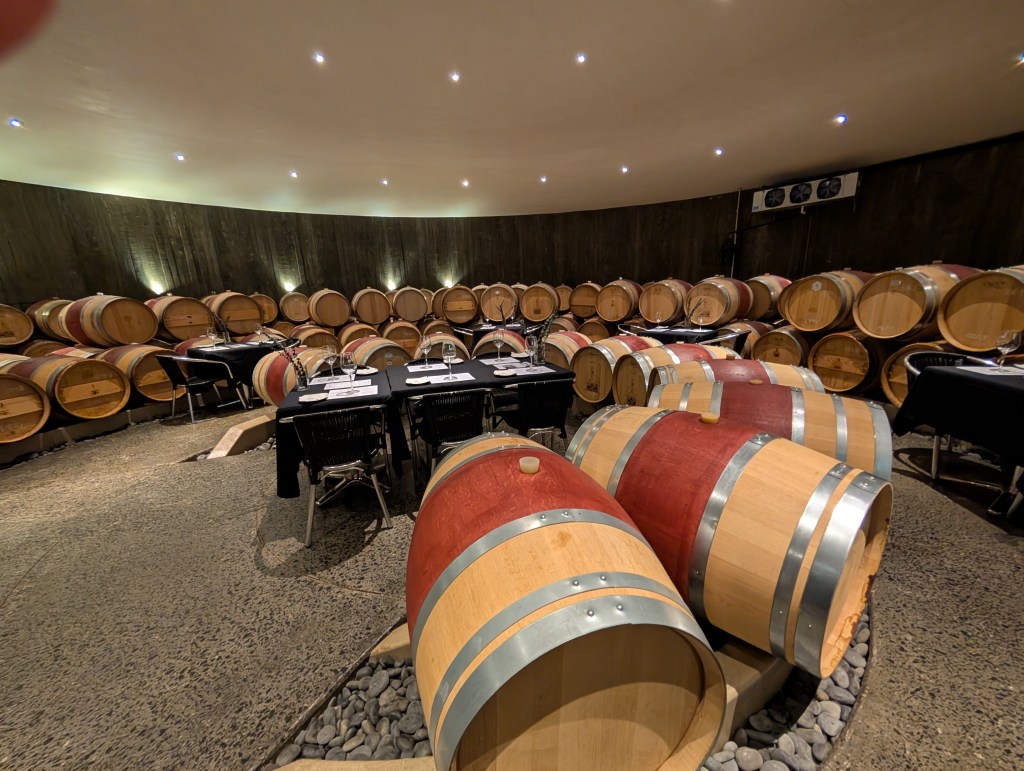
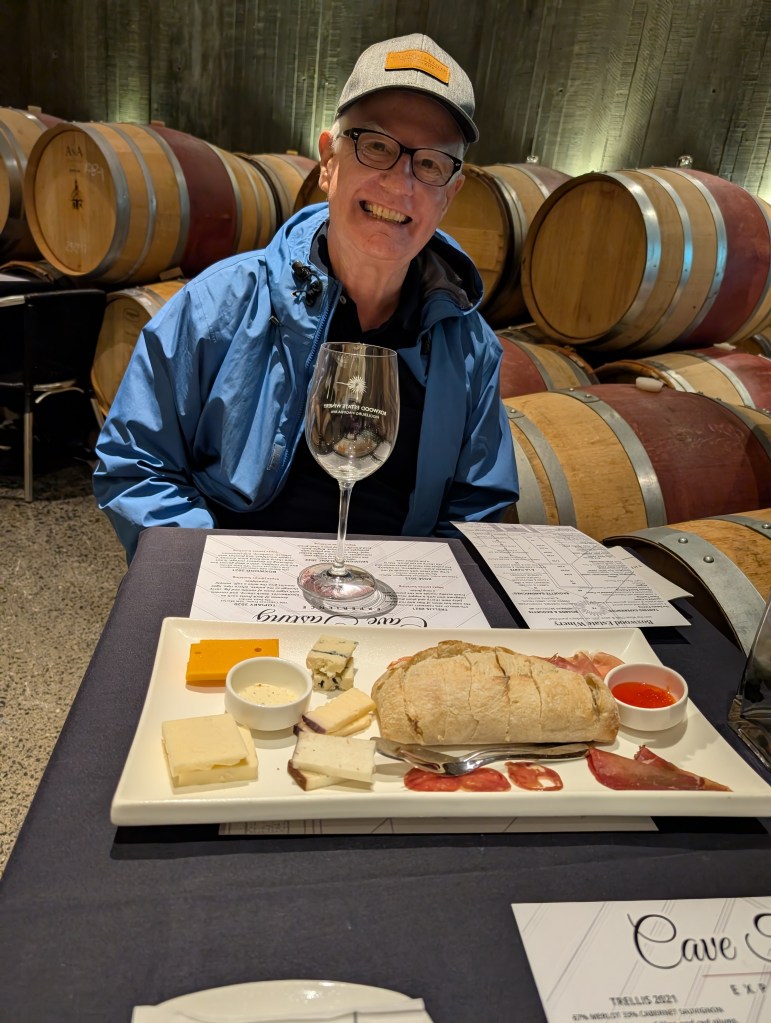
This was about a 30 minute drive from Stone Tower.  Jack Kent Cooke, who sold the Redskins to Dan Snyder, owns this estate and the facility is very attractive.  They have two interesting tastings, the Estate Paring, and the Cave Tasting Experience.  Both are by appointment.  We chose the Cave Tasting Experience as we were most interested in those five wines.  We booked it for 2:00.  There was one other group at the same time but they were seated in a different section of the room so each of us had our own tasting experience.  The other group was having a very good time and occasionally got a little noisy.  A jacket was recommended since the cellar is at a lower temperature but we were comfortable without our jackets.  Their Deluxe charcuterie board, a $40 item on their menu, was included as part of the tasting which cost $50 each. 

We had their Sauvignon Blanc, Rose, Trellis Red Blend, Topiary Red Blend, and Boxwood Red Blend.  We enjoyed all of them and were surprised that we liked the Topiary more than their Boxwood which is their 2nd highest price wine.  We bought two bottles, which were $34 each.  The tastings were a nice pour, probably about 2 oz. We did not get any extra pours this time ☹. 

We considered their Wine Club, but they are selecting the wines for each shipment.  We are interested in getting the wines we like, not exploring new wines that we have not tried, so we passed on joining their club. 

Boxwood is ranked second of the four places we visited.  We very much enjoyed the Cave Tasting and recommend visiting this winery and trying that tasting experience.  A reservation is required.

Cooper’s Hawk Winery and Restaurant – 19870 Belmont Chase Dr., Ashburn

This restaurant/winery was just 10 minutes from our hotel so we made a reservation there for dinner on Saturday evening.  Unfortunately, we have very few good things to say about that visit.  Cooper’s Hawk is a winery that buys grapes from different regions and makes their own wines, but they have no vineyards of their own.  We were assured that they buy only the BEST grapes from NAPA and other regions, so the winemakers who are in those regions must be using the second-best grapes for their wines.  We had a 7:00 reservation but were not seated until 7:35. When we asked why the delay, we were told they overbook the reservations.  One of the women working the large bar area for wine tastings took pity on us and another couple next to us and gave us a tasting of one of their white wines while we waited.  The waiters are clearly highly incented to get people to join their wine club as he was far more interested in that than in taking our order for food and wine.  I ordered the Jambalaya and had to ask for Tabasco to give it any kind of kick. 

I had a glass of Old Vine Zin with my meal and it was a nice wine.  I would not pay $31 for a bottle, but my only argument is with the price, not with the wine.  Beth had their Pinot Gris with her Chicken Risotto and that was a nice pairing.  I pay under $20 for nice Pinot Gris and this was $29 a bottle.  The per glass price was only $10.50 for each of them and I have no argument with that as a restaurant price. 

The restaurant and winery are highly rated on Yelp but we were very disappointed in the long wait for the table and nothing after that gave u any reason to want to go back there.  This was a clear last place choice of the four wineries we visited. 

Bluemont Vineyard – 18755 Foggy Bottom Rd, Bluemont

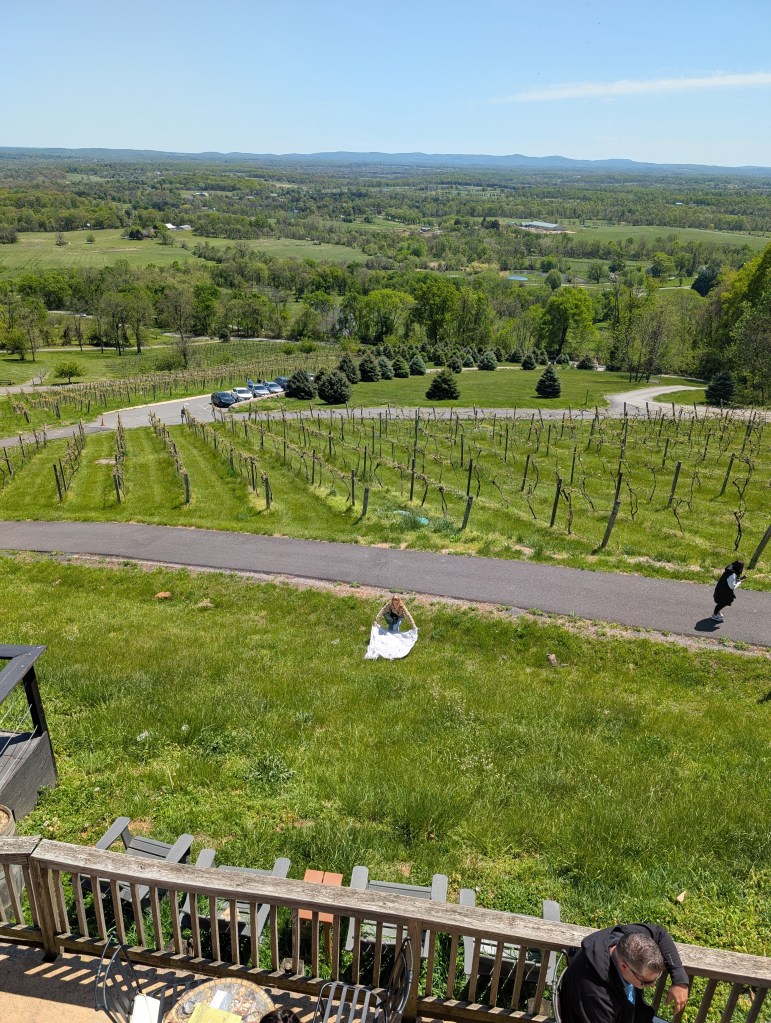
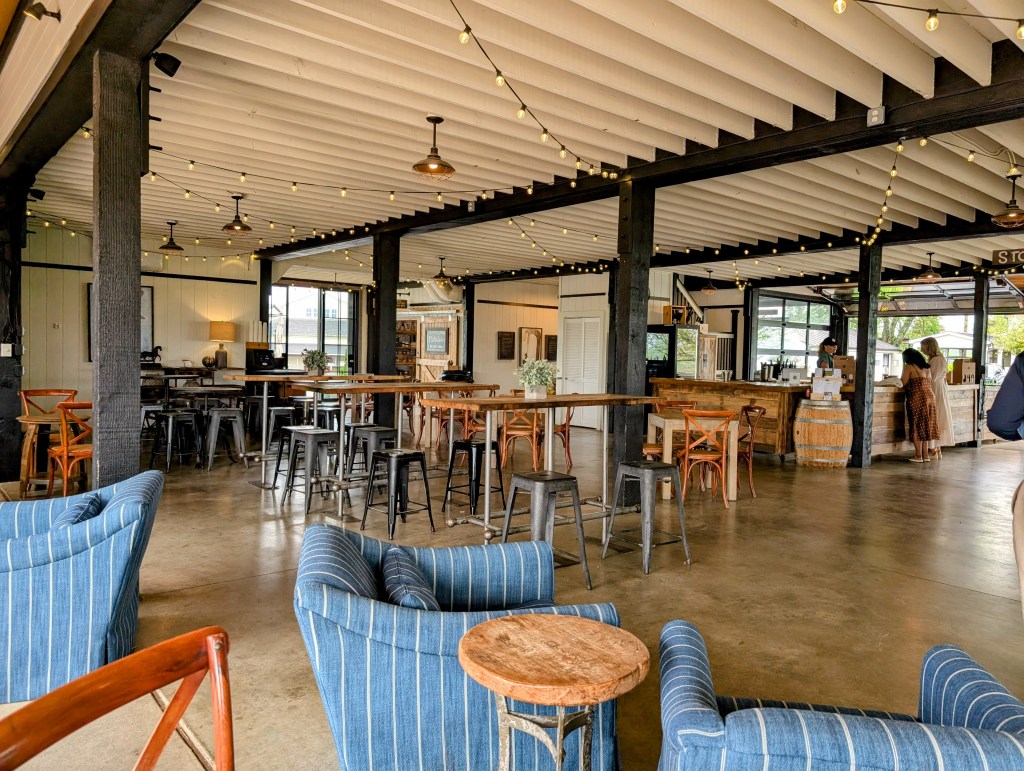
This winery was the furthest away from us and it was a 90 minute drive home on a Sunday afternoon.  The facility is gorgeous, sitting high on a hill with great views over some of their vineyards and some orchards.  Their vines first produced wines in 2007 so they have mature vies a a history of making very good wine. They also have a close affiliation with the Dirt Farm Brewery and the Henway Hard Cider Barn that are across the street from them and do joint events with them.   We were there right when it opened Sunday morning and went to the Tasting Room where we got their Signature Flight of six wines.  We sat at the end of the bar and for most of the time we were the only ones in there so Forrest, a Master Somme, had plenty of time to talk with us about the wines.  The first wine was an Albarino, and when we talked about our wine tasting trip to Spain and the Albarinio’s we had there, Forrest quickly realized he could have a good conversation with us and was able to learn some things from us, even with his Master Somme background.  Our pours got a little larger and he started pulling other bottles off the shelf for us to try. 

The wines in the flight were their Albarino, Viognier Reserve, Rose of Tennat, Cabernet Franc, Cabernet Franc Reserve, and Summit (a blend of Petit Verdot, Tennat, and Cabernet  Franc).  To this he added their Assent White blend, the Donkey Rose, and the Tennat red.  We spent well over an hour with Forrest and really enjoyed the wines and the discussion.  There was a card there to sign up for their Wine club and I had a few questions for Forrest.  If we signed up for the 3 Pack Club, which is three bottles four times a year, could we choose which wines we wanted and would they ship them to us.  Also, if we signed up while we were there, could we have our lunch in the Members Tasting Room up on the balcony where the views are incredible.  The answers were we can totally pick the wines for each shipment, shipping is a flat $20 fee, and yes he would escort us in to get a good table there.  Beth immediately laid claim to two of the first three bottles – the Viognier Reserve and the Rose Tennat.  I agreed and added the Cab Franc Reserve for that first shipment.  We get 15% off the price as club members, which brought the prices closer to what I think is reasonable.  The Cab Franc Reserve, my favorite is only $40 with our discount. We will try a few of the shipments and as long as we are enjoying the wines we can continue it, but we can drop the membership anytime. 

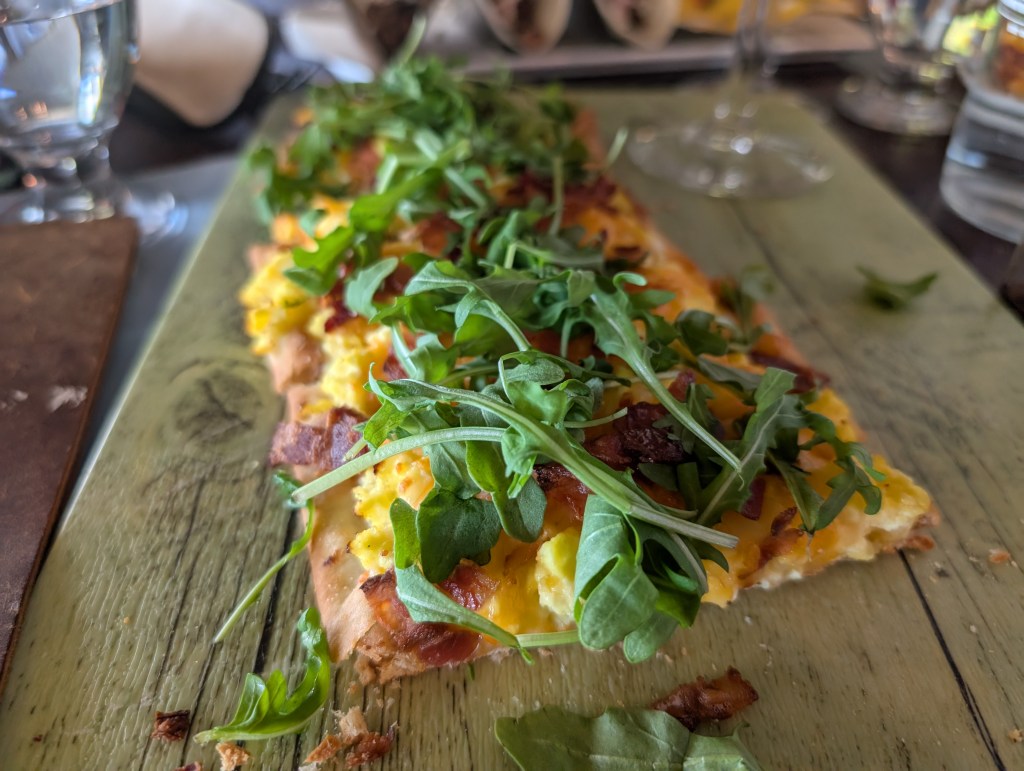
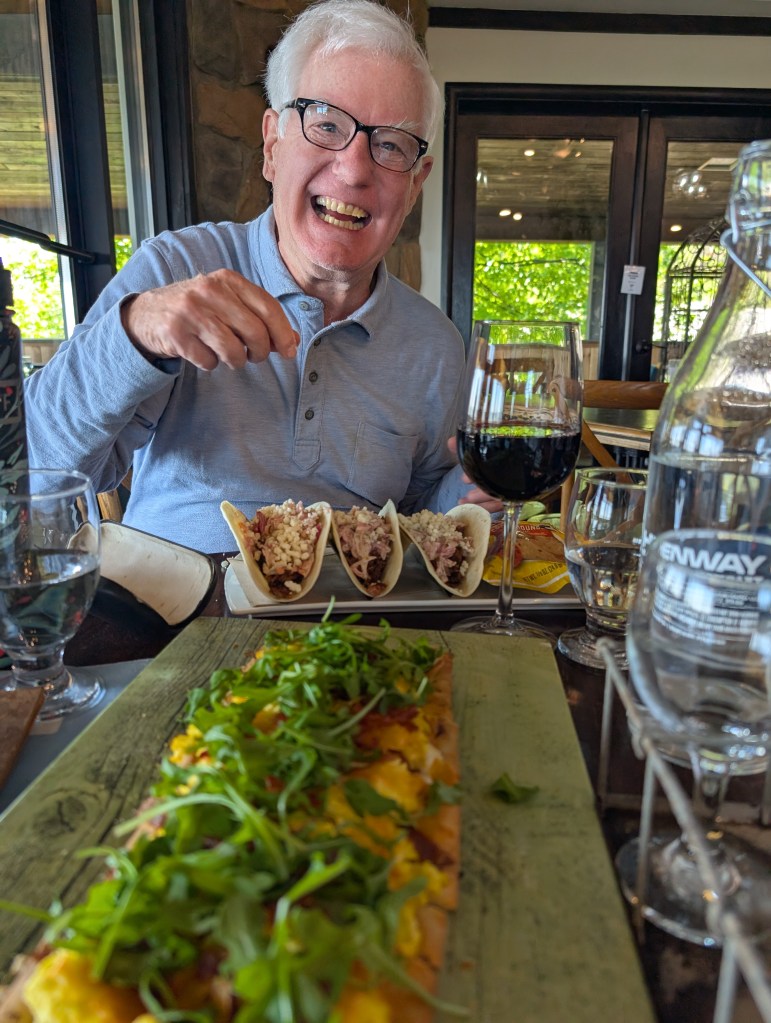
This picture is from the balcony where we had our lunch. On Saturdays and Sundays they have both a Lunch menu and a Brunch Menu.  Beth got the Brunch Flatbread with egg, bacon, and cheese. It was delicious as the picture below shows.  They offered one of us a flight of three wines as a member and Beth had those followed by a glass of the Voignier Reserve.  I had the brisket tacos and they were delicious. The picture at the start of this post is of me enjoying the arrival of our food and wine.  I had the Cab Franc Reserve that was my favorite from the tasting with them.  We decided that we were really enjoying the day and had been there over 3 hours and did not want to go to another winery.  We would get desert with another glass of wine and then drive home.  Both desserts were great.  I tried the Field Blend which was just a couple of dollars less expensive than the Cab Franc Reserve and it was nice but not in the same class as the Cab Franc Reserve.  Beth tried the Petit Manseng white which had a little sweetness, but it was also very nice.  I doubt either of those two will be in any of the shipments that we get. 

Bluemont was clearly our first choice for wines, food, tasting experience, and facility. 

I hope this summary of the four wineries was of interest and we strongly recommend giving three of them a try.  I hope you enjoy them as much as we did. 

Delicious Ciabatta Rolls

Do you love a sandwich on a nice Ciabatta Roll?  I do, and making them yourself can be easy and a fun!

The primary bread recipe that I use can make many different breads.  I use it most for my Baguettes but also for:

  • Italian Loaves – I just shape each loaf shorter and fatter, so the loaf has a diameter about double that of a baguette.
  • Dinner rolls – in a future blog post I will talk about all the different kinds of interesting dinner rolls you can make with this dough.  If you don’t want to wait, get the Bakers Companion book from King Arthur Flour and look at pages 222=223.
  • Ciabatta loaves or rolls – see below.

My basic bread recipe and lots of notes and suggestions can be found on my Blog Post Baking Delicious Baguettes –http://- https://billwinetravelfood.com/2024/05/04/baking-delicious-baguettes/

I will jump on my soapbox one more time about what has made all the difference for me in bread baking – using pasta water!  When we make pasta, we leave the pan of cloudy water that that is left when we take the pasta up so that it cools while we are eating.  What makes that water cloudy is lots of starch that the pasta gives off when put in the boiling water.  Yeast love that starch!  I measure out two healthy cups of that water and chill it in the refrigerator and then put it in a zip lock bag and freeze it.  When I am making any bread, I put that large clump of frozen water in a ceramic bowl and into the microwave at a low setting for 3-4 minutes until it is completely melted.  I then use one cup for my starter and the second cup for making the dough as spelled out in the above recipe.  Your bread will rise much better and faster using that starchy water, especially the final oven rise. 

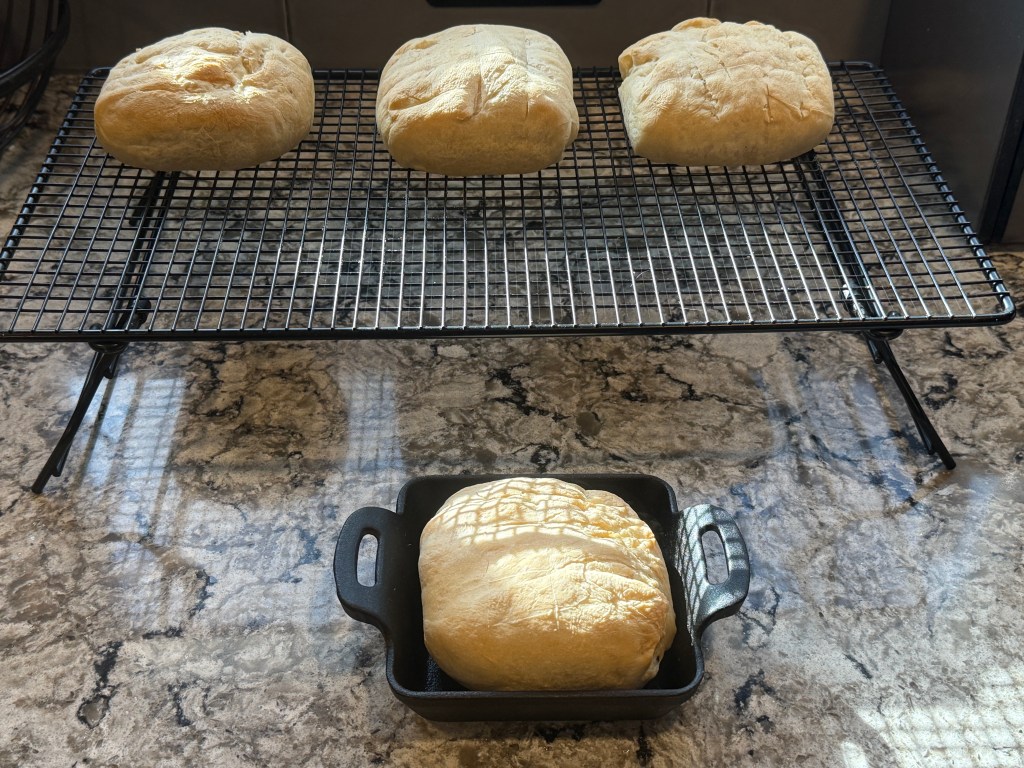
For Ciabatta loaves I just shape the loaves a little flatter and wider than baguettes for the final rise so the slices come out in a flat oval. 

For my Ciabatta rolls I divide the dough into 8 equal sized pieces.  Getting each piece pretty much the same size is important so they are all fully cooked at the same time.  To do this I use my digital scale with a sheet of wax paper on it.  I divide the dough into two pieces and weigh each piece.  I move pinches of the dough from one to the other until they are both very close to the same weight.  I then repeat that process two more times, splitting each of the halves into two so I have four pieces that I get to equal weights, and then split each of those so I have eight pieces of equal weight.  When I say equal, plus or minus 0.1 lb. is good enough.  It takes me about 10 minutes to do this, a lot faster than it might seem from the above description. I shape each of the rolls to be about 4”x4” which I think is great for sandwiches.  You can use a La Cloche to help maintain that size for the final rising and have each roll on a small piece of parchment to go on your baking stones.  Just as a reminder, the baking stones I use are covered in my Blog Post Pizza Stone Alternative which you can find at https://billwinetravelfood.com/2023/02/14/pizza-stone-alternative/

I use the baking stones, but I put each of my loaves into a small cast iron baking pan for the final rise and the baking.  The baking stones get the cast iron up to speed faster and the cast iron pan holds the shape during baking.  You can see the pans I use in the picture above.  The ones I use are the WINCO Cast Iron Server 10 oz.  A link to get them from Amazon is below.  We also use them to make several individual cornbreads, which is great since there are just two of us, so we can freeze the others for a later dinner. https://www.amazon.com/dp/B07YLD3SD8?ref=ppx_yo2ov_dt_b_fed_asin_title

I spritz the rolls with water and use a lame slashing tool to score the top of each roll with three slices in each direction just before putting them in the oven so I have a pattern of small squares in the finished rolls.  I cook them for 20 minutes in a 425° oven and they come out with nice color.  They will freeze well for a few months if you are not serving all eight right away. 

In addition to using them for sandwiches, I also defrost one, warm it in the oven, and slice it when we want bread to accompany the meal.  One roll sliced is great for the two of us instead of using 1/3 of a baguette and having the rest left over. 

If you give this a try, I’d love to hear how it works out for you.  I hope you enjoy your Ciabatta Rolls as much as we do.   

Slow Roasted Standing Rib Roast

We had a delicious Standing Rib Roast for our family Christmas Dinner and I am sharing the recipe and my notes on this if you would like to give it a try.  The recipe that you can download below says Slow Roasted Prime Rib.  Most recipes say that a standing rib roast can be called Prime Rib but I am a stickler for details, I believe for it to be called Prime Rib, you have to use a cut of beef that is labeled Prime, which is not always easy to find and is always pretty expensive.  One of the key things to get the Prime status is for the meat to have very good marbling, that is lots of small traces of fat all across the meat.  This renders out during the cooking and makes the meat tender and that is why it can command that premium price.   The layer of fat at the very top of the roast, the fat cap, is also important.  Don’t trim it off.  But the marbling across the meat is the biggest difference in the various grades the meat is given. 

The 9.1 lb. roast that I served for our Christmas dinner cost us $46 and it was tender, moist, and delicious!  How did I do that?  The two keys were getting a very good price on a decent not great, cut of beef that was labeled Choice, and then using a slow roasting Reverse Sear approach to cook it.  Using a cut labeled Choice is more accurately called a Standing Rib Roast and that is what I have in the title line of this post.  Standing means that the roast has bones that let it stand up in the roasting pan.  Those bones can be part of the roast, but they can also be cut off and tied back on which is what I did.  The reason for that is in the notes below.

How Do You Get a $148 Roast for $46?

We prefer meats from Safeway as having the best meats of the three supermarkets in Olney, MD.  Every year for the major holidays Safeway puts their Beef Rib Roast, Bone In on sale.  That cut has a usual sticker price of $15.99/lb. but the sale reduces it to $9.99 for about a one-week period before the holiday.   But anyone who puts their phone number in when they check out is eligible for additional discount coupons if you check the Safeway website.  It takes extra effort to go online and download the coupons for additional savings, but it can really be worthwhile.  Several years ago we found this additional coupon online that dropped the price down to $4.99/lb., and now we know that it will be there for every holiday sale.    The roast we had was 9.1 lb. and the sticker price, in round numbers, was $148.   We paid $46 for it. 

This cut is a lower grade of Choice and generally does not have much marbling and is usually not very tender.  Beth shopped to find one that had the best marbling and as shown in the picture, this one was pretty good for a Choice grade.   

Slow Roast and Reverse Sear Made A Big Difference

Most recipes call for Standing Rib Roast to be cooked at 325°, sometimes with the oven at 450° or 500° for 15 minutes initially to give the meat a sear.  Having a crust on the outside of the roast is one of the things most people really like about this kind of roast.  This approach is good for very good cuts of beef, i.e. expensive, but can produce meat that is not very tender and juicy.  Not what you want for a nice holiday meal. 

The slow roast, reverse sear technique is a much better way to get tender and moist slices that are very flavorful.  The slow roasting breaks down the connective tissues and makes it much more tender.  This approach cooks the roast slowly at 250° for as long as it takes to get to a desired internal temperature, 120-124°F for rare, 128-130°F for medium-rare, or 132-135°F for medium and medium-well.  It then rests for 30 minutes to let all of the juices retract into the meat so it is very moist and juicy.  The roast then is seared at high heat, at least 500°, for about 10 minutes until it reaches an internal temp of 128-130° for rare, 134-136° for medium-rare, or 140-144° for medium and medium well.  This gives it the nice rich color and crust that make Standing Rib Roast delicious.  It should rest again for 10 minutes after the reverse sear before being carved. 

The picture shows the rare to medium rare slices on two of the plates that evening. 

You can download the recipe I used below.  Below that are some additional notes from the cooking process that you might find helpful

Notes:

  • The biggest thing with the slow cook, reverse sear process is you CANNOT use minutes per lb. for the cooking.  The initial slow cook needs to be to a target temperature for how you like your beef, regardless of how long that takes.   Both stages took longer for me than the recipe indicates.  Give yourself lots of time for the slow cook to get to the needed internal temp and still have the roast carved and on the table in time with the other dishes that are being served.  For your first effort I suggest starting a good 30 minutes before your calculation for how long it should take based the size of the roast says.  It can rest for a while wrapped in foil and/or in a 100° oven if it gets done more quickly than you expected, which is unlikely.  Raising the oven temperature to speed up the cooking defeats the whole purpose of what you are doing. 
  • I used a ThermoPro TempSpike for the initial slow cook because it is wireless so I don’t have any cords running in and out of the oven.  You do not want to be opening the oven and letting the heat out multiple times to check the temperature with an instant read thermometer. You need a tool that stays in the roast for the cooking process and lets you see on your phone when it gets to the desired temperature. I did my Reverse Sear at 600° so I switched to a ThermoPro Digital WiFi Meat Thermometer because the TempSpike should only be used for cooking below 450°.
  • The meat cooks with the fat cap up, so you do not need to trim any of the fat off the roast.  Between the two cooking stages that fat will render down and add flavor and moistness to the meat. 
  • I was very comfortable cutting the bones off the roast and tying them back on.  Safeway is happy to do it at no cost and to French the bones, which means they trim all the meat off around each bone for the top couple of inches for appearances sake.  We had a very nice lunch from the three bones that we had, so cutting meat off for appearances sake does not make sense to me.  The recipe calls for the roast to be liberally seasoned on all sides with kosher salt and black pepper, so cutting the bones off lets you season the side that are up against the bones as well as both sides of the bones. It also makes final carving much easier and faster. Tying the bones back on adds flavor to the roast and is recommended.  I put kosher salt and already ground black pepper in a small bowl and mixrd them together thoroughly and then sprinkled them liberally on every side. 
  • Doing the above step 24 hours before you cook the roast and having it sit uncovered overnight in the refrigerator helps tenderize the meat and adds to the flavor.  The meat does not need any more salt or pepper the next day before going into the oven for the slow cook stage. 
  • Taking the roast out of the refrigerator 2 hours before putting it in the oven lets it get close to room temperature but is not long enough to have any risk of bacterial infection.  The slow roast time will be much longer if the center of the roast is not close to room temperature when you put it in the oven. 
  • I put the roast in a disposable aluminum roasting pan on the heavy duty V rack that I use for roasting the Turkey at Thanksgiving. 
  • During the 30 minute rest when it was out of the oven and before the Reverse Sear, the internal temp went up 12° so it was continuing to cook while resting.
  • The recipe calls for the Reverse Sear to be done in a 500° oven for 5-10 minutes.  We had other dishes we were cooking in both of our ovens, and I wanted a higher temp, so I did the Reverse Sear on my Kamado grill where I could do it at 600°.  Many gas grills can also get that high, but I think the hardwood charcoal also adds a little additional flavor.  I lit it an hour before I wanted to put the roast on, 30 minutes before taking it out to rest.  That let the ceramic get fully up to temperature.  If you do the reverse sear on a grill, I recommend leaving the roast on the rack in the roasting pan so the fat does not fall into the fire and flame up.  Using the temperature probe let me take the roast off just as soon as it hit the target temperature. 
  • I let the roast rest for 4 minutes before carving it.  I did not get any significant juices on the carving board, but I noticed some on the platter when I put the platter on the table.  As noted above, the meat was very moist and juicy, but I think a 10 minute rest would be better before carving. 
  • Being able to quickly cut the butchers twine and remove the bones in one piece made carving much easier.  With three bones, trying to carve it so three people got a bone in slice would have been very difficult.  I did the slices about ¾” thick and then cut them in half so our guests could have lots of choices on how much meat they wanted and come back for a small piece if they wanted seconds (or thirds). 
  • Talk to your butcher at Safeway.  He or she will tell you when they will have the Rib Roast Bone In on sale. 

My wife also made Poached Cod for the fish lovers in our family.  We accompanied the meal with three nice wines from Bordeaux, all $20 or less.  Chick out my blog on those wines at https://billwinetravelfood.com/2024/12/30/a-bordeaux-celebration-for-our-2024-family-christmas-dinner/

I hope you give this recipe a try and I welcome your feedback on this post and on the wines. 

A Bordeaux Celebration For Our 2024 Family Christmas Dinner

We very much enjoyed the Bordeaux wines shown in the picture below that we had at the family’s Christmas Dinner to accompany Standing Rib Roast and Poached Cod.  We had 14 people representing three generations.   The low price we paid for each of the three wines significantly added to their appeal. 

Chateau Mauvesin Barton, a Bordeaux Left Bank wine, was the most popular of the three wines.  In July of 2023 I did a blog post recommending this wine as THE Best Buy in Bordeaux with selling price of $20/bottle.  For more information on this great wine you can check it out using the link below. https://billwinetravelfood.com/2023/07/09/bordeaux-best-buy-chateau-mauvesin-barton/

Chateau Mauvesin was purchased by the Barton family in 2011 and they have invested significantly in the thirteen years since then to improve the vineyards and the wine making process at that vineyard which had fallen on hard times.  This is now the third Bordeaux vineyard owned and operated by the Barton family.  The oldest of their vineyards is Léoville Barton which was started in 1722 and was named a 2nd Growth in the famous 1855 classification of the best 60 chateau in Bordeaux.   In 1821 the Bartons purchased Chateau Langoa, a 3rd growth in the 1855 classification, which was just across the street from them and they renamed it Langoa Barton.  Chateau Mauvesin is situated in the “Moulis-en-Médoc” appellation, to the north of Bordeaux, on the left bank of the Gironde estuary. Because the Mauvesin vineyard is not in the same AOC, it is operated as a separate entity, but with the same quality standards as the two Grand Cru Classe estates. 

We enjoyed three bottles of the 2019 vintage which had been opened at 10 AM, decanted  at 1 PM and served, at 60° F, at 3 PM.  It had opened up nicely by that time and the three years of bottle aging after the 12-15 months in oak, one third in new barrels, one third in barrels having already aged one vintage, and one third in old oak barrels coming from Château Léoville Barton, showed this is starting to mature nicely.  I am comfortable keeping this at least 10 more years.    The 2019 wine is 64% Merlot, 27% Cabernet Sauvignon, and 9% Cabernet Franc.  Just for background, the blend for the 2020 vintage was only 38% Merlot while the Cabernet Sauvignon was increased to 59% showing the winemakers are recognizing the changes in the vineyards with the investments made since 2011 and using them to achieve their target tastes for the Mauvesin Barton.   The 2019 has gotten ratings of 90-82 points from a handful of reviewers. 

Our other red wine was from the Right Bank. This wine was a St. Emilion Grand Cru bought at Trader Joe’s and sold under their name, so less is known about its origins.  Trader Joe’s is selling this wine for $16 and I have not had a St. Emilion Grand Cru that I enjoyed as much for under $30.  We finished two bottles of this wine so I am not the only one who really enjoyed it. 

On the back of the label it mentions Chateau Jacques Blanc, one of the estates with the most acreage in the Grand Cru AOC.    The wines sold under the Jacques Blanc name command a price of over $70.  They are 85% Merlot and 15% Cabernet Franc.  I would expect that the wine they are selling to Trader Joe’s is made from their younger vines and probably also grapes they buy from other vineyards in that AOC.  I plan to get at least 6 more bottles of it because we never know how long Trader Joe’s will continue to sell any of the wines that they private label.  My experience is that these private label wines are generally well worth the price. 

The surprise hit of the evening was the white wine, Lions de Suduiraut Blanc Sec.  For most family events I only occasionally need to open a second bottle.  For this dinner, just one glass of wine was left in the third bottle when my guests left.  Chateau Suduiraut is in the Graves region south of the city of Bordeaux and close to the border with Spain.  That region is best known for its fantastic dessert wine, Sauternes.   Chateau Suduiraut was ranked First Growth Premier Cru Classe in 1855 for their Sauternes which sells for about $90/bottle.  Sauternes is made from white grapes which get a specific bacterium from the air in that region that creates what is called the “noble rot” and gives that wine is rich sweet taste.  Chateau Suduiraut also makes four dry white wines, none with any bacteria, and the Lions de Suduiraut is the least expensive of the four.  I buy it on sale for $18/bottle.   It is a blend of three white grapes: Semillon 57%, Sauvignon Blanc 30%, and Sauvignon Gris (not often seen) 13%.  The wine is round and fresh with tastes of pear and toasted hazelnuts.  I really enjoy the persistent finish that it has. 

I think all three of these wines could hold their own in competition with wines selling at twice their price. 

I would love to hear what you think of these three wines.

I also did a post on the delicious 9 lb. Standing Rib Roast that only cost us $46! Check that out at https://billwinetravelfood.com/2025/01/03/slow-roasted-standing-rib-roast/

What Is Aioli? And What Does It Have To Do With Mayonnaise?

Have you seen restaurant menus with one or more dishes being served with an aioli and wondered how do they make that sauce?  Would you like to be able to easily add a sauce like that to some of the dishes you make at home?  It is very easy to do that! 

The picture shows a tapas dish that I did this week for a family birthday party where I used a simple lemon aioli.  I grilled my Merguez sausage and sliced the links on a long diagonal.  I put some lemon aioli on a crostini, added the sausage, and topped it with a strip of fire roasted red pepper.  They were delicious!

You can get the write-up and the recipe for making Merguez sausage from my blog page using the link below:

Let’s start with what is an aioli.  For an authoritative answer here is what Wikipedia says:

Aioli, allioli, or aïoli; is a cold sauce consisting of an emulsion of garlic and olive oil; it is found in the cuisines of the northwest Mediterranean.

The names mean “garlic and oil” in Catalan and Provençal. It is found in the cuisines of the Mediterranean coasts of Spain and France.

Some versions of the sauce are closer to a garlic mayonnaise, incorporating egg yolks and lemon juice, whereas other versions lack egg yolk and contain more garlic. The latter gives the sauce a pastier texture, making it more laborious to produce as the emulsion is harder to stabilize. There are many variations, such as adding lemon juice or other seasonings. In France, it may include mustard.

The simplest way to make an aioli is to add garlic to mayonnaise.  But how you do that and what mayonnaise you use will have a MAJOR impact on how your sauce tastes. 

Growing up our refrigerator had Hellman’s Mayonnaise in it, and I hated it.  To me it was just sweet glop.  It had to be used to make tuna fish or chicken salad sandwiches, but they were never favorites of mine because they were just too sweet.  When Beth and I took the one week cooking class in France, on the first day of class we made mayonnaise.  It was an eye opener for me.  There was no sugar or any other sweetener in it, and it was delicious! 

What is mayonnaise?  Going back to Wikipedia again “Mayonnaise is an emulsion of oil, egg yolk, and an acid, either vinegar or lemon juice”.  Note that there is NO mention of sugar or any sweetener in that definition.  We took an egg yolk, a little Dijon mustard and whisked them together with some olive oil and canola oil and a little lemon juice. 

Making a cup of mayonnaise took less than 10 minutes and the cost of it was the cost on one egg plus some olive and canola oil that we had on the shelf.  We used it in our cooking class to make several sauces and came away with a totally different opinion about mayonnaise.  You can download the recipe for homemade mayonnaise below:

Why ever buy mayonnaise at the store when it is so easy and inexpensive to make?  And it tastes much better!  Unfortunately, there are some good reasons why the better choice should sometimes be store-bought.  First, the smallest amount of mayonnaise that this recipe makes is a little over a cup.  Very few recipes call for that much mayonnaise.  Second, homemade mayonnaise has a VERY short shelf life.  It needs to be consumed within an hour of being put on the food and should not be kept in the refrigerator for more than about 4 hours.  The reason is that it uses a raw egg yolk and has no preservatives.  If you are just going to use a tablespoon or two of mayonnaise you would be throwing out most of what you made.  For food for something like a picnic, it would likely spoil before the food was eaten. 

There are some store-bought mayonnaise brands that I find tolerable.  In our refrigerator is Hellman’s Olive Oil Mayonnaise.  It does have over 20 ingredients on the label and the 7th one is sugar so it does have a little bit of a sweet taste.  A great many of our convenience foods have too much salt, too much sweetener, and loads of preservatives that let them last for months from when they are made to when they are consumed, much of that time on an unrefrigerated shelf somewhere.  None of those things are good for us.  The list of ingredients does include egg yolks, and I don’t think you can make mayonnaise out of cooked egg yolks, so those preservatives must be pretty powerful.  If I need just a small amount of mayonnaise, or a longer time before the food is eaten, I can live with a store-bought brand like this one. I think of it as a necessary evil. 

When making an aioli it is important to remember that raw garlic can have a very strong taste.  What I do is to crush my garlic and then squeeze lemon juice over the garlic and let it sit for about 15 minutes.  The acid in the lemon juice will cook the garlic and make the taste softer.  This is the same way that sliced fish can be put in lemon juice and that will cook the fish in a way that is called ceviche. 

If I just need a tablespoon or two of aioli, then I will use that store-bought mayonnaise.  The garlic and lemon juice that I add reduces the sweetness and adds significant flavor and is a pretty good aioli.  The recipe for making that simple lemon aioli can be downloaded below:

I hope this write up is interesting and helpful and I encourage you to download the two recipes and give it a try. Your feedback is always appreciated and If you give this post a Like, it will encourage more people to take a look at it.