Wine Recommendations for Thanksgiving 2024

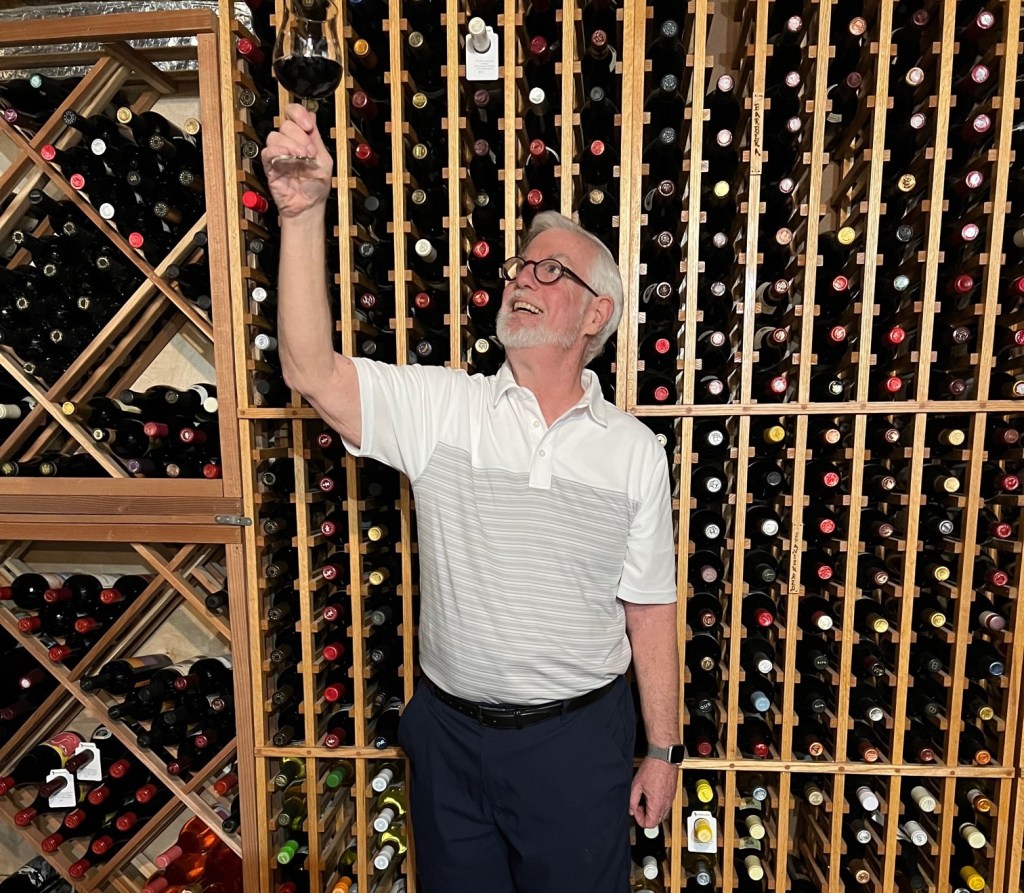
Thanksgiving is coming in three weeks.  What wine(s) do you plan to serve with your Thanksgiving dinner this year?  Have you bought them yet?  There are lots of alternatives.  Below is a download where I recommend 44 different wines that I think pair very well with turkey.  I suggest having two or three different wines on the table, if the number of adults supports that, so people can try different wines with their meal.

One question I frequently get when I recommend wines is, “Where can we find them.”  I have recommendations for that in the above download.  For a more detailed discussion on wines sources you might want to click on my blog post on that topic https://billwinetravelfood.com/2023/07/29/where-do-i-find-the-wines-that-are-being-recommended/

Most people associate poultry with white wine, following the white meat – white wine guidance.  But this is not a rule, and turkey does have delicious dark meat as well.    My recommendations start with three white wines: Chardonnay, Pinot Gris, and Riesling.  I am also recommending you consider a dry Rose and/or a medium bodied Pinot Noir.  Both also pair very well with turkey.  The prices shown in the attachment are rough averages of what the larger online stores are selling them for.  There can certainly be a variation of a few dollars, depending on your state and what store you pick.  Taxes and shipping, if ordering online, are additional.

One common theme in my blog posts on wine is that Americans drink their white wine much too cold and their red wine at too warm a temperature.  White wines should be drunk at 60° F.  Most refrigerators are at about 48° and taking wine out of the refrigerator and pouring it blocks off much of the delightful taste of that white wine.  I highly recommend taking white wine out of the refrigerator, opening it, and let it sit on the counter to breathe and open up for 30 minutes before serving it.  If you don’t believe me, try this experiment.  Get two bottles of the same wine and open one of them and let it sit on the counter for 30 minutes.  Then open the second right from the refrigerator.  Compare the tastes, the first one with have many more tastes than the second one. 

Good red wines served at room temperature are also hiding much of their flavors.  Winemakers usually finalize their wine by blending wines from different grapes or using the same grape but from several properties.  The wines have aged in barrels in the cellar which is at 60° F.  The winemakers are tasting the wine at that temperature when they finalize their wine.  Serving red wines that have had the time to open up and that are at 60° will let you taste what the winemaker wants you to drink.   You will get the most flavor out of the Pinot Noir that is the last set of recommended wines below if you open the bottle and let it breathe 3-4 hours before serving and then put it in the refrigerator, open and standing up, for 30 minutes to get the wine to 60° F before serving it. Try the same kind of experiment with a red wine to see how bog a difference it will make.

Also available for download is my recipe for Roast Turkey.  Beth and I were married in 1971 when I was a grad student at Columbia and she was entering the Navy Nurse Corps.  She was on duty on our first Thanksgiving Day. so I volunteered to cook a turkey instead of going out to eat when she got home from the hospital.  The turkey was golden brown, moist, and delicious.  At the end of the meal she looked at me and said that she was never roasting a turkey and, 53 years later, she has held firm to that.  For the last 16 years I have been blessed to have different grandchildren cook the turkey with me, so the recipe and tradition are being handed down.  In the below blog post are lots of pictures that may be a good compliment to the recipe if you download it. 

I hope the two attachments add to your enjoyment of Thanksgiving.  Your comments and feedback are always appreciated. 

Another Great White Wine You May Not Have Heard Of – Aligoté

First the pronunciation – alley go TAY.  This is a white grape from the Burgundy region of France that has long been hidden in the shadow of the great Chardonnay wines frequently called White Burgundy.  It is a cross between the Pinot Noir grape used in all the great red Burgundy wines and the Gouais Blanc grape that was done in the 17th Century. 

For hundreds of years it was just a white table wine that was grown in the locations that were not good enough for the two stars of Burgundy – Pinot Noir and Chardonnay.  And the top winemakers ignored it, so the resulting product was often not very good.  Below I have a great story about the poor quality of Aligoté but I cannot certify that all parts of this story are true of you are a fact checker.

One of the towns in Burgundy near Dijon had a good amount of Aligoté vines but no market for the wine made from them.  The mayor of that town had the idea that if they added some additional flavor to the Aligoté, that might get people to buy it.  The town also grew black currants, and people in the town would make a dark red sweet  liquor out of them called Crème de Cassis.  At a town event the mayor poured a little of the Crème de Cassis in the bottom of his wine glass and then filled the glass up with Aligoté.  He walked around suggesting that people try this cocktail mix and many of them really liked it.  Word spread about mixing Aligoté with Crème de Cassis and that cocktail became popular in Burgundy and then spread into the rest of France and eventually around the world.  The name of the mayor was Kir, and that name was given to this cocktail. 

Unfortunately, the popularity of the cocktail did not generate significantly more sales of Aligoté.  Rather than put that wine on their shelves, cafes chose to use other house white wines with the Crème de Cassis and still call it a Kir.  When sparkling wine from the neighboring region of Champagne was used instead of Aligoté, that became Kir Royale. 

Early in the 20th century some good winemakers became more interested in the Aligoté grape and started using good vinification processes with it and got a nice crisp, dry white wine with a little fruity acidity and white fruit aromas.  In 1937 it got an AOC, Bourgogne Aligoté.  The Côte Chalonnaise sub region of Burgundy has had some very good success with Aligoté.  To the best of my knowledge, this grape is not grown outside the larger Burgundy region. 

We first tried Aligoté in the 90s and it became our house white wine with a price under $10 for about 10 years.  We had only one source for it in DC and for some reason one day they told us that they could no longer get it.  After that, the only Aligoté we could occasionally find was from A & P De Villaine.  This wine is made from grapes grown on the personal estate of Aubert and Pam de Villaine in the town of Bouzeron in the Cote Chalonnaise.  Aubert is best known as the co-owner of one of the most famous estates in the world, Domaine de la Romanée-Conti, where he served as the co-director until 2021.  He was a big believer in the Aligoté grape and thanks largely to his advocacy, it first earned the appellation Bourgogne Aligoté de Bouzeron in 1970 and was upgraded to A.O.C. Bouzeron in 1997.  Their Bouzeron Aligoté is the best Aligoté on the market, but it was $35 when we first had it and now is generally about $45, so not a table wine. 

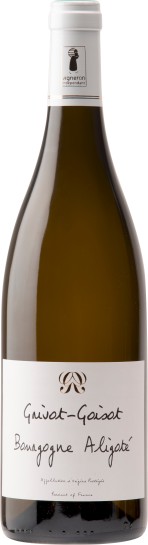
However, in the last few years a number of very good Aligoté wines have become available in the US, generally around $20.  A search for Aligoté on for wines that can be shipped into to Maryland had 25 different products that were under $30 – http://www.wine-searcher.com. Our current favorite is the Grivot-Goisot – Aligoté Bourgogne 2022 shown in the picture at the start of this post.  We are getting this from our favorite wine store in DC, Calvert Woodley.  Their price is $22 but it was recently on sale for $19 and we got a case of it.  It pairs nicely with seafood and chicken dishes and is great to sip at before dinner.  We have Crème de Cassis in the bar, but have no intention of adding it to this wine!

If you enjoy crisp, dry white wines with some good flavors, I suggest you give Aligoté a try.  Let me know what you think. 

Bordeaux Red Wines – Part 3, Right Bank Wines

The third and final post on Bordeaux red wines for under $30 is finally here and my apology for the long delay.  Like the two earlier posts on Bordeaux red wines, I have most of the information in two downloads. 

The first download provides background on the Right Bank Terroir and how it is different from the Left Bank and the primary grapes used for Right Bank red wines.  I also cover the AOCs for the Right Bank and the Saint-Emilion Classification to help understand the information that is on the label to help you in your wine selection process.  Lastly, I provide a little information on three of the top estates on the Right Bank.

The second download is a list of fourteen recommended Right Bank wines.  For each of them I have their Classification, the percentages of the different varietals in that wine, and a typical retail price for the 2020 vintage.  Six of those wines are under $30.

I hope you have enjoyed the three posts about Bordeaux red wines and are enjoying trying some of the ones recommended in the three posts.  Do you have a preference between Right Bank and Left Bank?  Are some of the under $20 wines now a favorite table wine?  Feedback is very interesting and helpful and “Likes” are greatly appreciated. 

Blog Post On Another Website On A Different Topic

This blog is only for discussion on wine, Food, and Travel.  I did a blog post on the Maryland Forward Party’s website on my conclusion from Tuesday’s Presidential Debate and just posting a link to it if you might be interested.

https://www.marylandforwardparty.com/how_important_is_trust_in_deciding_who_to_vote_for

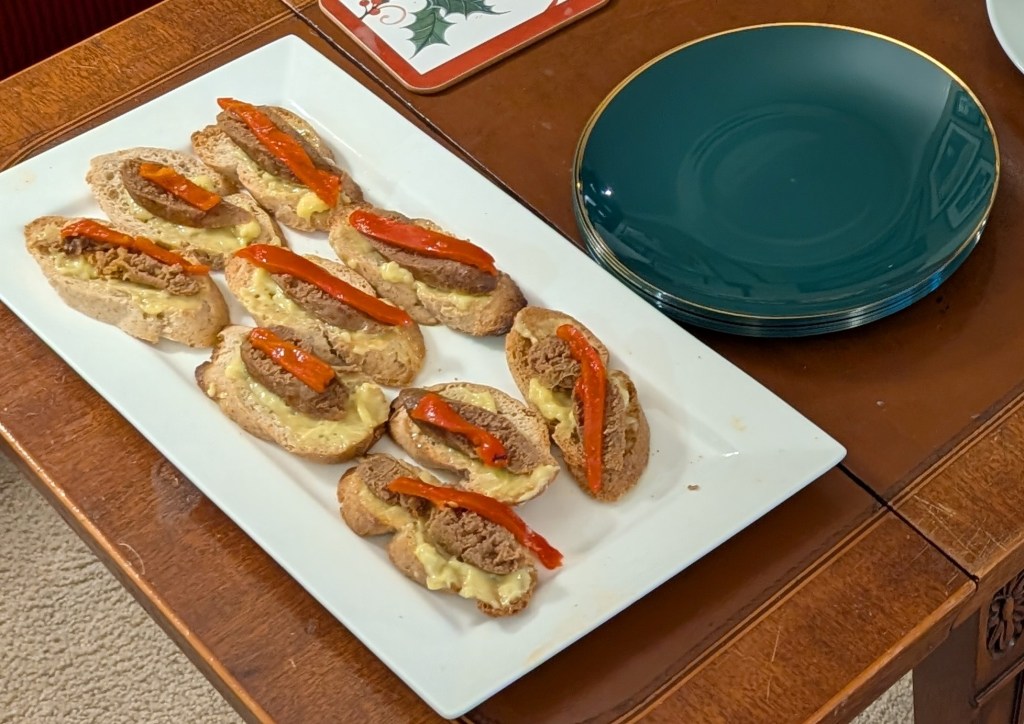
Homemade Merguez Sausage

I really enjoy the spicy lamb Merguez sausages that originated in North Africa and are an ingredient in many Mediterranean dishes.  When I go to a Spanish Tapas restaurant my short list of must have dishes includes how they are using Merguez.  I have thought about making sausage for a while now and I finally got off my butt and did it last week. Merguez was the sausage that chose to make as my first effort.  The results were delicious, and I plan to both make Merguez again when we have eaten the ones that I just made and froze, and to try making other sausages.  That short list of future efforts includes Italian (both sweet and hot), Bratwurst, Kielbasa, and a Sriracha Andouille that I found an interesting recipe for.   I did spend about 8 hours in the prep, grinding, stuffing, and clean up – so it is not a simple process.  And if you do not have a Kitchen Aid Mixer, the time, effort, and cost could increase significantly.

If you have any curiosity on either Merguez sausages or how sausages are made, or both, this blog is about how I learned sausage making 101 from a great posting on the internet and how my initial effort making Merguez sausages was done and the results.  I will also provide some links to recipes using Merguez that you might find interesting. 

Merguez Sausages

I’ll start with a little background on Merguez Sausages for those who are not familiar with them.   They are a lamb sausage that originated a long time ago in North Africa.  They are very spicy, with cumin seed, coriander seed, fennel seed, paprika, garlic, and salt adding to the flavor.  They also have Harissa, the chili paste from Tunisia, and some powdered chili pepper to give them a kick but they are more spicy than peppery.  In my initial effort I found them hotter than the store-bought Merguez sausages that we have been using in our cooking and when I talk about the recipe below, I will cover how I plan to decrease the heat in the next batch that I make. 

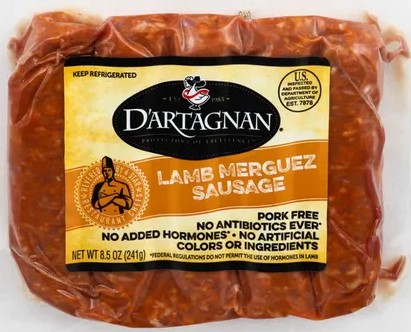
Merguez Sausages can be found in many supermarket chains.  Use Google to search for “Merguez sausages near me” and you will very likely see at least one entry.  The product most often seen is shown in the picture below, from D’Artagnan, and they are excellent.  And their 8.5 oz package typically sells for $10-12 or about $1 per oz.  I made a little over 4 lb. of sausage and my ingredients cost about $26 so my sausages were less than half the price of the D’Artagnan ones which is a reason to think about making your own. 

Sausage Making 101

I found a 4 page write up, Homemade Merguez Sausage, written a few months ago by Joshua Bousel online and that convinced me to give it a try.  You can find that article at https://www.seriouseats.com/homemade-merguez-sausage-recipe. I highly recommend it and I will talk about the minor variations I took from his recipe which is at the end of his write up.  In the Needed Equipment section below I will cover the one major disagreement I have with his write up. 

There were three things that I really like in his write up.  The first was the importance of having the right amount of fat in your mixture.  “Low fat and sausage are two things that you never want to see together.”  The second is the importance of keeping everything very cold in the grinding process and again in the stuffing process.  I thought I was doing a pretty good job of that but learned it really was important and ways to do it better that I will share.   The last is the lesson I quickly learned when I started making bread and again when I started smoking meats on my Kamado Grill.  The only way to learn to bake a baguette, smoke a brisket, or make delicious sausages is to try it and make mistakes.  Learn from those mistakes and try it again.  Don’t expect perfection, or an easy time of it, the first couple of times. 

At the end of his write up he shows a total time of 2 ½ hours, not including clean up.  I easily spent double that on this first effort.  And the clean up was at least 30 minutes each after the grinding and after the stuffing.  It would have been much worse if almost all the Kitchen Aid grinder and stuffing accessories had not been able to go in the dishwasher.

Needed Equipment

One of the best kitchen investments we made when we got married was a Kitchen Aid Stand mixer.  I got one for Beth when we were first married and, when I started making bread and then homemade pasta, I was using it as much or more then she was.  Our first one gave us over 35 years of great service, and after a minor repair it was moved to our youngest daughter’s home where it is still doing great work.  Its replacement is still going strong after 16 years on the job.  The Food Grinder Attachment that is available for this mixer is a good one and can be used for a variety of purposes.  I used the fine grinding plate and got everything done in one pass. 

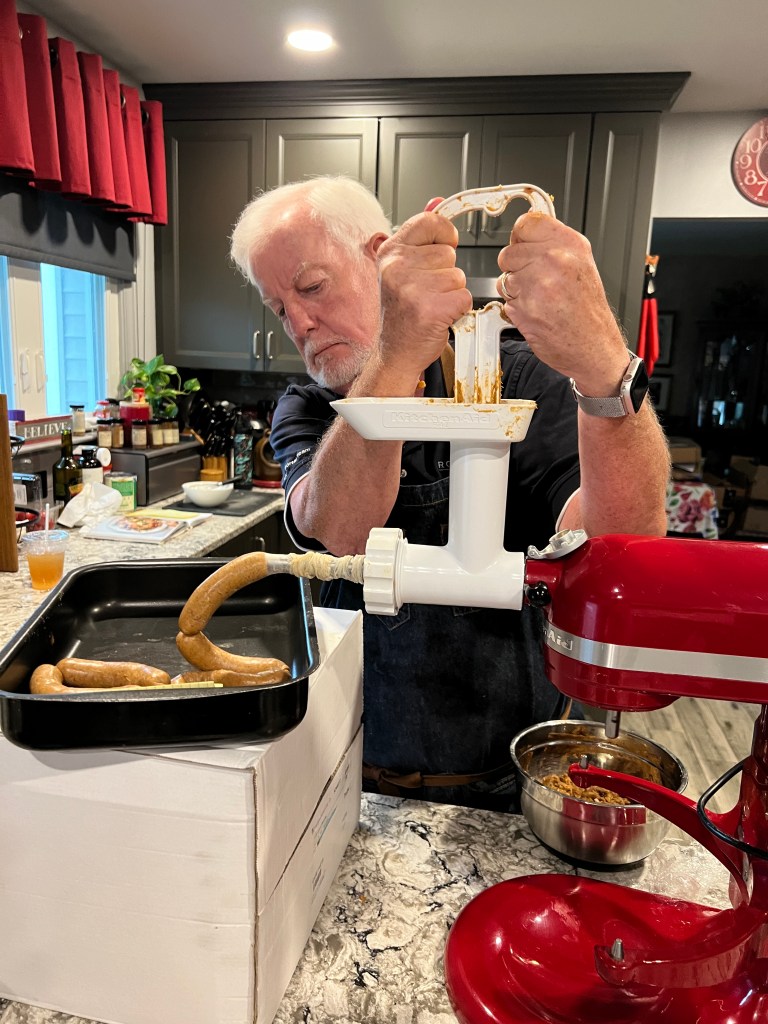
Joshua was not at all happy with the sausage stuffing capability of the Kitchen Aid but it worked fine for me.  The biggest complaint that Joshua had was the sausages were filled about 10” off the counter and would tear with the weight of hanging down.  To get the pan that catches the sausages right under the stuffer, I put an empty cardboard wine box under the mixer, as shown in initial the picture above, and that solved that problem for me.  The sausage stuffer that Joshua recommends is an excellent one but it cost $175 on Amazon and I need to be making a lot of sausage to justify that investment.  I purchased a set of three metal stuffing tubes that fit the Kitchen Aid Grinder. 

The Food Grinder Attachment is priced at $60 on the Kitchen Aid website but Amazon has a metal Meat Grinder Attachment that includes the sausage stuffing tubes for $39 so adding that to your Kitchen Aid is not a huge cost. 

You will also need to purchase the dried sausage casings.  Amazon has a very good selection.  Make sure you get the right size.  Merguez is a smaller in diameter sausage and it calls for Sheep casings and a stuffing tube of 15 mm.  The casings package I bought for $19 had two casings, each one would make about 26 sausages.  I used one for this first batch and more on that in the Sausage Stuffing section below. 

Recipe To Make Merguez Sausage

I made several minor adjustments to Joshua’s recipe based on some additional research I did on recipes for Merguez:

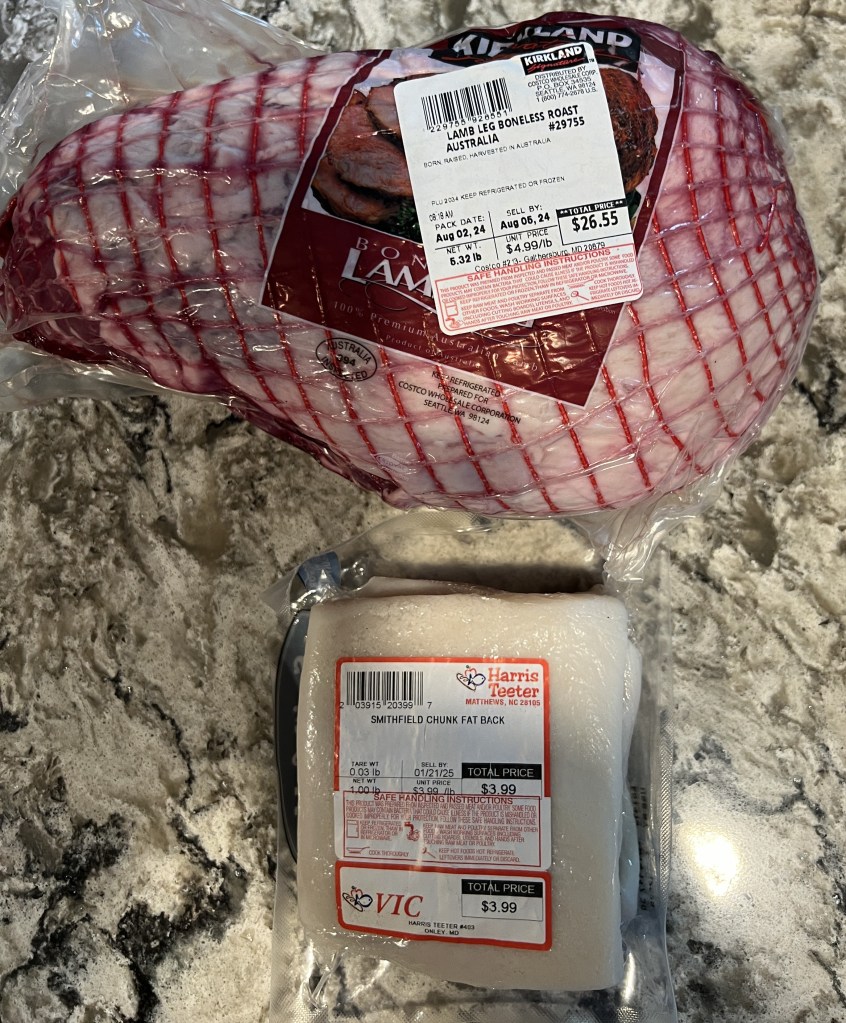
  • I bought a 6.3 lb.  boneless leg of lamb at Costco for $4.99/lb.  This was a lot cheaper than any lamb shoulder I could find.  I cut off 2.7 lb. of the leg, taking the parts that had the most fat to help with the fat content for the sausage.  The rest we froze and will use for another lamb recipe like lamb stew. 
  • Harris Teeter showed up in my search as the closest source for fatback pork.  I needed to ask someone where it was in the store, but they took me right to it.  It was a 1 lb. package with three square pieces of fatback in the package for $4.  I needed to trim off the skin but with a sharp boning knife that only took a couple of minutes and I had 10 oz of the fatback after removing the skin.  That did not give me the same 3:1 ratio as the recipe calls for but because I had taken the pieces with the most fat off the boneless leg of lamb, I was comfortable with that mix and was very happy with the end product.  The packages for the lamb and the port fatback pork that I bought are shown in the picture below. 
  • I used Smoked Hungarian Paprika which is a hot paprika but I like the taste that the Hungarian paprika adds and I wanted to bring that smoky flavor.  Using the hot paprika, and having just over 3 lb. of fat and lamb instead of the 4 lb. called for in the recipe, gave me a sausage that was hotter than the D’Artagnan sausages that we had purchased.  Next time I will cut the cayenne pepper back to ¼ tsp to bring that heat level down. 
  • I had dried ground versions of the cumin seed, coriander seed, and fennel seed on the shelf so I used them instead of toasting the seeds and grinding them.  Grinding the seeds probably brings more flavor so I will do that next time but for the initial effort I took this shortcut and I think I had minimal if any loss of taste.
  • I added to the seasoning mix:
    • ½ TB Onion powder
    • 1 Tsp freshly squeezed lemon juice and ½ Tsp Lemon zest to add a little more citric taste to the sausage
  • I followed the directions on the package for the lamb casings to prep them, not the ones in Joshua’s write up. 

Grinding the Sausage Mixture

I put the grinder attachment in the refrigerator overnight and then in the freezer while I cut up the lamb and the fatback and coated it with the spice mixture.  I then put the bowl of cut up pieces in the freezer for 20 minutes before I started grinding them.  Next time I will get the mixture ready for grinding the day before and keep it in the refrigerator overnight and then in the freezer for at least an hour before grinding.  I will also take the mixture out of the freezer 1/3 at a time so it stays colder.  The picture below is the mixture ready to be ground.

I really want to do a better job getting all the pieces coated with the spice mixture next time.  When I got to the bottom of the bowl, there was a lot of the spice mixture sitting in the bottom of the bowl.  I ended up pouring that remaining spice mixture into the bowl of the ground mixture and following Joshua’s recommendation for one minute under the Kitchen Aid paddle to get everything evenly added into the mixture. 

Pushing the pieces down the feed tube with the food pusher was more of an effort than I had expected.  I think it got harder as the mix warmed up in the bowl as I was grinding.  I ended up with 4.2 lb. of ground mixture.  I could not figure out how 2.7 lb of lamb and 10 oz of fatback could become 4.2 lb. of mixture until Beth explained that it was the air that was captured in the ground mixture that added to the weight. 

I was really happy that everything but the cutting blade could go into the dishwasher.  It did take a little time to rinse off all the debris from the grinding attachment parts for the grinding step and the sausage stuffing step as our dishwasher does not have a way of processing that, just catching it in a filter that is not easy to clean. 

After I was finished the grinding process I cooked the test patty that Joshua suggested and got Beth’s agreement that the mix was good, I kept the mixture overnight in the refrigerator covered with plastic wrap and did the sausage stuffing the next day. 

Sausage Stuffing

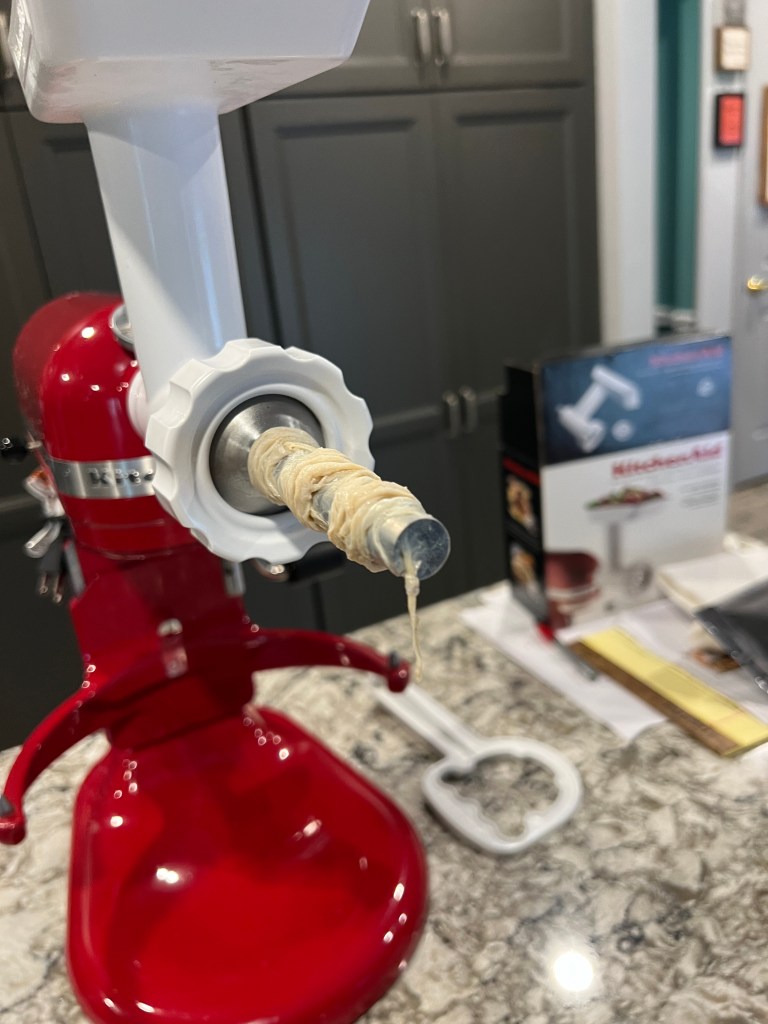
The picture below shoes the lamb casing on the smallest feeding tube and the end tied in a knot.  I struggled to get that knot done but, as discussed below  having to do it several times, I got a little better at it with multiple tries.  I needed to wash the fat and residue off my hands each time to get a good grip on the casing to tie it. 

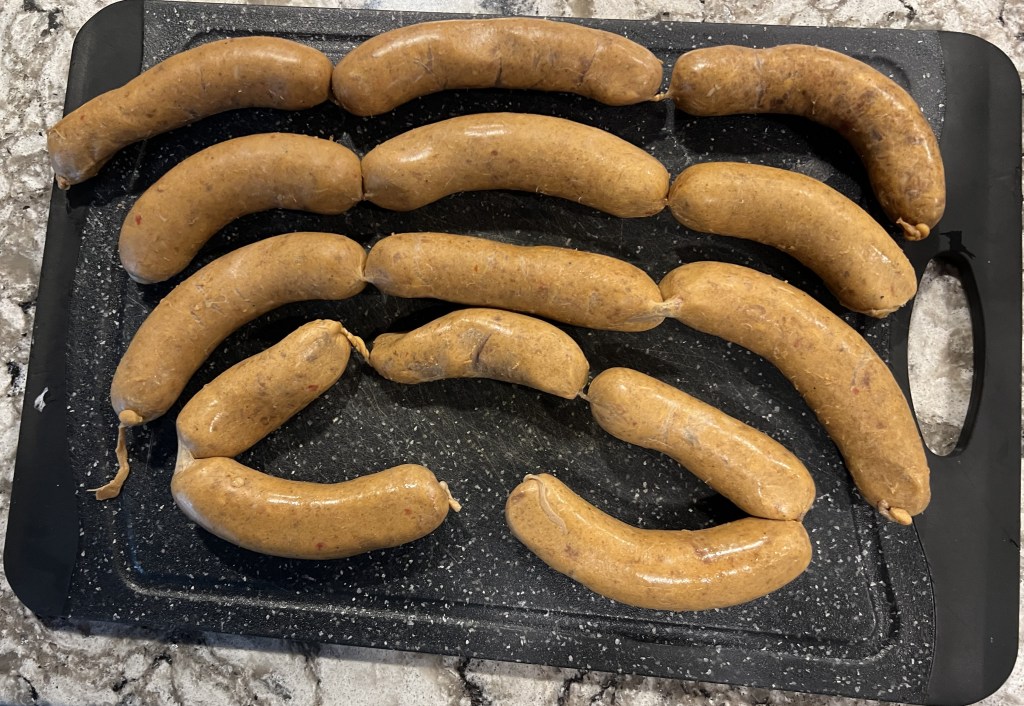
Several of the recipes that we have for Merguez call for it to be removed from the casing then cooked.  Beth had the brilliant suggestion that we freeze some of the mixture as patties so we did not go to the effort of putting in a casing and then taking it out of the casing to cook it.  I made 4 patties that were 8 oz each and froze each in a small zip lock bag.  The remainder made the 14 sausages shown in the picture below. 

I did have a learning curve with the stuffing and several times had to stop the Kitchen Aid to cut off the casing, take out the mix from a casing that had a problem and start the process again.  The set of five sausages of different sizes at the bottom of the picture are ones that I kept even though they were not the right size and shape.  The nine ones above that came out pretty good but not in one stream of nine linked sausages, just three sets of three links each.  I think I will do better next time and even better with more practice.  I also struggled with the food feeder pushing the mix down into the body of the grinder to be fed into the tube and casing.  As the mix got warmer some if it would go around the edges of the food processor and when I went to pull it out to add more mixture, bring a lot of the mixture back up with it.  Taking only 1/3 of the mixture out of the freezer at a time should help keep it cold enough to lessen that problem. 

When all the sausages were stuffed I followed Joshua’s suggestion and put them in a bowl covered just with some paper towels overnight in the refrigerator to let the all the flavors blend. We then froze the links in four packages and will be using them in the recipes below over the next two months.

Merguez Recipes

Here are links to six different recipes that use Merguez sausages.  I think they show the range of different dishes that are complemented by this spicy sausage.  I made the first on on the list with the D’Artagnan Merguez and that convinced me I wanted to try to make the Merguez myself. Three of these recipes are from celebratory chefs that have good recipes: bobby Flay, Narc Murphy, and Chris Santos.

Summary

  • Merguez sausages are delicious and can be used in a many different dishes
  • You can make them yourself for about half the price of store-bought Merguez
  • Like putting up a batch of canned items from your garden, making sausage takes time and effort, but the results are delicious and well worth the effort
  • I enjoyed making the sausages and plan to both make Merguez again and experiment with other sausage recipes

Note: I have not done any blog posts for a while due to lots going on with the family, all positive things.  I have several other posts on wine and travel I have been planning to do all lined up.  Thanks for your patience during this lull in my blog posts. 

Petit-Figeac: An outstanding 2nd wine from one of the top Bordeaux chateau

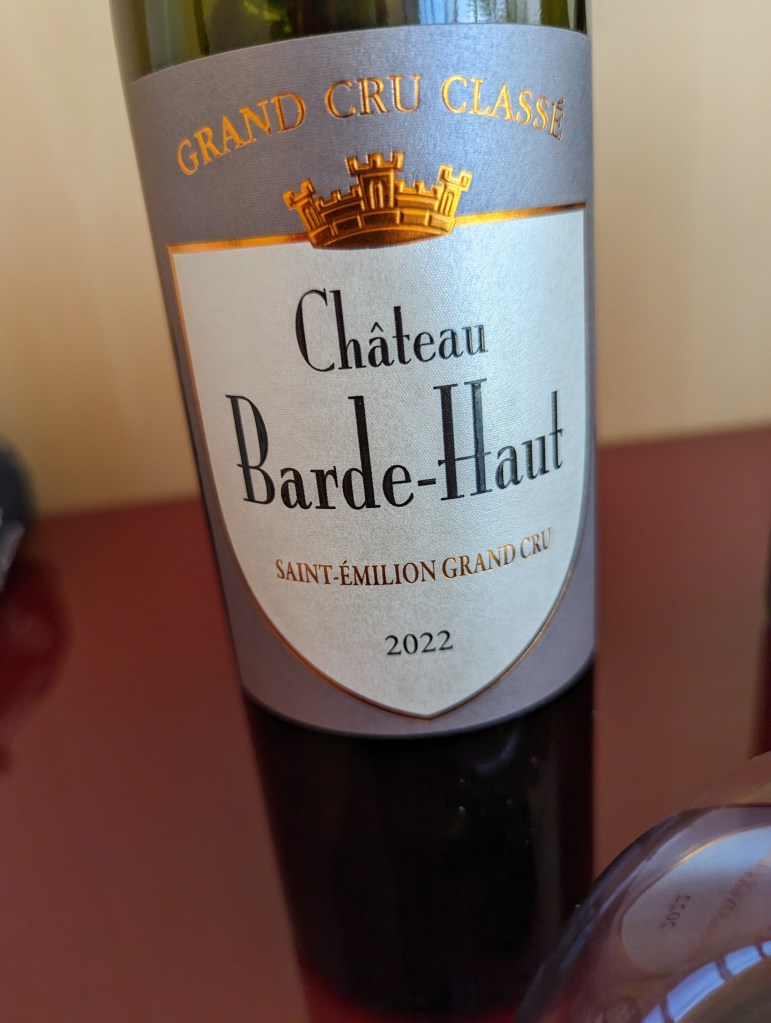
The most recent St. Emilion reclassification in 2022 had only two estates at the very top of the list as Premier Grand Cru Classe A: Chateau Pavie and Chateau Figeac.  We had the pleasure of visiting Chateau Figeac and having a wonderful lunch there last year and it is our favorite Right Bank wine and in our top three for all of Bordeaux. 

I believe Chateau Figeac is unique in their commitment to use an equal amount of Cabernet Sauvignon and Cabernet Franc in the blend, generally about 70% the volume.  Merlot is the third wine that completes the blend.  While that makes it approximately one-third of each of the grapes, the amount of the two Cabernets is always equal but can vary slightly from vintage to vintage with Merlot completing the blend.  At our lunch they talked about what a challenge it is to have the Cabernet Sauvignon and the Cabernet Franc play nicely together; each one wants to be the primary grape.  They say that these two wines define both the content and the form of the wine.  To grow these three grapes they have 40 different parcels that fall into 4 microclimates.  The average age of their vines is 35 years.  Nearly 30 of their 133 acres are kept as a nature preserve to promote biodiversity and the estate has Level 3 High Environmental Value certification. 

The Premier Grand Cru Classe wines are made to have high aging potential.  At our luncheon we had decanted magnums of 2009 and 1981 and while both were delicious, the 1981 had aged beautifully and was spectacular. 

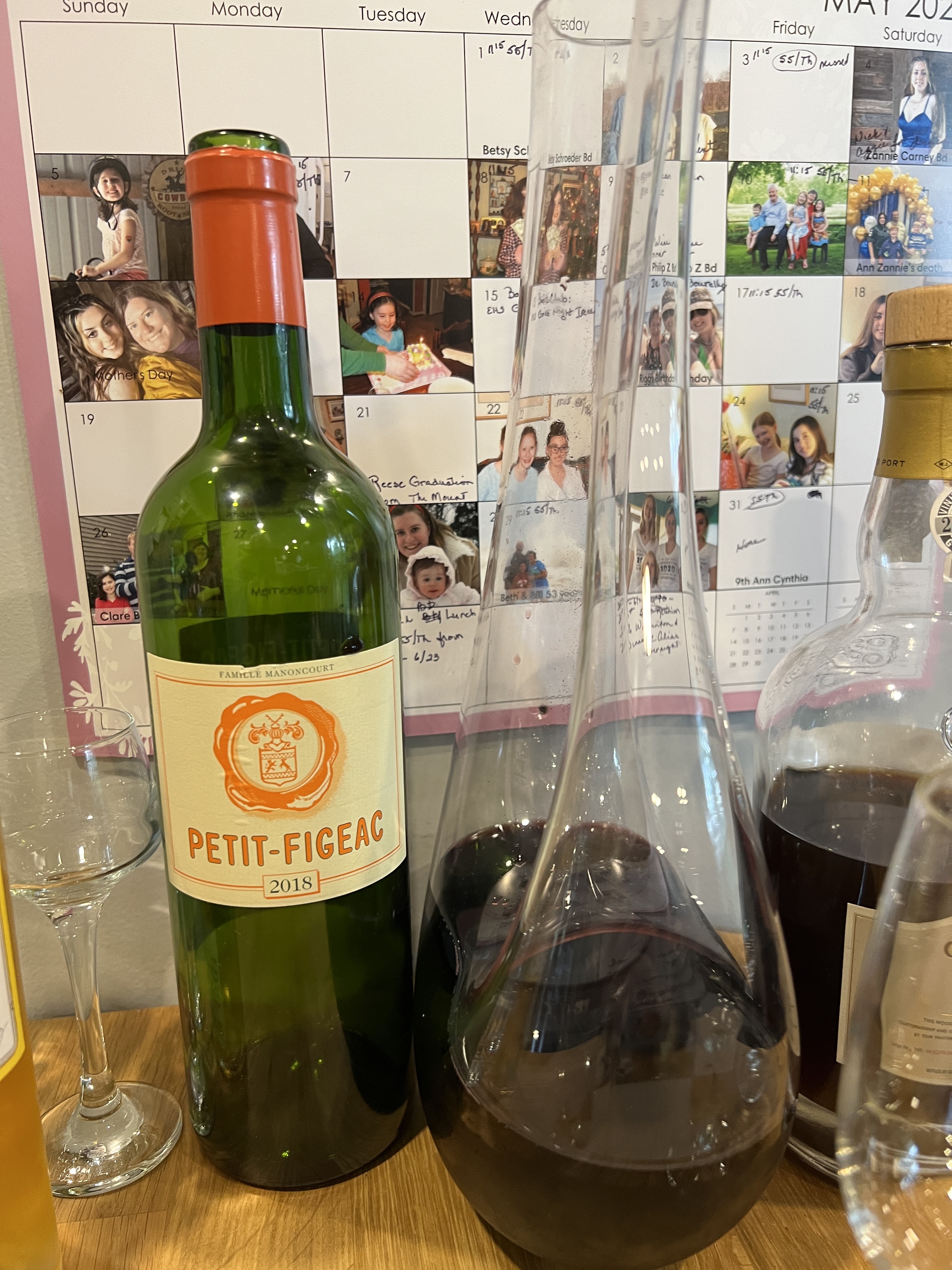
With our first course at that luncheon, we were served the 2018 Petit-Figeac, their second wine. Chateau Figeac started making a second wine in 1945 and it was renamed Petit-Figeac in 2012.  It has always been made exclusively from grapes grown on their property and uses some of the younger vines to make a lighter wine that shows its appeal earlier and is a great introduction to the spirit of the estate.  I put it right up with most of the Left Bank 1855 classification wines that we had tasted. 

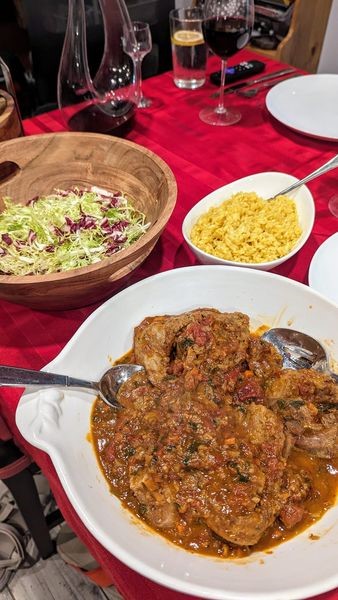
I bought a bottle of the 2018 for $70 and we had it with the delicious dinner that Beth made to celebrate our 53rd wedding anniversary.  I opened the bottle at 1:00 PM and left it standing up in our wine fridge until 4:00.  I then decanted it with an aerator and brought it to 60° F and served it at 7:30 to accompany our main course, Veal Osso Buco with Risotto Milanese.  It had opened up beautifully and as we sipped it, we relieved some of our great memories of our Bordeaux trip. 

I am not a fan of blind tastings, but I think this wine would easily hold its own with wines over $100.  I have two bottles of 2020 that are aging in my cellar and just replaced the 2018 for a special occasion to be determined in the next few years.  Given time to breathe and open up, I think a Petit Figeac can be served when it is fine years old.  I am very confident that no bottle in my cellar will get older than 10 years so I cannot put an upper boundary on how long to age it. and I did not see anything like that on the excellent Chateau Figeac website.  I would wait at least 10 years if I had any Chateau Figeac and it really should be 20 years.  As with all Bordeaux wines there are variations from year to year, but with the state of the art wine making facility they put in place in 2021 the variations are very small and I will happily drink any vintage someone wants to pour. 

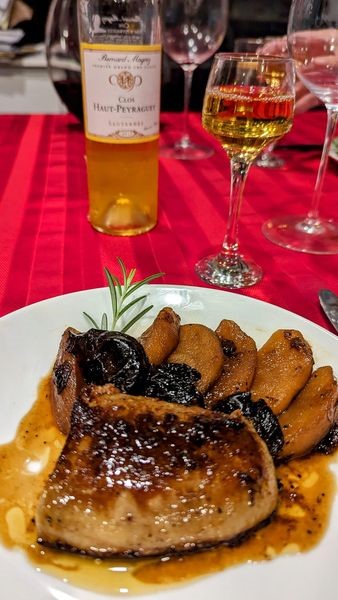
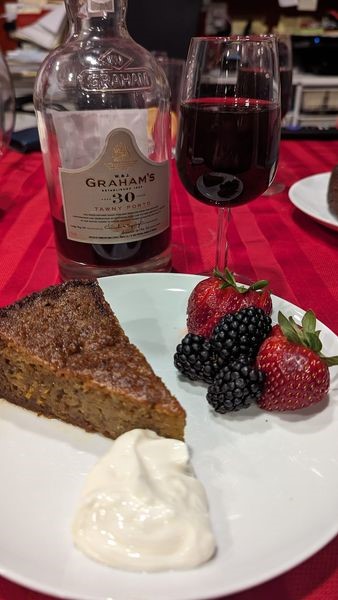
Beth started our dinner with Fois Gras that had been sautéed in Sauterne with apple and prune slices.  It was delicious and we enjoyed the rest of the Sauterne with it.  For dessert she made a Pistachio Greek Honey Cake with Greek Honey flavored Greek yogurt.  The cake was soaked with a honey syrup made from the Greek honey which had a lovely flavor unlike any other honey I have had.  We had some Graham’s 30 year old Tawny Port with the cake.  Pictures are below and it was just a great meal to celebrate 53 years with the most wonderful partner to share my life. 

Fois Gras starter

Osso Buco with Risotto Milanese

Delicious Dessert

Dry Aged Steak – What, Why, and How

I have done several posts on doing a Reverse Sear as the best way to cook a steak in those posts I have mentioned that we really like to Reverse Sear a thick cut Dry Aged steak.  What is a Dry Aged Steak?  Why Dry Age a steak?  Why does a Dry Aged steak cost so much more?  Is Dry Aging something that requires an expensive professional environment or can it be done in a home kitchen? 

I just dry aged a 5 bone ribeye roast and got six thick dry aged steaks from it and my cost was only $10.97/lb.  In this post I will answer the first of the three questions above, and you can download a discussion with lots of pictures on how I created my own dry aged steaks at a great price. 

What is a Dry Aged Steak?

Dry aging is a process that puts a large cut of protein in a controlled environment for a few weeks.  This post will talk about beef as the protein, but dry aging can be used for many other proteins including fish.  You cannot dry age a steak. You dry age a large cut of beef like a ribeye and then cut it into steaks.

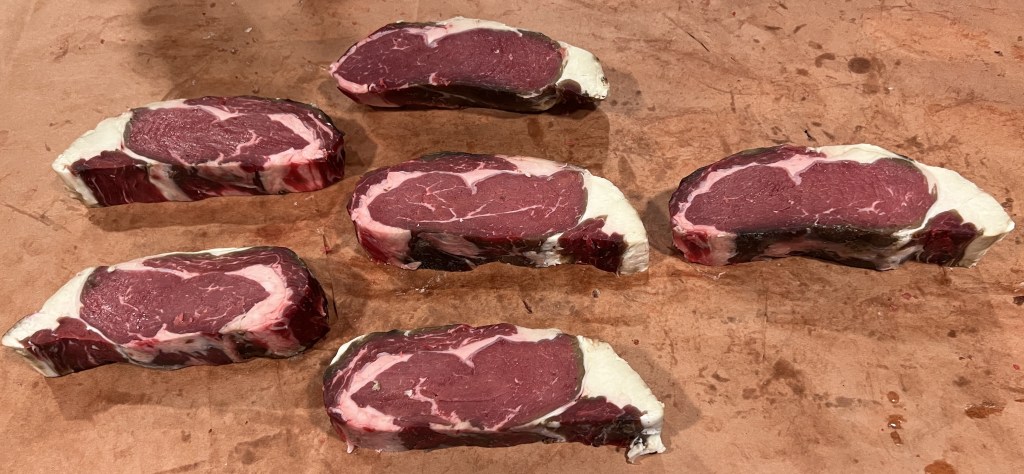
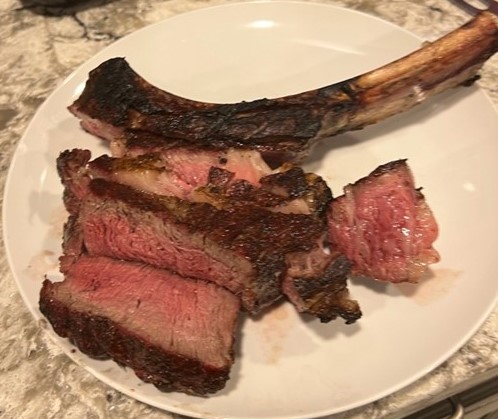
The dry aging process generally takes at least 3-5 weeks during which the roast will lose about 15-18% of its weight.  At the end of that process, the roast has a developed a dry skin that needs to be trimmed off.  I dry aged a 12 lb. boneless roast and when I had it trimmed and ready to cut into steaks, it was 7.2 lb.  The controlled environment lets the aging happen without any mold developing on the roast.  The first picture below is the roast showing its bright red color.  The second picture is the 6 dry aged steaks I cut after dry aging that roast showing they now have a deeper red color.   The last picture is a dry aged steak that I cooked with the Reverse Sear method and let sit for five minutes before cutting into thick slices showing hour bright red and juicy the steak is, in case you had any concerns about the color of the freshly cut steaks or concerns about some of the juices evaporating during the day aging process.

Steaks are not dry aged, large cuts of beef like a whole ribeye or porterhouse are dry aged and them trimmed and cut into steaks.  To cook a dry aged steak so you get the best flavor, the steak should be cut to be at least 1 ½” thick.   

Why Dry Age Beef?

The short answer is that it makes the steaks taste MUCH better!  Many of the top steak houses have a dry aging room where they hang the large roasts for weeks before cutting them into steaks to serve to customers.  Peter Lugers in New York City, often ranked the best steak house in the world, built their reputation on dry aging their steaks and cooking them to perfection.  When you order they will ask how many people want the steak and they will cut a steak to the thickness for that many and serve one steak for the table. 

The aging process causes the connective tissues in the large roast to break down, making it much more tender.  Filet Mignon is the most tender cut of beef, but it has the least flavor of any cut of beef.  Dry aging can make other cuts almost as tender, but the richer flavor that they have compared to Filet Mignon is enhanced even more by the dry aging process.  Dry aging causes some of the juices to evaporate, concentrating their flavor.  Cooked correctly, dry aged steaks are very moist and delicious, the evaporation does not cause them to dry out. 

Why Do Dry Aged Steaks Cost So Much?

On a restaurant menu a dry aged steak commands a premium price over a regular steak, if they have both on their menu.  Some of the larger Harris Teeter supermarkets have a refrigerator sized dry aging unit in their store and that is where we first got our dry aged steaks when we wanted to splurge.  It is generally right next to the meat counter in the stores that have it, and the top of it is glass sided so you can see the roasts hanging in the unit.  Each of them has a sign on it for when that roast was put in the unit, when it will be available to cut steaks from, and the last day that steaks can be cut from it.  You can tell the person at the meat counter how think you want your steak cut.  They are generally in the $25-30/lb. range which is significantly higher than the steaks from the same cut of beef that have not been dry aged. 

The reason why is cost.  First you have about a 30-40% weight loss between the evaporation and the trimming that needs to be done.  Second that roast will be in the unit for 5-7 weeks before it is sold.  If they just cut it into steaks when they got it, it would be sold in a couple of days.  Sitting for that long has a cost and that is reflected in the price that they charge.  They also have to consider the cost of the dry aging unit and the floor space it takes up in the store.  People are willing to pay that price for a custom cut dry aged steak. 

Can I Dry Age Steaks In My Home Kitchen?

Yes – But!  The biggest issue is likely the amount of refrigerator space that is taken up for five weeks.  The entire roast needs to sit on a rack in a pan in your refrigerator for that length of time with room around it for the steak to breathe.  For many home kitchens that is a showstopper.  We have a second full sized refrigerator in our basement and I was able to use half of one of the shelves for the five weeks to dry age a half ribeye.  Using our primary refrigerator in our kitchen was not an option. The refrigerator needs to be a full sized frost-free refrigerator that has a compressor fan and  has regular traffic so the door is opened and closed several times a day.  Small beverage refrigerators or dorm room mini fridges will not properly dry age a roast. 

There are several companies that sell dry aging kits or bags.  For Christmas our son got me the UMAi Dry Aging Bags, which are highly rated, and they really worked well for me.  They also have bags for making charcuterie or slow fermented dry sausage.  Below is a link to a 10 minute video that will give you a good introduction of how to dry age a roast at home and what you will get when you do that.  It also has some very good insights on how the steak will taste so much better from the day aging.  I think you will find it very interesting. https://www.youtube.com/watch?v=pGMuWEhAWTc&list=PLU7RqiCq-smfgsCtmge3nuJBtAwkEQT-X&index=9

They are doing a full ribeye in this video.  I bought about a half a ribeye and the link below will let you download a PDF file where I will walk you through the process I did with lots of pictures. 

A high-level financial summary may encourage you to download that file.  We buy our meet at Safeway which has the best meat in the town we live in, and they will custom cut it for us if we ask.  Because it is just the two of us, I had then cut me a 5 rib roast that was 13.2 lb., about half of a full ribeye.  The sticker price for that roast was $198.02.  In the PDF I will tell you how I paid $79 for that roast.  I had them trim and remove the bones but leave them in the package because the sale price was for a bone in ribeye roast.  I could have done the dry aging with the bones attached and I do like a bone in steak.  But working with the bones is a little more difficult in prepping for the dry aging.  More importantly, being able to custom cut the thickness instead of cutting between each of the bones I got six steaks instead of only five really thick steaks.  In the PDF I have a picture of five bones showing they have a lot of meat on them, enough for a full meal for two of us.  In computing the cost for my steaks I did not deduct anything for those bones, so that meal will be free to us.  Taking away the bones, my roast weighed 12 lb.  After 35 days of day aging it weighed 10 lb.  After trimming I had a 7.2 lb. roast that I cut into six steaks the thickness I wanted.  Since I paid $79, that comes out to a cost of only $10.97/lb. and I have the meaty rib bones for free. The current supermarket sale price for a boneless ribeye steak is $16.99/lb., so I will be enjoying the much flavorful dry aged steaks for $6 less!

I cooked one of the steaks that evening and froze the other five.  The steaks will be OK in your refrigerator for up to three days after cutting them.  Any longer than that and they should be frozen.  Because the evaporation has reduced and concentrated the juices in the meat, they will have less impact from being frozen than a regular steak.  You can also dry aged previously frozen roasts. 

If you want to try some dry aged steaks from Harris Teeter before trying to dry age a roast, that is what we did.  If you dry age a roast and get some great steaks, or if you buy a nice dry ages steak, I strongly encourage you to Reverse Sear it for the best flavor.  Below is a link to my blog post on Temper Your Steak and Then Reverse Sear It for a discussion with lots of pictures on how to do this. https://billwinetravelfood.com/2022/08/18/temper-your-steak-and-then-reverse-sear-it/

I hope you become as big a fan of dry aged steaks as Beth and I are and I hope you decide to dry age a roast yourself.  Let me know what you think. 

This has been two food blogs in a row! Please do not worry that I have given up wine. I have several wine blogs a a travel blog planned.

Baking Delicious Baguettes

Do you love a nice French Baguette?  What are you paying for that baguette today, $5-6?  Why not make your own?  The ingredients for the baguette I am holding in the picture cost me about 91 cents, paying retail for them. 

I love baking bread.  I got started 25 years ago when I really hated my boss.  I tried different things to deal with the frustration from work, like picturing his face on the golf ball and swinging as hard as I could at it.  That only caused me to deposit a large number of golf balls deep the woods or at the bottom of the water hazards.  I tried baking bread and the more I punched the dough, choked it, and picked it up and slammed in back on the counter, the better the bread tasted.  What a surprise.  I solved the frustration0 problem by changing jobs, but I really enjoyed baking bread and kept it as a hobby.

I am also not at all artistic.  Give me three tries with a ruler and I can draw one sort of straight line.  But baking artisan breads let me for the first time create things with my hands that I was proud of.  And few things smell better than freshly baked bread when it is ready to come out of the oven, nice and golden brown. 

So baking your own baguettes can save you money, reduce your stress and frustration, be a fun thing that you can be proud of, and have your whole family loving the smell and wanting a slice of the freshly baked bread.  Why not give it a try?

Being very honest – it took me  a number of tries until I got a baguette that I was very proud of, but all the other benefits were there from the beginning.  Attached is my recipe for baguettes developed over the years, with lots of pictures and notes on what I am doing and why.  I hope you can have as much fun with this as I have had.

You can download my recipe here.

One secret ingredient really made my bread better the last couple of years.  And I am sharing that secret here.  For years I would use bottled water to make my bread because tap water has chlorine and the yeast do not like that.  But on one of the TV cooking shows I heard about using the water from cooking pasta for bread baking and other cooking.  The cloudy water left after boiling pasta got that way from starches given off by the pasta when it is cooking.  The yeast loves those starches.  I often freeze three cups of pasta water after we make pasta so I will have it when baking.  It will keep for months frozen, and I leave it out in a bowl overnight to defrost the day before I will be baking.  You should salt your pasta water to taste like the ocean before you put your pasta in the pot to get the right taste for your pasta.  When I use pasta water for my bread I cut the salt added to the dough in half because that pasta water is salty.  Pasta water does not need to be filtered because it is boiled when making the pasta and that gets rid of the chlorine in the water.  It really makes a big difference!  I hope you give bread baking a try and have as much fun with it as I have had. 

I have been doing so many wine postings that I am way overdue on doing a food blog.  I have another one coming out about dry aging steaks.  You have seen several posts I have done on cooking dry aged steaks.  This one covers buying a whole Ribeye and dry aging it myself.  I will also be doing a travel blog about our Viking cruise in February to see the Northern Lights.  That one is way over due.  After my 3rd post on Bordeaux wines under $30, this one recommending Right Bank wines, I will be doing one on five Italian white wines that I really like.  If you subscribe to this blog, you will get an email letting you know when those posts come out. 

Recommended Bordeaux Wines for Under $30 – Part 2, Left Bank Wines

Thank you for the great response to Part 1 of this three-part series on my recommendations for Bordeaux Red Wines for under $30.  In this second post in the series, I will be covering wines from the Left Bank of Bordeaux with a short write up of ten wines that I really like.  The third and final part of this series will be on Right Bank wines.  There is a downloadable list of the ten recommended wines at the end of this post and I also make available the download on how to get the best flavor out of these wines by letting them breathe and serving them at the right temperature and the link to my post on where to get the wines, both of which were also included in the first post in this series.

Why is such a big deal made about wines from one side of a river versus wines from the other side of the river?  To keep this post short, the answer to that is available in the download below –  Micro Crus, Left Bank Terroir, and Medoc Classifications.  This is intended to add on more knowledge about Bordeaux to what you learned from the download in the first post on Bordeaux Geography and Geographic Classifications.  Yes, there will be another download with the final post in this series that will cover Right Bank terroir and the St. Emilion Classification. 

Taking the list at the end of this post to a good wine store and getting a couple of the recommended bottles so you can sip some good wine while you read about the Left Bank might be the most enjoyable way to learn more about Bordeaux red wines. 

Recommended Left Bank Wines

Here is a short write up on each of the ten Left Bank red wines that I am recommending.  While the Left Bank is known to lead with Cabernet Sauvignon and enhance it with Merlot, Cabernet Franc, and sometime a little Petit Verdot, a few of these recommended wines have more Merlot than Cabernet Sauvignon. 

Chateau Noaillac: This stylish Cru Bourgeois is owned by the Pagès family, who also own Château La Tour de By, another highly regarded Cru Bourgeois of the Médoc. The vineyard now totals approximately 100 acres, with an average age of vines of 20-25 years. Made from a roughly equal blend of Cabernet Sauvignon and Merlot, this wine is a classic Médoc, with rich notes of cassis and mineral, and with a finishing polish of toasty oak. Robert Parker describes this wine as “Unwinding in the glass with aromas of minty red berries, cassis, pencil shavings and loamy soil, it’s medium to full-bodied, supple and elegant, with an attractive core of fruit, refined tannins and a penetrating finish.”  Classification: Cru Bourgeois.  Varietals: Approximately equal mix of Cabernet Sauvignon and Merlot.  Typical Price: $16

Chateau Bel Air: Dark ruby/purple. Fruit and some dustiness on the nose, opens up nicely with air and becomes more complex with notes of leather and earthiness. Bone dry, elegant but powerful fruit on the palate, grippy well-rounded tannins, and mouthwatering acidity well integrated with the fruit and oak. Medium to longish finish.  Classification: Cru Bourgeois.  Varietals: 50% Cabernet Sauvignon, 30% Merlot, 13% Petite Verdot, 7% Cab Franc.   Typical Price: $17. There is also a Chateau Bel-Air Lussac, very similar name, that is on the right Bank in St. Emilion that I am not familiar with. 

Chateau Caronne Ste. Gemme: A Bordeaux estate just south of Saint-Julien in the Haut-Médoc. Its “grand vin” is a classic Bordeaux blend, and it was classified as a Cru Bourgeois Supérieur of Haut-Médoc in 1932 and Cru Bourgeois Exceptionnel in 1966.  The vineyard covers a single 40 hectare (98 acre) plot. It is planted on a layer of gravel overlying a combination of iron-rich sandstone, sand and clay soils. Plantings are divided into 60% Cabernet Sauvignon, 34% Merlot, and 6% Petit Verdot, with the average age of these vines totaling 30 years old.  It was recently purchased by 4th Growth La Tour Carnet, which it neighbors, and will likely be added to their Grand Cru Classe wine and not continued to be sold under a separate label, so buy this now and if you like it, stock up as 2021 might be the last vintage it will be available.  Various reviewers have given them 88-91 points.  Classification: Cru Bourgeois Exceptionnel.  Varietals: see above.  Typical Price: $20

Chateau La Cardonne: This vineyard sits on a high plateau in the north of the Medoc peninsula where gravel soils are dominant, layered on different depths of clay. Further down the slope, there are parcels comprised of clay-limestone soils, layered on blue marl with limestone outcrops. There is such diversity in each parcel, each creating their own variety of wine so each parcel separately, giving rise to complex and elegant wines.  The wine is deep crimson, with a relatively subtle nose. Nicely polished fruit with some energy and real zest in this Cru Bourgeois. Fine, classic, and silky.  One of the few nice Bordeaux that some of the Montgomery County Maryland stores carry for those who live close to me.  Classification: Cru Bourgeois.  Varietals: 50% Merlot, 45% Cabernet Sauvignon, 5% Cabernet Franc. Typical Price: $23.

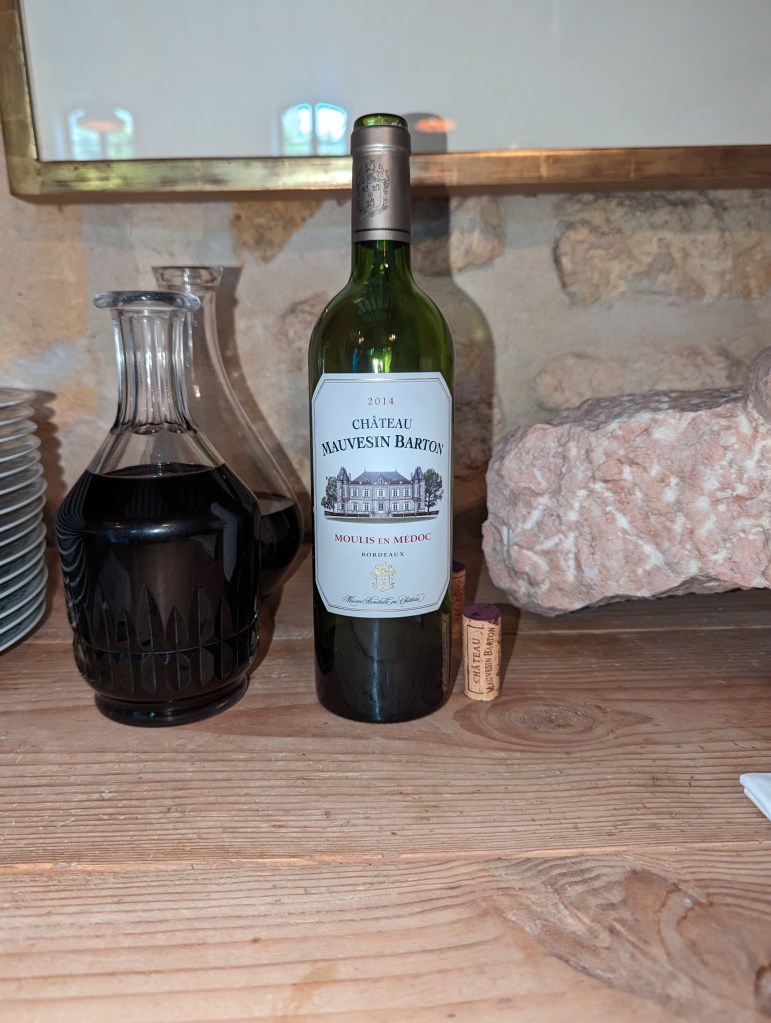
Chateau Mauvesin Barton: I am a huge fan of this wine and consider it the Best Buy in Bordeaux.  I did a whole blog post on it last year and you can find it at https://billwinetravelfood.com/2023/07/09/bordeaux-best-buy-chateau-mauvesin-barton/ . The thumbnail is that The Barton family who owns Leoville Barton, my favorite 2nd growth, and Langoa Barton, a very good 3rd Growth, bought Mauvesin in 2011 and put a lot of money into the vineyard and wine making facility and manage it with the same team as their Grand Cru Classe wines.  Because it is not in St. Julien, they have to keep it a separate label and it is a steal at this price.  The mix below is for the 2020 vintage.  The winemakers have chosen to change the percentages significantly in different years as the vines mature from the investments made in the last 12 years.  Classification: Moulis en Medoc.  Varietals: 59% Cabernet Sauvignon, 35% Merlot, 6% Cabernet Franc.  Typical Price: $22

Chateau Greysac: Situated at the confluence of the Gorgonne estuary and the Atlantic Ocean just north of St. Estephe, it sits on a large swale of Gunzian gravel over a clay-limestone base.  A blend of Cabernet Sauvignon and Merlot, with a dash of Cab Franc and Petite Verdot. Fresh red berries, along with notes of cedar and spice, mingled with dusty tannins and impressive structure.  The nose is aromatic, elegant and displays good depth and harmony. There are notes of bourbon vanilla, blackberry and more slightly raspberry associated with hints of blueberry as well as points of racy minerality, nutmeg and sweet spices.  The palate is fruity, mineral, balanced and offers freshness, an acidic frame, a nice fineness of grain as well as harmony, a little tension and greediness. This wine consistently gets 90-92 points from many reviewers.  Classification: Cru Bourgeois Superieur.  Varietals: Merlot and Cabernet Sauvignon with a splash of Cab Franc and Petit Verdot, specific percentages not provided.  Typical Price: $25.

Chateau Senejac: The wine has a beautiful red color with bright reflections. The nose is precise with notes of cherry. It continues with spicy notes revealing the expression of the Petit Verdot. The attack on the palate is fresh, balanced and smooth. The tannins are silky and distinctive. On the palate, the fruit is ripe and plump. The finish is long, precise with a beautiful aromatic intensity. It is an elegant, aromatic wine with a beautiful tannic finesse.    Consistently gets 89-93 points from multiple reviewers.  Classification: Cru Bourgeois.  Varietals: Made from a robust blend of Cabernet Sauvignon, Merlot, Cabernet Franc, and Petit Verdot, percentages not provided.  Typical Price: $25

Chateau Listage: This wine is from the Listrac Médoc appellation which is the most recent and smallest of the Médoc appellations. The soils of Listrac Médoc are typical of the Medoc, composed of Pyrenean and Garonne gravel as well as clay.   Château Lestage shows a deep purple color. It has an attractive, clean and pure bouquet with lifted strawberry and raspberry scents infused with a touch of vanilla from new oak. On the palate, the wine offers a lot of ripe red fruit and black current flavors. It shows good structure with silky tannins, for some good aging. Aged 12 months in oak, 2/3 new oak.  Wine Enthusiast consistently gives this wine 90-92 points.  Classification: Cru Bourgeois Exceptionnel.  Varietals: 62% Merlot, 37% Cabernet Sauvignon, and 1% Petit Verdot.  Typical Price: $25

Chateau Haut-Bailly “HB”: Chateau Haut-Bailly is one of only sixteen estates that has the classification of Cru Classe de Graves and its top wine sells for $120-150.  They make a great “second” wine Haut-Bailly II that is a best buy at $40.  This HB wine is their “third” wine and it was known as “Pessac-Léognan” since 1987 and was recently rejuvenated after 30 years of success and renamed to HB. The initials of the property are highlighted in a more concise format. HB originates from the estate’s youngest vines. A brief stint of barrel ageing provides a little more structure and softness, while retaining a wine that is enjoyable after a couple of years in bottle.  Classification: Cru Pessac-Leognan.  Varietals: 63% Cabernet Sauvignon and 31% Merlot.  Typical Price: $29

L’Orme de Rauzan-Gassies: L’Orme is the second label of the prestigious classified growth, Chateau Rauzan-Gassies, a 2nd Growth 1855 Grand Cru Classe. It is about 2/3 Merlot, grown on the sandy gravel soils of the Medoc, just outside Margaux. This is full-bodied with ripe cassis flavors, notes of violet, vanilla and sandalwood, followed by a firm, dry yet elegant finish.  A very attractive price for a second wine from such a prestigious estate.  Classification: Haut Medoc.  Varietals: a blend of approximately 65% Merlot and 35% Cabernet.  Typical Price: $29.

You can download a list of these wines to take to a good local wine shop here.

 If you are not seeing these wines in your local stores, check out the post that I did: Where Do I Find The Wines That Are Being Recommended? https://billwinetravelfood.com/2023/07/29/where-do-i-find-the-wines-that-are-being-recommended/

This last download, also offered on the earlier Red Bordeaux Wines Under $30 – Part 1, has recommendations of serving good red wine, from any region of the world, to get the best flavor it has to offer. 

Red Bordeaux Wines Under $30 – Part 1

Some of the best red wine in the world has been made for hundreds of years in the Bordeaux region of France.  But there are over 10,000 different vineyards there with prices ranging from under $10 to over $1,000 for a bottle.  How do you find the best wines that fit your price range?

This will be the first of three blog posts about red Bordeaux wines that cost less than $30/bottle, and that Beth and I really like.  In each of these posts I will recommend 6 to 10 bottles and provide a little background on them (generally cut and pasted from different web sites).  And there is a list of these wines that you can download and take to the store with you.  I will also have another download that I hope helps you decipher the complexity of Bordeaux wines so you can try other ones that are similar to the ones from my list that you like that may be more available to you and give you more choices.

The thing that makes Bordeaux wines so complicated is that they have multiple levels of certifications.  The download on this first blog will talk about the Bordeaux geography and how that defines the first levels of classification.  Any wine that is made in the geographic region defined as Bordeaux that only uses grapes grown in Bordeaux can have the first and simplest designation Bordeaux on their label.  Four of my recommended wines have just the Bordeaux designation.  The other four have the next step up, Bordeaux Superior.

 In the second post I will recommend 10 wines from the Left Bank.  My download there will talk about how the Left Bank is different from the Right Bank and the unique classifications that Left Bank wines can have.  In the third post I will recommend 6 Right Bank wines and talk about the unique Right Bank Classifications.  If you sip these 24 wines while you read the different downloads, I am very confident that you will become a big fan of at least some Bordeaux red wines, if you are not already.  And you will have the knowledge to look at a label of a Bordeaux wine that you have not seen before and make a pretty good decision if the price on that bottle is reasonable, and if you want to try it.

Just a reminder that last year I did a post on My Favorite 11 White Bordeaux Wines For under $30 so I am not playing favorites when I talk about red wines in the next several posts.  You can find that post at https://billwinetravelfood.com/2024/01/04/my-favorite-11-white-bordeaux-wines-for-under-30/.  And if you do not have a wine store that has a good selection of Bordeaux wines, and want to get a good price on these recommended wines, check out my post on Where Do I Find the Wines That Are Being Recommendedhttps://billwinetravelfood.com/2023/07/29/where-do-i-find-the-wines-that-are-being-recommended/.

The wines I will talk about below have a single classification, either Bordeaux or Bordeaux Superior.  But probably the most famous wine in the world, Chateau Lafite Rothschild is entitled to all of the following designations:

  • Bordeaux
  • Medoc
  • Haut Medoc
  • Pauillac
  • 1855 Grand Cru Classe First Growth

Each of those classifications is more restrictive, and usually lets that wine command a more premium price.  The Grand Cru Classe 1st Growth is held by only 5 Chateau and a bottle of the 2022 vintage of Lafite will cost you $760.  That bottle will not be available to you until mid year 2025, so to get that price you are buying a future.  You will pay that full price today, even before the wine has been taken from the casks where it is aging and put into a bottle.  By the time that that wine is on the shelf next year and experts have had a chance to taste the bottled wines and not just from the barrel, it will have a price tag of close to $1,000.  And it will only start to show why it is worth that kind of money if it is aged in a proper cellar until at least 2032 and it will start to hit its flavor peak around 2062, 40 years after the grapes were harvested.  Understanding the different classifications will help you understand why different wines command the price that they do and what to look for on a label to find wines like the ones that you really enjoy. 

The prices shown are typical or average prices for that estate.  There will be some variation for year to year but there has not been a really bad year in Bordeaux for some time and in this price range you need a pretty sophisticated palate to prefer one year over another.  As the wines age, they will increase in price.  Most guidelines say wines of this class really benefit from at least five years of aging, so the 2019 vintage is now in that window.  Most of them will hit their peak of flavor around 5-10 years and start to get old and lose some flavor at 12-15 years. 

This download has recommendations of serving good red wine, from any region of the world, to get the best flavor it has to offer. 

Recommended Wines

Chateau de Blaignac: Complex aromas of red fruits and bouquets of more evolved aromas of candied fruit and prunes. The palate has a supple attack and rich mid-palate, with an already evolved tannic structure that gives this wine a nice suppleness. The finish remains balanced and contributes to good length in the mouth.  Significantly better than most red wines at this price point.  Also highly regarded for their Sauvignon Blanc white wine which I have not tried. Classification – Bordeaux.  Varietal: Blend of Merlot and Cabernet Sauvignon, specific percentages not made available.  Typical Price: $14.

Chateau Nicot: Owned by the Dubourg family, whose history dates back to the 1800’s, Château Nicot is located in the heart of the Entre-deux-Mers. With generous black currant fruit and plum aromas, this blend of Cabernet Sauvignon and Merlot is opulent with a hint of smokiness. It has medium tannins and mouthwatering acidity making it delicious with a holiday roast or a savory winter stew.  Dominated by 70% Merlot, this is obviously a wood-aged wine. But the toastiness is balanced with ripe black fruits and fine concentrated tannins to give a wine that will age well.  Rated 89 by Wine Enthusiast.  Classification – Bordeaux.  Typical Price – $14.

Cap Royal: Cap Royal is a unique project of the head winemaker of the esteemed Pauillac second growth Pichon Baron, the brilliant Jean-René Matignon. It is made from grapes personally selected by Jean-René from vineyards across the Médoc and other areas of Bordeaux. Luminous deep red with purple reflections, it offers classic Bordeaux aromas and flavors of cassis and blackberry/blueberry, gently seasoned with oak aging. The polish of Jean-René’s hands-on winemaking shines through.  Very few wines at $15 have this much character and flavor.  Classification: Bordeaux Superieur. Varietal; 70% Merlot, 30% Cabernet Sauvignon.  Typical Price $15.

Chateau De la Cour d’Argent: Cour d’Argent has a deep purple-black color and notes of crushed blackberries, warm plums and boysenberries with wafts of Sichuan pepper and dried Provence herbs. The medium-bodied palate has lovely harmony and freshness with a soft texture and a lifted finish. Aged 14 months in one year old barrels.  Wine Advocate gave the 2020 vintage 88 points.   Appellation: Bordeaux Supérieur.  Varietals: 95% Merlot, 5% Cabernet Franc and Cabernet Sauvignon.  Typical Price – $17

Virginie Thunevin: In 2006, Jean-Luc Thunevin, dubbed the “bad boy” of Bordeaux (a title he relishes) bought this property located in Fronsac for his daughter Virginia Thunevin. The maintenance of the vineyard, the grape harvest and the winemaking are supervised by the same team that is in charge of Château Valandraud, one of the top St. Emilion Grand Cru Classe wines.  We visited Valandraud last year and loved every wine that Jean-Luc poured for us.  The 2019 needs several hours of decanting and aeration to fully open up, but when it does, it does not taste like a $17 wine. The 2018 Domaine Virginie Thunevin is racy and silky to the core. Raspberry jam, freshly cut flowers, mint, spice and blood orange all open in the glass. This is an especially ripe style, but there is a good bit of freshness too. All the elements are impeccably balanced in this budget-friendly offering.  Ratings of 89-92 points form 4 major reviewers. Classification: Bordeaux.  Varietal: 100% Merlot.  Typical Price: $17.

Chateau Marjosse: Built in 1782, Château Marjosse is a property located in Entre-deux-Mers on the right bank of Bordeaux. Although located in Entre-deux-Mers, its terroir closely resembles that of Saint-Emilion.  The property had been owned and operated by Pierre Lurton, director of iconic estates Château d’Yquem and Château Cheval Blanc since 1997. Château Marjosse produces traditional Bordeaux, often viewed as one of the region’s best value wines.  Robert Parker’s Wine Advocate – “Deep garnet-purple colored, the 2020 Marjosse comes barreling out of the glass with rambunctious scents of cassis, crushed blackberries and black plum preserves, followed by hints of dark chocolate, anise and tar, plus a fragrant waft of lavender. The medium-bodied palate is soft, juicy and wonderfully refreshing, delivering wonderful poise and expression with a fun burst of pure black fruit on the finish. Delicious! (91-93pts)“.  Classification: Bordeaux.  Varietals: Merlot, Cabernet Sauvignon, Cabernet Franc, Malbec with percentages not identified.  Typical Price: $19.

D’Issan “Moulin d’Issan”: This is the third wine from Chateau d’Issan, a Grand Cru Class 3rd Growth that sells for $90.  Their excellent second wine, Blason d’Issan Margaux sells for $39 and this third wine is a great value at only $20. The Moulin d’Issan 2021 expresses the richness, the suppleness and the fruit character of its origins in a perfect balanced way. Charming in its youth, it has a beautiful ageing potential. Hand-picked, this wine aged in barrels which 25% are new oak for 14 months.  Classification: Bordeaux Superieur.  Varietals: A blend of 90% of Merlot and 10% of Cabernet Sauvignon.  Typical Price: $20.

Chateau Bruignac Premium: Located 15 kms south-east of Saint-Émilion, on a hill overlooking the Gamage river valley, winemaking has been carried out at Bruignac since at least the year 1000, for sure, and possibly since the gallo-roman ages. The wine is aged for 12 months for 100% of vintage in French oak casks (30% new), and 5 months in thermoregulated stainless wine-keepers. Densely compacted. Very expressive, dark fruit-driven character. So easy to pop and drink on its own or with a big burger. Remarkable value in the world of fine wine.  Classification: Bordeaux Superieur, Varietals: a blend of 60% Merlot and 40% Cabernet Franc.  Typical Price: $29. 

Here are the three downloads for this blog post: